
The End of Patience: How Washington’s ‘Maximum Pressure’ Pushed Tehran Over the Edge—and Changed the Middle East Forever
After nearly two decades of exercising “strategic patience”—a calculated doctrine of restraint that relied on allied proxy forces to deter Israel and the United States without triggering direct confrontation—Iran has abandoned its cautious approach following years of cumulative pressure, including Israeli strikes on its consulate, the assassination of its allies, the collapse of the Syrian government (which severed critical supply lines to Hezbollah), and finally, coordinated US-Israeli attacks on February 28, 2026, which convinced Tehran that restraint offered no protection. In response, Iran has formally adopted a doctrine of “active and unprecedented deterrence,” launching direct missile and drone strikes across nine countries—including Kuwait, Qatar, the UAE, Saudi Arabia, and Cyprus—to demonstrate that its previous forbearance was a choice, not a limitation. This escalation has shattered the illusion that regional powers like the UAE could pursue destabilizing “fragmentation” strategies while remaining insulated from consequences, ignited dormant crises from Bahrain to Iraqi Kurdistan, and revealed the bankruptcy of a Western approach that prioritized managed conflict and military pressure over genuine political resolution, leaving the Middle East facing an unpredictable new era where the old rules of engagement no longer apply.
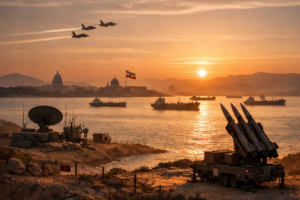
The End of Patience: How Washington’s ‘Maximum Pressure’ Pushed Tehran Over the Edge—and Changed the Middle East Forever
The black smoke rising over Dubai’s Jebel Ali port on March 1 wasn’t just debris from an intercepted missile. It was the funeral pyre of an entire era of Middle Eastern conflict—one where Iran calculated its responses in percentages and calibrated its retaliation with the precision of a surgeon.
For nearly two decades, Tehran played the long game. It absorbed blows that would have provoked immediate war from most nations: assassinated nuclear scientists, sabotaged facilities, killed commanders. It smiled through clenched teeth and called it strategic patience.
That patience is dead. And the Middle East will never be the same.
The Doctrine That Defined an Era
To understand what’s happening now—missiles falling on Dubai, Kuwaiti oil facilities burning, Cypriot ports struck for the first time in modern history—you have to understand what Iran just abandoned.
Strategic patience wasn’t weakness. It was architecture.
Iran built a region-wide system of deterrence that functioned like a series of interlocked pressure valves. Hezbollah in Lebanon wasn’t just a militia—it was Israel’s northern sword of Damocles. The Houthis in Yemen weren’t just rebels—they were the guardians of the Bab el-Mandeb strait. Hamas in Gaza and the Popular Mobilization Forces in Iraq completed a crescent of influence that surrounded Israel with precisely calibrated threat.
The beauty of this system was that it rarely needed to fire a shot. It existed to prevent war, not start one. Every Israeli prime minister knew that a strike on Iranian nuclear facilities meant Hezbollah’s 150,000 rockets turning Tel Aviv into a furnace. Every American president understood that attacking Iran directly meant oil prices spiking to $200 as tankers burned in the Arabian Sea.
It worked. For years, it worked.
Then came October 7, 2023—and everything broke.
The Unraveling
The massacre in southern Israel didn’t just trigger a war in Gaza. It triggered a cascade of miscalculations that would ultimately consume the very architecture Washington and Tel Aviv believed would protect them.
Israel’s response in Gaza was brutal and methodical. But its parallel campaign—the one targeting Iran’s network—was strategic and surgical. Senior Hezbollah commanders eliminated in Beirut. IRGC leaders killed in Damascus. Supply lines disrupted in Syria. The assassination of Ismail Haniyeh in Tehran—on Iranian soil, during the presidential inauguration—wasn’t just an operation. It was a message: There is no sanctuary. There is no red line you can draw that we will respect.
The April 2024 strike on Iran’s consulate in Damascus crossed a line Tehran had drawn decades earlier. Attacking a diplomatic mission is attacking sovereign territory. Iran’s response—Operation True Promise, the first direct military strike on Israel from Iranian territory—was unprecedented.
But even then, restraint lingered. The strikes were telegraphed. The damage was limited. Iran was still signaling: We can escalate. We choose not to. Give us a reason to stay calm.
Israel and the United States interpreted this as weakness. They pushed harder.
The Syria Earthquake
When the al-Assad government fell in 2025, Iran’s strategic map collapsed.
The land corridor from Tehran to Beirut—the artery that supplied Hezbollah with advanced weapons, the route that connected Iran to the Mediterranean—was severed. For decades, Syria had been the linchpin of Iranian regional strategy. Losing it wasn’t just a geopolitical setback. It was existential.
Iran watched as its investment in Syria—billions of dollars, thousands of lives—evaporated. It watched as Turkey, Israel, and various rebel factions carved up its carefully constructed influence. And it concluded, quietly at first, then explicitly in January 2026: Restraint is suicide.
The new doctrine was announced quietly but unmistakably: “active and unprecedented deterrence.” The translation from Farsi diplomatic language was simple: From now on, you hit us, we hit you. Not your proxies. Not your allies. You. Directly. Immediately. Disproportionately.
Washington didn’t believe it. Tel Aviv didn’t take it seriously.
On February 28, 2026, they tested it.
The 72 Hours That Reshaped the Gulf
The coordinated US-Israeli strikes on February 28 targeted Iranian Revolutionary Guard positions across multiple provinces. The official justification was “degrading offensive capabilities.” The timing—during ongoing negotiations in Vienna—sent an additional message: We don’t need diplomacy. We have F-35s.
What happened next shocked everyone who thought they understood Iran.
Within 72 hours, Iranian missiles and drones struck targets in nine countries:
- Kuwait: Oil facilities set ablaze
- Qatar: US airbase at Al Udeid targeted
- UAE: Jebel Ali port and Dubai suburbs hit
- Saudi Arabia: Aramco facilities in the Eastern Province
- Iraq: Multiple strikes near Erbil and Baghdad
- Jordan: Military positions along the border
- Israel: Tel Aviv and Haifa regions
- Cyprus: Port facilities used for logistical support
- Bahrain: US naval headquarters at Juffair
This wasn’t retaliation. This was a statement.
Iran was demonstrating that its previous restraint wasn’t technological limitation or fear—it was choice. And that choice had been revoked.
The UAE’s Reckoning
Perhaps no moment captured the transformation more clearly than the sight of debris falling on Dubai.
The United Arab Emirates had spent fifteen years building a foreign policy based on what analysts call “fragmentation strategy.” Work with Israel, work with the United States, work with anyone—not to unify the region, but to break unified opposition into manageable pieces. Normalization with Israel through the Abraham Accords. Competition with Qatar. Pressure on Turkey. Engagement in Yemen. Investment in Syria.
The underlying assumption was always the same: Our stability is insulated from our actions. We can play the game because we’re above the board.
The missiles falling on Jebel Ali demolished that assumption permanently.
For Emiratis watching smoke rise over their skyline—the skyline they’d spent decades building as a monument to post-conflict prosperity—the message was visceral: There is no separation. There is no immunity. Your stability was never insulated—it was borrowed against a future that just arrived.
The Dominoes No One Expected
What makes the current moment truly unprecedented isn’t just the direct Iran-Israel exchanges. It’s what’s happening around them.
In Iraqi Kurdistan, there are credible reports that the US administration is encouraging Kurdish forces to prepare for ground operations against Iran. The logic is straight from the fragmentation playbook: exploit ethnic divisions, create local proxies, fight Tehran through surrogates. But the logic of 2003 doesn’t apply in 2026. Iran’s response to Kurdish mobilization won’t be patient negotiation—it will be artillery and Revolutionary Guard units crossing the border.
In Bahrain, protests that had been dormant for years have erupted again. Saudi forces have been deployed to Manama to support the monarchy. But Saudi Arabia itself is dealing with burning oil facilities and the psychological shock of Iranian strikes reaching deep into its territory. The Kingdom that once projected stability across the Gulf is now consumed with its own defense.
In Baghdad, protesters tried to storm the Green Zone—the fortified compound housing parliament and foreign embassies. The Iraqi government, caught between Tehran and Washington for two decades, now faces the impossible task of managing a war on its soil that it never declared and cannot control.
In Lebanon, Hezbollah hasn’t fully mobilized—yet. But the group has demonstrated repeatedly that its organizational depth survived Israeli strikes. Low-level resistance, the kind that bled American forces in Iraq for years, remains a constant possibility. And with Syria’s new reality, Hezbollah’s supply lines may be compromised, but its fighters remain the most capable military force in the country.
The Human Cost of Strategic Collapse
Amid the geopolitical analysis, it’s easy to lose sight of what this means for ordinary people.
In Dubai’s International City, workers from India and Pakistan watched missiles streak overhead—the same workers who built the skyscrapers and drive the taxis and staff the hotels. They came to the Gulf for wages they couldn’t earn at home, for safety their own countries couldn’t provide. Now they’re sleeping in hallways away from windows, calling families in Kerala and Lahore to say I’m okay, I’m okay, I’m okay—wondering how long that will remain true.
In Tehran, families who’ve lived through eight years of war with Iraq, through sanctions that stripped medicine from pharmacies, through assassinations and sabotage and the constant drumbeat of “regime change” rhetoric—they’re watching their government finally strike back. Some feel vindication. Others feel terror at what comes next.
In Tel Aviv, parents with children in bomb shelters are calculating whether to send them to school tomorrow, whether to keep working from home, whether to book flights abroad that might not depart. The Iron Dome intercepts most rockets—but “most” isn’t “all,” and “all” was never the promise.
In Beirut, where economic collapse has already destroyed middle-class life, where electricity comes from generators and medicine comes from charities, the prospect of another war—this one with Israel directly, this one without the careful rules of engagement that previously contained conflict—isn’t geopolitical analysis. It’s survival calculation.
The Template No One Wanted
The current crisis didn’t emerge from a vacuum. It emerged from choices.
When Israel decided that settlement expansion in the West Bank was more important than two-state viability, that was a choice.
When the United States decided that maximum pressure campaigns and assassination programs were preferable to diplomacy, that was a choice.
When the UAE decided that normalization with Israel could proceed without addressing Palestinian political rights, that was a choice.
When every Western government decided that “managing the conflict” was more realistic than resolving it, that was a choice.
The template being applied across the Middle East now—isolated enclaves, permanent military pressure, systematic dismantling of self-governance, territorial expansion by force—is the Gaza template. It’s being extended to Lebanon, to Syria, potentially to Iran itself.
The problem is that templates assume passive subjects. They assume that people and nations will accept being managed indefinitely, that resistance has limits, that patience is infinite.
Iran just proved otherwise.
What Comes Next
The immediate future is terrifyingly clear: more strikes, more retaliation, more escalation.
Iran’s new doctrine means no Israeli or American strike will go unanswered. Israel’s security doctrine means no Iranian strike can go unanswered either. The logic of escalation is now hard-wired into both systems.
The longer-term questions are more complex.
Can a rules-based international order survive when its primary enforcers—the United States and its allies—routinely violate those rules when convenient? When territorial expansion is tolerated, collective punishment is normalized, and accountability is applied selectively?
Can regional stability be rebuilt when the foundational assumption—that fragmentation and force can substitute for genuine political resolution—has been exposed as fantasy?
Can ordinary people survive the choices their leaders made while they were busy living their lives?
The answers won’t come quickly. They’ll emerge in the faces of refugees crossing borders, in the oil prices spiking at pumps worldwide, in the election results of countries far from the Middle East that nonetheless feel its convulsions.
The Funeral of an Era
Strategic patience is dead. It was killed not by Iranian hardliners or American neoconservatives alone, but by the cumulative weight of choices made by people who believed they could manage conflict forever.
The question now isn’t whether the Middle East will be different. It already is. The question is whether the new order emerging from these flames will be better than the one being consumed.
For the workers in Dubai watching smoke rise over their adopted city, for the families in Tehran waiting for the next siren, for the children in Tel Aviv learning to recognize the sound of incoming rockets—that question isn’t academic.
It’s the difference between life and death.
And for the first time in decades, no one—not Washington, not Tehran, not Tel Aviv—has a clear answer.
You must be logged in to post a comment.