
The End of Caution: Why India’s ₹1,000 Crore RDI Fund is Really a Bet on Failure
India’s newly launched RDI Fund marks a quiet but strategic departure from the nation’s historically risk-averse approach to deep-tech innovation, offering concessional, collateral-light, long-tenure financing specifically designed to bridge the “valley of death” where prototypes stall before commercialization. By targeting technologies at readiness level four and above, approving loans within eight weeks, and accepting intellectual property as collateral, the fund addresses the structural mismatch between conventional lending and frontier research. More than a financial mechanism, it signals a cultural shift in public policy—one that tolerates calculated failure, prioritizes strategic sovereignty over audit compliance, and aims to crowd private capital into high-risk, high-return sectors like semiconductors and biotech. Though modest in initial scale, the fund’s design reflects a mature understanding that technological leadership requires patience, not just optimism.
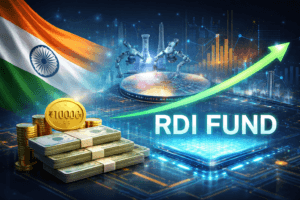
The End of Caution: Why India’s ₹1,000 Crore RDI Fund is Really a Bet on Failure
For the better part of three decades, the Indian deep-tech entrepreneur has existed in a state of perpetual limbo.
They have the PhD from IIT Madras. They have the patent filed for a novel semiconductor substrate. They have the validation from the National Science Seminar. What they do not have is a banker willing to take the call.
In the annals of Indian business, we have romanticized the “funding winter” and the “startup grind.” But there is a specific flavour of struggle unique to the hardware biologist or the materials scientist that rarely makes it to the cover of business magazines. It is not the struggle of building a user base; it is the struggle of proving physics. It requires laboratories, not laptops. It requires supply chains, not code commits.
For these founders, the launch of the Research, Development and Innovation (RDI) Fund on February 4, 2026, is not merely a policy update. It is the first time the Indian financial establishment has agreed to speak their language.
While the initial report focused on the mechanical details—2-4% interest, 15-year tenures, collateral-free structures—the true weight of this announcement lies in what it admits about India’s past failures and what it signals about its future ambitions. This is not a grant scheme. It is a confession. And it may very well be the quietest turning point in India’s attempt to escape the middle-income trap.
The Valley of Death is a Human Canyon
To understand why the RDI Fund matters, one must abandon the abstract language of economics and look at the human beings currently stuck in the “Valley of Death.”
This valley is not a metaphorical dip on a PowerPoint slide. It is a period of three to seven years where a scientist-entrepreneur knows their technology works in a controlled environment, but cannot prove it works at a million units. They need a pilot line. They need to import a specific grade of silicon. They need to pay salaries while the yield rates slowly improve.
In India, traditional capital has actively avoided this phase. Venture capital, driven by 10-year fund cycles, looks at a hardware company with a 5-year gestation period and sees a liquidity trap. Public sector banks, governed by the fear of the Comptroller and Auditor General (CAG), look at a balance sheet without physical assets and see a non-performing asset (NPA) waiting to happen.
The result has been a devastating brain drain—not of people leaving the country, but of ideas leaving the laboratory. Indian patents have historically been sold to Singaporean or German conglomerates at the TRL 4 stage (Technology Readiness Level 4) for a fraction of their eventual value. The inventor gets rich; the country does not.
The RDI Fund attempts to arrest this hemorrhage by inserting state balance sheet into the exact moment of maximum uncertainty.
The Architecture of Strategic Patience
The financial structuring of the RDI Fund reveals a level of bureaucratic sophistication rarely associated with Indian innovation policy.
The Rate: The concessional interest rate of 2 to 4 per cent is not charity; it is time arbitrage. A deep-tech venture cannot offer the 18 per cent returns an app-based lender demands within three years. By lowering the cost of capital to near-sovereign levels, the Fund allows the underlying science to dictate the business timeline, rather than the other way around.
The Tenure: Fifteen years is a lifetime in technology, but it is a blink in capital goods. Consider the pharmaceutical industry: a new molecular entity takes 10 to 12 years to move from synthesis to pharmacy shelves. Consider semiconductor fabs: it takes years just to certify a new material. By offering a 15-year view, the Fund is effectively telling innovators: We will not panic sell your shares when the first clinical trial fails.
The Collateral: Perhaps the most radical shift is the acceptance of Intellectual Property (IP) as collateral. For decades, Indian banks have operated on a tangible-asset paradigm. If you default, they want the keys to a factory. But in the 21st century knowledge economy, value resides in code, in formulae, in process patents. These are difficult to auction, but they are the only assets a deep-tech startup owns. The RDI Fund’s willingness to lend against IP signals a legal and financial maturity that India has historically lacked.
Beyond Crowding In: The Signal Effect
Proponents of the fund will rightly point to the “crowding in” effect—the idea that patient public capital will attract skittish private equity. With 191 proposals received within days, 160 from private entities, the latent demand is evident.
However, the greater impact may be psychological. In India, the “license raj” of the 20th century has been replaced by the “audit raj” of the 21st. Public officials are incentivized to avoid mistakes rather than chase breakthroughs. An IAS officer who sanctions a loan that fails faces scrutiny; one who sanctions nothing faces promotion.
The RDI Fund, by explicitly framing itself as a vehicle for high-risk commercialisation, offers a degree of political immunization. It creates a documented institutional memory that failure is permissible. This is not a minor detail. In bureaucratic ecosystems, permission structures determine outcomes.
If the eight-week approval window is honoured, it will shatter the stereotype of the lumbering Indian state. Speed in this context is not just about efficiency; it is about relevance. In fields like quantum computing or gene editing, a six-month delay renders funding moot—the global competition has already moved the goalposts.
A Mirror to the Yozma Generation
Globally, there are two templates for state-led technological leaps.
The first is the Defence Advanced Research Projects Agency (DARPA) model, where the state acts as a demanding customer, procuring technologies that do not yet exist. The second is the Yozma model, where the state acts as a loss-bearing partner, de-risking private investment until the ecosystem achieves escape velocity.
India’s RDI Fund leans closer to the Israeli Yozma program of 1993 than to American defence procurement. Yozma did not pick winners; it created the conditions for winners to emerge by offering attractive tax breaks and matching funds, catalyzing a venture capital industry that eventually became self-sustaining.
However, there is a crucial distinction. Yozma operated in a small, open economy focused primarily on software and communication. India’s ambition is broader and heavier. It seeks sovereignty in atoms, not just bits. It wants to manufacture its own lithium-ion battery separators, design its own RISC-V processors, and formulate its own specialty chemicals.
This requires a fund that is comfortable with capital intensity. The initial corpus, while significant, will need to multiply in the coming years. The RDI Fund is best viewed as a proof of concept for a larger shift: the acceptance that strategic technology requires strategic deficit spending.
The Cultural Shift: From Assembly to Architecture
For fifty years, India’s industrial strategy was defined by its constraints. Foreign exchange was scarce, licences were limited, and the global technology order was frozen by Cold War blocs. In that environment, “innovation” meant import substitution—reverse engineering a pump or a motor that had been designed in Europe.
That era produced competent engineers, but it did not produce frontier architects. It created a risk-averse culture where “proven technology” was the highest compliment and “untested” was a fatal flaw.
The RDI Fund represents a generational break from this mindset. By funding projects at TRL 4 and above, it explicitly targets technologies that are unproven at scale. It acknowledges that the first mover in a new field rarely has a perfect unit economics. It accepts that the first indigenous aircraft engine will be heavier and less efficient than the GE variant. But it also recognizes that you cannot improve an engine you are prohibited from opening.
This is the difference between technological consumption and technological citizenship. A country that imports engines remains a consumer. A country that builds imperfect engines becomes a citizen of the aerospace community, with voting rights in standard-setting bodies and supply chain negotiations.
The Stakes of Succeeding Slowly
It is crucial to manage expectations. The RDI Fund will not produce a globally competitive fabless semiconductor company by 2027. It will not solve India’s trade deficit in electronics by the next general election. Some of the 191 proposals will fail. Some borrowers will default. Some IP will prove worthless.
But the metric of success for this fund is not the repayment rate. It is the survival rate of high-risk enterprises during their most vulnerable phase.
If the fund ensures that five companies survive the valley of death that would have otherwise perished, and if those five go on to anchor supply chains or generate ancillary employment, the fiscal “loss” on the fund will be recouped a hundredfold through corporate tax and downstream productivity.
More importantly, if the fund establishes a precedent—that the Indian state can be a patient, intelligent, and fast-moving partner in innovation—it will alter the career calculus of the next generation. The brightest minds at the Bhabha Atomic Research Centre or the Centre for Cellular and Molecular Biology may choose to commercialise their discoveries domestically rather than licensing them abroad.
Conclusion: The Bureaucracy of Ambition
We are accustomed to viewing turning points as dramatic events—a moon landing, a budget speech, a trade war. But in the long arc of economic development, turning points are often administrative.
They occur when a form is simplified. When a collateral definition is expanded. When a repayment schedule is aligned with the rhythm of a laboratory rather than the rhythm of a treasury bill.
India’s RDI Fund is, at its core, a redefinition of risk. It moves the needle from “Will this officer be blamed?” to “Will this nation compete?” It replaces the question of “Is this borrower creditworthy?” with “Is this technology strategic?”
In a fragmented world where technology is the new currency of sovereignty, that shift in questioning is not merely a policy adjustment. It is a declaration of intent. For the first time, India is telling its deep-tech innovators: We will carry the risk. You carry the torch.
You must be logged in to post a comment.