
The End of an Era, The Birth of a Contender: How JSW Dulux Aims to Redraw India’s Paint Landscape
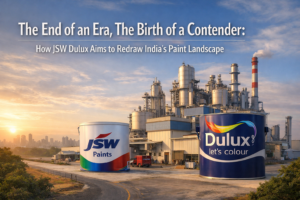
The End of an Era, The Birth of a Contender: How JSW Dulux Aims to Redraw India’s Paint Landscape
On March 11, 2026, a quiet but seismic shift occurred in the corridors of Indian corporate history. The Ministry of Corporate Affairs (MCA) issued a fresh certificate of incorporation, officially anointing a new identity for a company whose products have coloured the walls of Indian homes for generations. Akzo Nobel India Ltd, the storied paints and coatings maker, was no more. In its place stood JSW Dulux Ltd.
The name change is the final, formal step in a high-stakes acquisition drama that concluded in December 2025, when the $23 billion JSW Group, through its subsidiary JSW Paints, acquired a commanding 60.76 per cent stake in the Indian arm of the Dutch multinational. While the news might read like a standard corporate announcement, it is, in reality, a powerful narrative about the changing face of Indian industry: the confident rise of homegrown conglomerates, the enduring power of a beloved brand, and the forging of a new entity poised to challenge the status quo in one of the world’s most competitive paint markets.
More Than a Name: The Legacy of ‘Dulux’
For millions of Indians, the name ‘Dulux’ is not just a brand; it’s a synonym for quality, trust, and the promise of a fresh start. Walking into a ‘Dulux’ colour shop with a parent was a rite of passage for many homeowners. It carried the weight of a legacy built over decades, a legacy now entrusted to the ambitious hands of the JSW Group.
The decision to retain “Dulux” in the new corporate identity—JSW Dulux—is a masterstroke of strategic branding. It signals a merger of two powerful equities: the industrial heft, financial muscle, and domestic market acumen of the JSW Group, fused with the technological superiority, global expertise, and deep-rooted consumer trust of the Dulux brand.
“It’s a brilliant move,” says Alok Sharma, a Mumbai-based brand strategist. “JSW isn’t trying to reinvent the wheel. They are acknowledging that they have acquired a gem. The consumer doesn’t buy a corporate name; they buy a brand they trust. By keeping ‘Dulux’ front and centre, JSW ensures that the emotional connection with the customer remains unbroken, while the corporate parent provides the stability and aggressive growth capital that the Indian market demands.”
The transition, however, is bittersweet for many. Akzo Nobel’s journey in India was a testament to the enduring appeal of foreign expertise. From its origins as part of Imperial Chemical Industries (ICI) to its rebranding under the AkzoNobel umbrella, the company brought world-class technology and a rich colour palette to Indian shores. Its flagship product, Dulux Velvet, became a household name, synonymous with a premium, smooth finish. The passing of this baton to an Indian conglomerate marks a symbolic shift in the balance of economic power.
The JSW Gambit: Why Paints?
For the JSW Group, the acquisition was never just about buying a company; it was about buying a platform. The Group, a behemoth with interests spanning steel, energy, infrastructure, and cement, has long harboured ambitions in the paints sector. They launched JSW Paints in 2019, but building a national brand from scratch in a capital-intensive industry is a herculean task, especially against entrenched giants.
The acquisition of Akzo Nobel was a shortcut to the top table. Overnight, JSW Paints acquired:
- A Robust Manufacturing Footprint: Akzo Nobel’s existing plants provide immediate production capacity.
- A Pan-India Distribution Network: The most critical and difficult-to-build asset in the FMCG and paints sector is a network of thousands of dealers and retailers. JSW inherited this overnight.
- A World-Class R&D Legacy: Access to formulations and technology developed over decades.
- A Celebrated Brand Portfolio: Beyond Dulux, the portfolio includes brands like Trimetal, Sikkens, and Interpon, giving JSW a presence across decorative, protective, and industrial coatings.
This move propels JSW Paints from being a fringe player to the third-largest player in the Indian paints industry overnight, creating a formidable challenge to the market leader, Asian Paints, and other established players like Berger Paints and Kansai Nerolac.
“This is a game of scale and distribution,” explains Vikas Sood, a retail analyst based in Delhi. “Asian Paints has an unparalleled distribution network. JSW, with its deep pockets and the newly acquired Akzo Nobel network, can now begin to invest aggressively to bridge that gap. The message to the market is clear: there is a new heavyweight in the ring, and it’s here to fight.”
The Human Element: What Changes for the Customer and the Dealer?
On the ground, the transition is being managed with surgical precision. For the thousands of dealers who have stocked Dulux paints for years, the change brings a mix of curiosity and optimism.
“I’ve been selling Dulux for over 20 years,” says Ramesh Gupta, a hardware and paint dealer in a bustling market in South Delhi. “Customers ask for it by name. When the news of the JSW takeover first came, we were a little worried. Would they change the formula? Would the quality drop? But the company representatives have been very reassuring. They tell us the product will be the same, maybe even better, and that they will have more schemes and better support now.”
This reassurance is key. JSW Dulux is walking a tightrope. It must leverage the new parent company’s financial power to aggressively expand market share, but it cannot afford to alienate the loyal customer base that trusts the ‘Dulux’ promise. The focus, therefore, will be on “more”: more marketing, more distribution points, more product variants, and potentially more aggressive pricing to capture volume.
For the common consumer, the change will be imperceptible at first. They will still walk into a store and ask for Dulux paint. The real change will be felt in the years to come, potentially through a wider range of products at different price points, and a more pervasive presence across the country, even in smaller towns where Akzo Nobel’s reach may have been limited compared to the market leader.
The Road Ahead: A Market Poised for Colourful Battle
The Indian paints industry is on a vibrant growth trajectory, driven by a rising middle class, increasing urbanisation, and a steady real estate market. The entry of a fully-committed, deep-pocketed player like JSW Dulux is set to intensify competition, and that is excellent news for the end consumer.
We can expect to see:
- Aggressive Marketing: The advertising war for consumer mindspace will heat up. Expect a blitz of campaigns from JSW Dulux, leveraging its new identity.
- Product Innovation: With combined R&D capabilities, we are likely to see a faster rollout of innovative products, such as healthier, eco-friendly paints (low-VOC), specialty finishes, and smart coatings.
- Channel Expansion: JSW will likely invest heavily in expanding the distribution network, offering better margins to dealers to secure their loyalty and prime shelf space.
- Strategic Pricing: While not necessarily triggering an all-out price war, the new entity might introduce products at competitive price points to gain volume in the mid-market segment, putting pressure on the incumbents.
The board of the erstwhile Akzo Nobel India had approved the name change on January 28, 2026. With the MCA’s nod now in hand, the transformation is complete. The stock market, which always keenly watches the paints sector, will now turn its attention to how JSW Dulux performs under its new stewardship.
Conclusion: A New Chapter Begins
The creation of JSW Dulux Ltd is more than just a corporate renaming. It is a powerful symbol of India’s economic evolution. It represents a moment where a homegrown industrial giant confidently steps up to acquire and nurture a global legacy brand, aiming to write its own success story in one of the most lucrative consumer markets.
The company’s new Certificate of Incorporation is not an end, but a beginning. It marks the start of a new chapter for a beloved brand, now armed with the ambition and resources of one of India’s most dynamic business houses. As the amended Memorandum of Association and Articles of Association officially reflect the name “JSW Dulux Ltd”, the message to competitors, customers, and the market is loud and clear: the colours of competition in India are about to get a whole lot brighter. The legacy of Akzo Nobel India now becomes the launchpad for JSW Dulux, and the entire industry will be watching to see just how vividly this new entity paints its future.
You must be logged in to post a comment.