
The End of an Era? Elbridge Colby’s ‘Gauzy Abstraction’ Jab Signals a Realist Reboot for India-US Ties
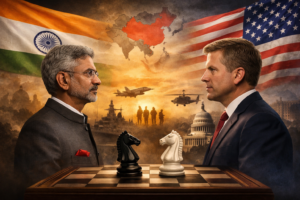
The End of an Era? Elbridge Colby’s ‘Gauzy Abstraction’ Jab Signals a Realist Reboot for India-US Ties
For nearly two decades, the language of the India-US relationship was built on a foundation of shared values. It was a vocabulary of “trust,” “shared destiny,” and, most importantly, the “rules-based international order.” From the landmark civil nuclear deal to the elevation of the Quad, this lofty framework allowed both New Delhi and Washington to frame their strategic convergence as something greater than mere convenience—a partnership of democracies destined to uphold a global system.
That rhetorical era came to a crashing halt in New Delhi this week. In a series of remarks that echoed through the corridors of South Block, US Under Secretary of War for Policy Elbridge Colby dismissed the very concept of the rules-based order as a “gauzy abstraction.” In its place, he offered a blueprint for engagement defined by “hard-nosed collaboration,” “interests,” and “incentives.”
Colby’s speech at the Ananta Centre was not merely a diplomatic statement; it was a philosophical demolition of the past two decades of US foreign policy orthodoxy. For a country like India, which has long prized its strategic autonomy while simultaneously benefiting from the American-led global order, Colby’s words signal a profound shift—one that demands a recalibration of how New Delhi perceives its most critical bilateral relationship.
The Death of ‘Gauzy’ Diplomacy
To understand the weight of Colby’s language, one must look at what he was discarding. The “rules-based international order” has been the mantra of US foreign policy since the end of the Cold War. It was the justification for NATO expansion, the basis of global trade law, and, crucially, the ideological glue that bound the US to emerging powers like India. For Indian diplomats and strategists, invoking the “rules-based order” was a shorthand way to signal alignment with the West without appearing subservient.
By labeling it a “gauzy abstraction,” Colby—a key architect of the Trump administration’s defense strategy—did more than just reject a phrase. He rejected the idealism that underpins multilateralism. He suggested that the US is no longer interested in policing a global system for the sake of abstract principles. Instead, Washington is pivoting to a purely realist framework: power, geography, and tangible national interest.
This is music to the ears of some in New Delhi who have long criticized Western hypocrisy regarding the rules-based order (applying it to Russia but ignoring it in Gaza, for instance). However, it also removes a vital shield. If the US is no longer interested in upholding “rules” abstractly, then the protection those rules afforded to India—in terms of intellectual property, trade dispute mechanisms, and freedom of navigation—becomes conditional, contingent entirely on transactional benefit.
The Jaishankar Doctrine, Borrowed and Returned
One of the most striking aspects of Colby’s address was his explicit invocation of External Affairs Minister S. Jaishankar. By quoting Jaishankar’s critiques of Western foreign policy and aligning the US doctrine of “flexible realism” with India’s “Bharat First” approach, Colby was engaging in a sophisticated piece of political theater.
He was telling India: We are no longer the naive hegemon you criticized in your books. We are now adopting your playbook.
This is a clever rhetorical trap and a potential point of alignment. For years, Jaishankar has argued that India must be a “hard-headed” power, prioritizing national interest over sentimental alliances. Colby essentially replied, “Agreed. So let’s drop the sentiment.”
However, there is a risk for India in this mirroring. When two realists sit at a table, the negotiation becomes zero-sum. The “shared values” framework allowed for compromises; if the US and India were “natural allies,” they could overlook trade disputes or strategic disagreements for the greater good. Under a “hard-nosed” framework, there is no greater good beyond the immediate ledger. If India wants American defense technology, it must pay the price—not just in rupees, but in policy concessions, be it on Russian oil or trade tariffs.
The Shadow of Pakistan and the Transactional Trap
Colby’s rhetoric did not occur in a vacuum. The backdrop to this “hard-nosed” reset is a bilateral relationship that has been under unprecedented strain. The mention of the 50% tariffs imposed in August 2025 and the diplomatic friction following the May 2025 India-Pakistan confrontation loom large.
The article highlights a deeply unsettling reality for India: while Washington is demanding “hard-nosed” realism from New Delhi, it appears to be practicing a fickle version of it in Islamabad. The US’s deepening engagement with Pakistan, particularly the Trump administration’s embrace of Field Marshal Asim Munir and Pakistan’s role as a mediator in the Iran conflict, represents a fundamental contradiction to the “Indo-Pacific” strategy.
If the relationship is purely transactional, then India must accept that the US will also transact with Pakistan. For decades, the US assured India that ties with Pakistan were narrow (focused on Afghanistan) and did not diminish the strategic partnership with India. Colby’s “realism” strips away that assurance. It suggests that the US will work with whichever regional power offers the most immediate tactical advantage—be it India for countering China, or Pakistan for mediating in West Asia.
For Indian strategists, this is the nightmare of a purely realist partnership: it lacks the inertia of an alliance. If the US can slap 50% tariffs on India one year and cosy up to the Pakistani military the next, the relationship is not a partnership; it is a series of fleeting transactions.
The Defence Industrial Complex: A Test of ‘Hard-Nosed’ Logic
Despite the tough talk, Colby did offer a substantive carrot. His focus on long-range precision fires, maritime domain awareness, and, crucially, supporting India’s indigenous defence industry points to the core of where the US sees value.
By supporting “Made in India” defence production, the US is making a strategic bet. It wants to break India’s dependence on Russian hardware—a legacy of the Cold War that still complicates US-India strategic integration. Colby’s mention of overcoming “regulatory barriers” and “bureaucratic inertia” is a direct nod to the frustrations both sides have faced with defence deals (from the MQ-9B drones to jet engine technology).
But the “hard-nosed” framework applies here too. If India wants technology transfer (the holy grail of the defence relationship), it must prove it is a reliable partner that won’t reverse-engineer the tech for Russia or China. Colby’s emphasis on “vigorous, self-assured states, not dependencies” is a warning: the US is willing to help India build its industry, but only if India demonstrates that its strategic trajectory is irreversibly aligned with Washington’s interests.
A New Language for a New World
What Colby did in New Delhi was fundamentally change the dictionary of the India-US relationship. The “strategic partnership” framed by Bush and Singh is dead. The “shared values” trope used by Obama is out of fashion. In its place is the language of “flexible realism.”
For Indian readers and policymakers, this requires a difficult admission. For the last 20 years, India enjoyed a “best of both worlds” scenario: it received the benefits of American capital, technology, and strategic backing, while maintaining the rhetorical freedom to criticize the excesses of the Western order. Colby’s visit suggests that the US is closing that gap. The US is now saying: If you want to be a realist, we can be realists too. And realists don’t give away technology or market access for free.
The reaction of External Affairs Minister Jaishankar at the Raisina Dialogue—that a nation’s rise is determined by itself—was a preemptive defense against this pressure. It was India’s way of saying that no matter how “hard-nosed” the US gets, India’s sovereignty is non-negotiable.
Yet, the timing of Colby’s “gauzy abstraction” remark is telling. As the world grapples with the ongoing Iran war and the shifting sands of West Asia, and as China continues to assert itself, the US is looking for a partner in India—but not a dependent, and not a lecturer. It wants an enforcer.
The question for India is whether it can play that role within the constraints of its own “Bharat First” doctrine. Can India be a “hard-nosed” partner with the US while maintaining the strategic autonomy that has defined its foreign policy for seven decades? Colby’s speech suggests that the era where India could have it both ways is coming to an end. The “gauzy abstraction” of partnership is being replaced by the stark, unforgiving clarity of interests. Whether that leads to a stronger alliance or a messy divorce will depend on how New Delhi chooses to respond to this new, hardened language.
You must be logged in to post a comment.