
The Empty Cylinder: How a War 2,000 Miles Away Broke India’s Street Food Economy
The Middle East conflict has disrupted shipments through the Strait of Hormuz—through which 90% of India’s liquefied petroleum gas transits—triggering a severe LPG shortage across India. The government has prioritized cooking-gas supplies for 340 million households, leading to restricted allocations for restaurants and street stalls. As a result, street vendors in cities like New Delhi face desperate shortages, forcing many to resort to coal and wood or pay up to five times the normal price on a thriving black market. The crisis exposes India’s deep vulnerability to geopolitical disruptions in the Gulf and is inflicting severe hardship on the informal food economy that serves millions of lower-income urban residents.
The Empty Cylinder: How a War 2,000 Miles Away Broke India’s Street Food Economy
In the labyrinthine lanes of Lodi Colony in South Delhi, the air usually smells of caramelized onions, sizzling turmeric, and the faint sweetness of rising dough. But on a recent sweltering afternoon, the air was thick with a different kind of haze: the acrid sting of burning coal and damp wood.
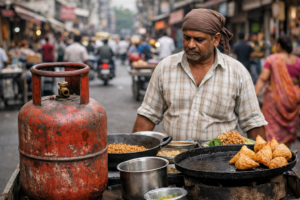
Munna, a cook who has been flipping naan on a griddle for fifteen years, stood over a makeshift stove, sweat dripping from his brow as he fanned embers with a piece of cardboard. His aluminum trays, usually stacked high with idli and dosa, sat empty. The blue flames of the liquefied petroleum gas (LPG) cylinders that form the invisible backbone of India’s urban food network have vanished.
“The boss managed to get a cylinder on the black market for 5,000 rupees,” Munna said, wiping his hands on his vest. “Normally it costs 1,000. But that supplier is already dry. Now he’s looking for another one. Without a cylinder, we won’t last long.”
Munna’s predicament is not an isolated case of local mismanagement. It is the ground-level reality of a geopolitical crisis playing out 2,000 miles away. The ongoing conflict in the Middle East, specifically the blockade and disruption affecting the Strait of Hormuz, has exposed a critical vulnerability in the world’s most populous nation. As 90% of India’s LPG—the fuel that powers not just homes but the informal economy—transits through that narrow chokepoint, the country is facing its most severe gas supply crisis in recent history.
The Invisible Crisis
For the Indian government, the crisis is a political minefield. Prime Minister Narendra Modi’s administration has publicly denied the severity of the shortage, framing the situation as manageable. However, internal memos and supply chain data tell a different story. Behind the scenes, the government has been forced to make a brutal calculation: prioritize the 340 million households that use LPG for cooking under the flagship Ujjwala scheme—a program that is a key voter base—while restricting supply to the commercial sector.
The result has been a quiet suffocation of the informal economy. Street stalls, or thelas, which dot every corner of Delhi, Mumbai, Bengaluru, and Kolkata, are the first casualties. These aren’t just businesses; they are the primary source of affordable, cooked food for millions of migrant workers, students, and lower-income families who lack the space, time, or resources to cook at home.
For these stall owners, the gas cylinder is not just a utility; it is a unit of survival. A standard 14.2 kg commercial cylinder is the difference between opening for business or shuttering the shutters. With the legitimate supply drying up due to government-ordered rationing, a thriving, dangerous black market has emerged.
In the shadows of Delhi’s wholesale markets, a new kind of commodity trader has appeared. Cylinders that used to cost ₹1,000 are now changing hands for ₹3,000 to ₹5,000—a markup of up to 400%. These transactions are conducted in cash, in back alleys, with no receipts. The risk is high; hoarding LPG is a criminal offense in India due to the explosive risk and the subsidized nature of the fuel. Yet, desperation is fueling an illegal storage network that puts entire neighborhoods at risk of catastrophic accidents.
The Hormuz Chokepoint
To understand why a cook in Delhi is burning coal, one must look at a map of the Middle East. The Strait of Hormuz, a narrow waterway separating Iran and Oman, is the world’s most critical oil and gas artery. For India, it is an Achilles’ heel.
India is the world’s second-largest importer of LPG. While the government has spent years trying to diversify energy sources—signing deals with the United States, Australia, and exploring domestic coal gasification—the sheer volume of supply needed means the country remains tethered to the Persian Gulf. When conflict disrupts shipping lanes in Hormuz, insurance premiums skyrocket, shipping routes are rerouted, and import volumes plummet.
The current Middle East conflict has done more than just delay shipments; it has destabilized the long-term contracts that India relies on. Suppliers in the Gulf, facing their own production challenges amid the war, have diverted shipments to Europe and other markets willing to pay a premium. India, which historically relies on negotiating lower prices due to its volume, finds itself outbid and outmaneuvered.
India’s vulnerability is compounded by its storage infrastructure—or lack thereof. While the government boasts of increased strategic storage for crude oil, LPG storage remains highly sensitive. LPG must be stored under pressure in specialized spheres or caverns. Most Indian cities hold only a few days’ worth of buffer stock. When the supply chain hiccups, it doesn’t take weeks for a crisis to hit the streets; it takes days.
The Human Cost of Fuel Poverty
The gas shortage is rapidly redrawing the economic geography of India’s cities. In the upscale neighborhoods of South Delhi, the crisis is an inconvenience—restaurants have turned to induction cooktops or imported electric ovens. But for the working-class neighborhoods and the street vendors who serve them, it is an existential threat.
Walking through the food stalls of Lodi Colony, one encounters a mosaic of despair. One stall owner, who asked to be identified only as Ramesh, pointed to his empty tandoor oven. “I have been making naan here for 20 years,” he said. “Yesterday, I had to tell my regular customers to go elsewhere. If I use wood, the bread tastes different. People won’t pay for it.”
The shift back to traditional biomass fuels—wood, coal, and kerosene—is a massive public health regression. India has spent the last decade aggressively campaigning to reduce indoor and urban air pollution caused by biomass burning. The Ujjwala scheme was lauded internationally for providing clean cooking gas to millions of women, reducing respiratory illnesses and freeing up time spent foraging for firewood.
Now, in a cruel irony, the same urban poor who were supposed to be the beneficiaries of clean fuel are being forced back into the smoky past. The stalls are not just polluting the air for themselves; they are contributing to the toxic smog that chokes Delhi every winter. Environmentalists warn that if the gas shortage persists for another month, the city’s air quality index, already among the worst in the world, will see a sharp, sustained deterioration.
Political Pressure and Denial
In New Delhi, the corridors of power are tense. The government’s strategy of “denial until managed” is wearing thin. Opposition parties have seized on the shortage, accusing the Modi administration of failing to secure the nation’s energy needs. They point out that while the government boasts of being a global economic powerhouse, its energy security is still held hostage by a narrow strait in the Persian Gulf.
The state-owned oil marketing companies (OMCs)—Indian Oil, Bharat Petroleum, and Hindustan Petroleum—are caught in a bind. They are trying to stagger supplies, but the infrastructure isn’t there to compensate for the import gap. Rail and road transport of gas is inefficient compared to shipping, and the country lacks the massive pipeline network needed to distribute alternative sources quickly.
For the average voter, however, the crisis is felt in their wallets and their stomachs. The black market is not just expensive; it is exclusive. Those without the capital to front ₹5,000 for a cylinder are simply left out. This has led to a quiet consolidation in the street food industry. The small, single-cart vendor is being wiped out, while larger operations with more capital reserves are hoarding supplies or pivoting to electric equipment, which requires a stable grid that many parts of the city lack.
Looking Ahead: A Structural Wake-Up Call
Economists argue that this crisis, while acute, may serve as the necessary shock to force India to confront its energy fragility. For years, policy experts have warned about the “Hormuz dependency.” The current situation is the worst-case scenario they had modeled.
The government is now scrambling to accelerate long-pending reforms. There is renewed urgency behind the push for coal gasification—converting India’s vast coal reserves into synthesis gas. Similarly, the push for ethanol blending and compressed biogas (CBG) is being fast-tracked. India has immense potential for CBG, derived from agricultural waste, municipal garbage, and sewage. If scaled up, it could provide a decentralized, shock-proof alternative to imported LPG.
However, these solutions are years away from scale. In the immediate term, India is left with the unenviable task of managing scarcity. The crisis highlights a harsh reality: in a nation of 1.4 billion people, the government’s first duty is to the household consumer, often at the expense of the informal economy that keeps the urban poor alive.
As dusk falls over Lodi Colony, the food stalls flicker with dim LED lights, but the griddles remain cold. Munna packs up his coal scraps, unsure if he will have work tomorrow. “The politicians in Delhi say there is no shortage,” he mutters, shaking his head. “But tell me, if there is no shortage, why am I sitting here without gas?”
For India, the answer to that question lies not in the kitchens of its capital, but in the geopolitical turmoil of the Middle East—a volatile dependency that has finally come home to roost. Until the Strait of Hormuz opens up again, or India builds a new energy paradigm, the empty cylinder will remain a symbol of the nation’s greatest strategic weakness.
You must be logged in to post a comment.