
The Elusive Resting Place: The Untold Human and Strategic Struggle to Bring Ran Gvili Home
For over 814 days since the October 7th attacks, the effort to recover the body of killed hostage Ran Gvili has evolved into a grim, covert shadow war, as revealed by a report in Saudi Arabia’s Asharq Al-Awsat. Palestinian sources claim Israeli special forces recently abducted an Islamic Jihad operative from Gaza City, believing he holds direct knowledge of the body’s location—a move highlighting the extreme, intelligence-driven measures required. The report further details a macabre handoff of the remains between militant factions, illustrating how the body is treated as a strategic asset, while underscoring the profound human and national imperative for Israel to recover its fallen, offering the Gvili family a path to closure and upholding a sacrosanct covenant between the state and its citizens, even amid the devastated complexity of postwar Gaza.
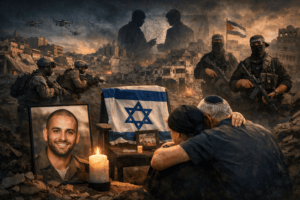
The Elusive Resting Place: The Untold Human and Strategic Struggle to Bring Ran Gvili Home
The calendar marks over 814 days, but for the family of Ran Gvili, time is measured not in hours but in anguish. Each day since October 7th is a loop of unresolved grief, a limbo where mourning cannot properly begin because a body has not been laid to rest. A recent, explosive report from Saudi Arabia’s Asharq Al-Awsat has pierced this agonizing silence, revealing a covert, high-stakes operation deep within Gaza City that underscores the brutal, complex endgame of Israel’s longest hostage crisis. This isn’t just a news bulletin; it’s a window into the shadow war for the dead, a conflict where intelligence, subterfuge, and raw human need collide in the rubble of a devastated city.
The Report: A Covert Snatch in the Heart of Gaza
According to Palestinian sources cited in the report, Israeli special forces conducted a daring operation “near Palestine Square” in Gaza City—a symbolic location the IDF had previously captured and flown the Israeli flag. Their target was not a high-ranking commander, but a specific field operative from the Al-Quds Brigades, the military wing of Islamic Jihad. This operative, a resident of the nearby Zeitoun neighborhood, was allegedly abducted because Israeli intelligence believes he holds a “direct connection” to the custody of Ran Gvili’s remains.
The operation’s purported location, about a kilometer west of the contentious “Yellow Line,” suggests a calculated incursion into an area of extreme risk. This isn’t a broad military sweep; it’s a surgical, intelligence-driven grab. The very fact that such an operation is being reported—leaked by faction sources to a pan-Arab newspaper—is itself a significant data point in the psychological and informational warfare surrounding the hostages.
The Gruesome Handoff: Between Jihadist Factions
The Saudi report contains a chilling detail that reveals the macabre bureaucracy of militant groups in Gaza. Islamic Jihad sources reportedly admitted that Gvili’s body was initially in their possession before being transferred to Hamas’s military wing in Gaza City. The stated reason? “Coordination between the factions.”
This handoff is more than a logistical footnote. It speaks volumes about the strategic value militant groups place on the bodies of fallen Israelis. A body is a tangible, psychological asset, a bargaining chip for future prisoner exchanges or political concessions. The transfer from Islamic Jihad to Hamas, the dominant governing and military force, likely centralizes negotiation authority and secures the asset with the group possessing the most fortified tunnel networks and command structure. Hamas sources added that they held the body for months in Zeitoun prior to the ceasefire, placing it squarely in one of Gaza’s most dense and historically militant neighborhoods—an area that has seen some of the war’s most intense combat.
The Human Calculus: Why a Body Matters More Than Ever
In the stark arithmetic of war, the recovery of one body might seem like a secondary objective. But this perspective misses the profound human and national imperative at play. For the Gvili family and Israeli society, the principle of “bringing everyone home” is sacrosanct. It is a covenant between the state and its citizens, rooted in Jewish tradition and Israel’s deep-seated military ethos. Leaving a soldier or citizen in enemy territory is culturally and morally unthinkable.
The recovery of remains offers the one thing families are desperately denied: closure. It allows for a proper burial, for the onset of mourning rituals (shiva, kaddish), and for grief to follow a known, if painful, path. Without it, families are trapped in a tortuous hope-despair cycle, haunted by unimaginable questions about their loved one’s final moments and treatment. The state’s relentless pursuit of the fallen is, therefore, a critical act of national solidarity and psychological repair.
The Strategic Nightmare: Searching for a Needle in a Rubble-Strewn Haystack
The operational challenge of recovering specific remains in post-conflict Gaza cannot be overstated. The landscape is apocalyptic: thousands of collapsed buildings, a labyrinth of booby-trapped tunnels, and a population in extreme distress. Hamas’s strategy has long been to use this complexity and the civilian environment as a shield.
Finding one body, likely hidden in a tunnel shaft or a ruined basement, requires hyper-specific human intelligence (HUMINT). This explains the reported covert abduction. Interrogating a mid-level operative with direct knowledge is a more viable—though immensely risky—tactic than blindly excavating square miles of devastation. It also signals that Israel believes the body is not lost in the general chaos but is deliberately being held and hidden by a structured command.
The Geopolitical Whisper Network: Why a Saudi Paper?
The medium of this report is as telling as its content. Asharq Al-Awsat, a London-based Saudi newspaper with wide reach in the Arab world, is a plausible channel for such leaks. Palestinian factions, particularly Islamist groups, have complex relationships with Gulf states. Leaking to a Saudi outlet could serve multiple purposes: it could be a pressure tactic, a trial balloon for negotiations, an attempt to showcase Israeli covert ops to disrupt them, or even an indirect communication line to Israeli intelligence.
The leak confirms that the issue of hostages and bodies remains a live wire in regional diplomacy. It keeps the story in the Arab public eye, reminding audiences of the unresolved costs of the war and potentially influencing behind-the-scenes mediators from Qatar or Egypt.
The Enduring Shadow of October 7th
The fight to bring Ran Gvili home is the final, grim chapter of the October 7th saga. It demonstrates that even after frontline combat subsides, the war continues in shadows and back channels. It is a war of intelligence assets, of interrogations in safe rooms, of deciphering truth from disinformation in factional leaks.
For Israel, the mission is clear and non-negotiable. It is a testament to a society that refuses to abandon its own, even in death. For Hamas and Islamic Jihad, the holding of remains is a last, grim card to play. And for the Gvili family, it is a desperate wait for permission to finally grieve.
This story, unfolding in covert ops and newspaper reports, is ultimately about the timeless human need for dignity—the dignity of a soldier’s return, the dignity of a family’s closure, and the heavy, enduring price a nation will pay to uphold it. As long as Ran Gvili remains in Gaza, the war, in its quietest and most profound sense, is not over. The world may have turned its attention elsewhere, but in a military headquarters in Tel Aviv and a mourning home in central Israel, the mission, and the vigil, continue with unwavering focus.
You must be logged in to post a comment.