
The Echo of Occupation: How One Palestinian Woman Found the West Bank Inside an ICE Jail
Leqaa Kordia, a Palestinian immigrant who spent a year in a Texas ICE detention center after being arrested at a Gaza-war protest, draws direct parallels between her treatment in US custody and life under Israeli occupation, citing daily humiliation, indifference from guards, and the stripping of dignity. Despite having no criminal record and a pending green card application, she endured overcrowded dorms, medical neglect that led to a seizure and hospitalization, and guards who laughed at detainees’ pleas. Released in March 2026 after an immigration judge ruled she posed no threat, Kordia now feels a duty to advocate not only for Palestinians but also for the women she left behind in detention, describing the facility as a jail where solidarity among detainees became a lifeline.
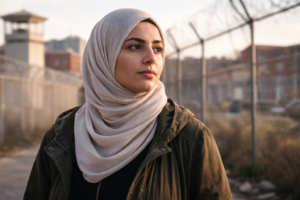
The Echo of Occupation: How One Palestinian Woman Found the West Bank Inside an ICE Jail
Paterson, New Jersey – The air inside the Palestinian café in Paterson is thick with the aroma of cardamom and fresh za’atar. For Leqaa Kordia, these smells are the first notes of a freedom she is still learning to trust. Two weeks ago, she walked out of the Prairieland Detention Center in Alvarado, Texas, after 365 days in custody. But as she sips her coffee, she admits that her body hasn’t quite caught up with her release.
She still sleeps with one eye open. She still flinches when a door slams. And she still cannot shake the feeling that she is being watched.
“When you are Palestinian, you are born into a reality where you are always the ‘subject,’ never the citizen,” Kordia says, her voice steady but fragile, like glass holding back a flood. “I thought if I could just get to America, that feeling would go away. I was wrong. I just traded one checkpoint for another.”
In her first print interview since her release from Immigration and Customs Enforcement (ICE) custody, Kordia draws a line that many in the American human rights community have danced around for years: the chilling parallel between the daily humiliation of life under Israeli occupation and the administrative purgatory of the US immigration detention system.
‘The Soldier Laughing in My Bedroom’
Kordia’s story does not begin in Texas, nor on the Columbia University campus where she was arrested at a protest against the war in Gaza in April 2024. It begins in the West Bank during the Second Intifada. She was nine years old.
She remembers waking up not to the sound of her mother, but to the metallic click of rifles. Israeli soldiers had taken over her family’s home. They stood in her bedroom, guns pointed at her small frame. One of them was laughing.
“As soon as I opened my eyes I saw that soldier laughing—literally laughing—and pointing his rifle in my face,” she recalls. For a child, the terror was abstract; the humiliation was concrete. It was a lesson in power dynamics: that your safety, your dignity, and your right to exist quietly in your own bed are privileges that can be revoked by a foreign uniform at any moment.
For years, she carried that memory with her. She learned to navigate checkpoints, to keep her eyes down, to survive the daily grind of a life where you are never the protagonist, only an obstacle for someone else’s military objective.
When she left for the United States in 2016 to reunite with her US-citizen mother, she thought she was leaving that world behind. She thought America was the antidote to occupation.
“I really used to believe that. Everybody can say whatever they want and do whatever they want,” she says, the bitterness of disillusionment creeping into her tone. “I was naïve.”
The ‘Human Tragedy’ of Prairieland
The arrest at the Columbia protest was swift. The charges were dropped the next day. But the ICE detainer was not. Despite having a pending green card application, no criminal record, and more than 200 members of her extended family killed by Israeli strikes in Gaza, Kordia was swept into the maw of the immigration enforcement machine.
She was sent to Prairieland, a facility she insists should not be called a “detention center.” “That sounds nice,” she says. “It’s a jail.”
It was here that the ghosts of the West Bank began to merge with her American reality. She describes the “paper-thin” mattresses on concrete floors, the women crammed into overcrowded dorms, the guards who refused to use names.
“They don’t call you by name. They call you ‘subject,’ or by your alien number,” she says. In Palestine, she was never “Leqaa”; she was a demographic threat. In Texas, she was never “Leqaa”; she was a case file.
The echoes grew louder when she recalled the behavior of the guards. When women—sick, pregnant, or elderly—asked for water or medical attention, they were met with indifference. When they asked why the showers were broken, guards shrugged and said, “It is what it is.” When they begged for warmth in the freezing facility, they were told the cold was to protect against “germs.”
But it was the laughter that broke her.
“As soon as I opened my eyes I saw that soldier laughing,” she had said of her childhood. In Texas, she saw the same thing: guards laughing at detainees, mocking their pleas, treating human suffering as a form of entertainment.
“It’s the stripping of dignity,” she explains. “That is the link between Palestine and ICE. It is the deliberate, systematic humiliation. They want you to know that you are nothing.”
Medical Neglect and the Seizure
The physical toll of that humiliation nearly killed her. On February 6, 2026, Kordia collapsed. She had a seizure. For days, she had been ignored. When she finally hit the floor, the other women in the dorm didn’t wait for the guards to act. A fellow detainee fought with officers to ensure Kordia’s hijab stayed with her as she was rushed to the hospital.
Her family didn’t learn about the seizure from ICE. They learned about it from another detainee who managed to sneak a message out. For three agonizing days, her mother tried to locate her daughter through official channels. ICE offered nothing.
“They just didn’t care,” Kordia says. “If I had died in there, they would have just moved on to the next subject.”
The ‘Family’ Behind the Fence
If the story of Prairieland is one of horror, it is also, unexpectedly, one of radical solidarity. Kordia says the women inside turned a warehouse of suffering into a commune of survival.
When someone was sick, others would pool their commissary money to buy food and cook it in the communal microwave. When it was someone’s birthday, they celebrated with chips and candy smuggled from the canteen. When the water had “things swimming in it,” they shared their bottles.
They exchanged phone numbers of relatives back home—a fragile network of care in case one of them was transferred, deported, or died.
“I was sent far away from my community in New Jersey, all the way to Texas, for them to isolate me,” she says. “Instead, I found a family.”
She became the educator of that family. Despite her trauma, she used the detention as an “opportunity” to talk to other detainees—and any guard willing to listen—about Gaza. She passed around a dog-eared copy of a book by Refaat Alareer, the Palestinian poet killed in an Israeli strike. Women from Honduras, from Venezuela, from Haiti—women who knew their own versions of war and poverty—listened.
“We all came from countries where we know what war is,” she says. “It wasn’t hard for them to relate.”
A New Duty
Kordia is free for now, thanks to an immigration judge who ruled for the third time that she poses no threat. But the administration is still seeking her deportation. She is in limbo—a space she knows intimately.
She doesn’t consider herself an activist. She calls herself a “server,” a “daughter,” a “Palestinian girl who protested her family being killed.” But she accepts that the word no longer fits. The past year has forged her into something else.
“Now, I’ll advocate on behalf of the ladies I left behind,” she says. “I was advocating on behalf of my family in Palestine. Now I’m advocating on behalf of my family here in America.”
She wants the American public to know what happens behind the fence. She wants them to understand that when you hear “ICE detention,” you should not picture a sterile holding facility. You should picture a freezing warehouse where pregnant women drink water from a fountain attached to a toilet. You should picture guards laughing at a seizure. You should picture the occupation—not of land, but of the human spirit.
“The least I can do is talk about what those I left behind are facing every day,” she says, looking out the window of the café in Paterson. “Whether they are in Gaza or in Texas, they are my people now. And they are waiting for someone to remember that they are human.”
As she walks out into the New Jersey sun, she squints. After a year in the fluorescent darkness of a detention center, the light is still too bright. But she doesn’t look away. She has spent her whole life being looked at by soldiers and guards. Now, for the first time, she is the one holding the gaze.
You must be logged in to post a comment.