
The Drums of War: As UK and US Issue Urgent Warnings, the Middle East Holds Its Breath
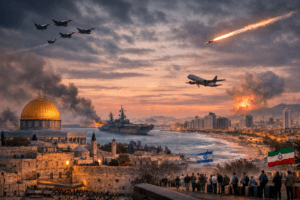
The Drums of War: As UK and US Issue Urgent Warnings, the Middle East Holds Its Breath
As diplomatic missions close and travel warnings are issued, families in Jerusalem, Tel Aviv, and Tehran face the same agonizing question: Is this the moment the region tips back into all-out war?
On a grey Friday afternoon in late February, the British Foreign Office did something that, for the thousands of British nationals living in Israel and the occupied Palestinian territories, turned an abstract geopolitical crisis into a personal emergency. It changed its travel advice, warning against “all but essential” travel to Israel and Palestine. Simultaneously, in Tehran, the Union Jack was lowered as the British Embassy “temporarily closed” its doors and switched to remote operations.
Across the Atlantic, the United States followed suit. Ambassador Mike Huckabee sent a stark email to embassy personnel in Jerusalem: non-essential staff and their families were authorized to leave. “There may be outbound flights over the coming days, there may not be,” the email read, adding the chillingly pragmatic suggestion that “persons may wish to consider leaving Israel while commercial flights are available.”
For the casual observer, these are headlines about diplomatic protocol and travel insurance. But for the millions of people living in the shadow of the escalating conflict between the United States, Iran, and Israel, they are something far more profound. They are the official, undeniable signal that the situation is no longer just tense—it is potentially terminal.
The View from the Ground: “It’s Not Just News Anymore”
To understand the weight of these announcements, one must look beyond the political rhetoric and the military posturing. One must look at the human landscape.
In Jerusalem’s Old City, the ancient stones of the Al-Aqsa Mosque compound, also known as the Temple Mount, have seen empires rise and fall. But for the shopkeepers in the winding souks and the families in the eastern neighbourhoods, the current crisis feels uniquely precarious. The memory of last June’s 12-day war, triggered by earlier tensions, is still raw. The bombing of sensitive nuclear sites in Iran during that conflict, as confirmed by a recent UN watchdog report, blurred the lines between a “limited” exchange and a regional conflagration.
“It’s tense here,” one resident might tell you, echoing the sentiment that permeates the air. But tension is a familiar companion in this part of the world. What is different now is the feeling of being watched, of being a potential target. The US has spent the last month amassing a fleet of aircraft and warships in the region—a visible, floating declaration of intent that casts a long shadow over the beaches of Tel Aviv and the ports of the Gulf.
For a dual-national family in Tel Aviv, the decision is agonizing. The schools are still open, the cafés on the beachfront are still full, and life, on the surface, continues. But the advice from London and Washington introduces a new variable: the risk of being trapped. The Foreign Office explicitly warned that international borders “could close quickly and with little notice.” Do you stay and hope diplomacy prevails, or do you pack a single bag, explain to your children that you’re going on an unexpected holiday, and join the queue at Ben Gurion airport before the flights—as the US embassy warned—potentially disappear?
The Diplomatic Domino Effect: Why Embassies Close
The closure of an embassy is never a decision taken lightly. It is a monumental logistical and political act. For the UK to move staff from Tel Aviv to “another location within Israel” and to shutter operations in Tehran signifies a complete breakdown in the assumption of safety.
The British Embassy in Tehran has been a lightning rod for protest and a symbol of fractured relations for decades. Its “temporary” closure is a defensive measure, a recognition that in the event of US military action, diplomatic personnel could be at risk—either from official retaliation or from the unpredictable fury of street-level anger.
This creates a vacuum. When diplomats leave, lines of communication are frayed. The very channels used to de-escalate crises in the middle of the night are suddenly silent. It is a physical manifestation of the collapse of trust, a step that makes accidental war more likely.
The Nuclear Shadow and the 20-Point Peace Plan
Underpinning this dramatic movement of people is the seemingly intractable standoff over Iran’s nuclear programme. The recent talks between the US and Iran failed to produce a deal. While both sides spoke of “significant progress,” the lack of an agreement left the US’s preferred diplomatic solution hanging by a thread.
President Donald Trump used his State of the Union address to lay out his case. While he expressed a preference for diplomacy, his threat was unambiguous: he would not allow Tehran to obtain a nuclear weapon. This ultimatum, backed by the naval armada in the region, has created a high-stakes game of chicken.
Secretary of State Marco Rubio’s upcoming trip to Israel to discuss “a range of regional priorities including Iran, Lebanon, and ongoing efforts to implement President Trump’s 20-Point Peace Plan for Gaza” adds another layer of complexity. The “20-Point Peace Plan” suggests a comprehensive post-conflict vision, but negotiating the details of peace while simultaneously preparing for war is a paradox that defines the current moment. It implies that the US is either preparing the ground for the day after a conflict, or using the credible threat of force as leverage to finally force Iran to the negotiating table on American terms.
The View from Tehran: Sanctions, Strikes, and Survival
In Tehran, the news of the British embassy closure will be met with a weary resignation. The Iranian rial has likely fluctuated on the unofficial market, a barometer of public anxiety. For ordinary Iranians, the threat of US strikes is not just a geopolitical headline; it is the memory of past sanctions, the fear of economic collapse, and the dread of another war.
The Iranian government insists its nuclear work is for peaceful purposes, a claim viewed with deep scepticism by the West, especially after the discovery of undeclared sites. The confidential UN report revealing that inspectors have been denied access to sensitive sites since they were bombed last June only deepens the mistrust. From Tehran’s perspective, allowing inspectors back in while US warships are positioned to strike feels less like cooperation and more like providing targeting data.
Iran’s threat to attack Israel if the US strikes is the region’s most dangerous fuse. It transforms a potential US-Iran conflict into an immediate Israeli-Iranian war, drawing in proxies in Lebanon, Syria, and Yemen. It is the reason why travel warnings have been issued not just for Iran, but for Israel. An attack on Israel by Iranian drones or missiles, or by their proxy Hezbollah in Lebanon, would not discriminate between military targets and the bustling streets of Tel Aviv.
A Region Trapped in the Waiting Room
For the time being, the Middle East is in a strange kind of limbo. It is a waiting room where the news channels are blaring, the diplomats are rushing, and the militaries are poised, but the daily routines—buying bread, going to work, picking up children from school—continue.
The travel warnings are the needle scratching across the record of normalcy. They are an official admission that the governments who issue them can no longer guarantee the safety of their citizens. They force a reckoning: is this just another cycle of violence that will blow over, or is this the big one?
As the sun sets over the Al-Aqsa Mosque, casting long shadows across the city, the question hangs in the air. Will there be a diplomatic breakthrough from Rubio’s visit? Will the US blink? Will Iran?
Or will the waiting end, not with a deal, but with the sound of sirens? The world watches, and the people of the Middle East hold their breath, hoping that this time, the warnings are just a precaution, and not a prophecy.
You must be logged in to post a comment.