
The Driver in the Driver’s Seat: Why Radhakrishnan Kodakkal’s Move to Daimler Truck Signals a New Era for Auto Tech
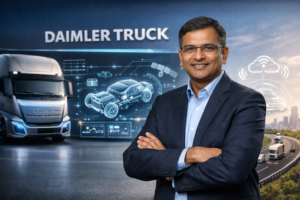
The Driver in the Driver’s Seat: Why Radhakrishnan Kodakkal’s Move to Daimler Truck Signals a New Era for Auto Tech
The press release was standard fare: a new leader appointed, a thank you to the outgoing executive, and a forward-looking statement about growth and innovation. But beneath the corporate veneer of the announcement that Radhakrishnan Kodakkal would take the helm at Daimler Truck Innovation Center India (DTICI) lies a story far more significant. It’s a narrative about the tectonic shifts occurring in the automotive world, the evolving role of India in the global knowledge economy, and the specific breed of leader needed to navigate a industry caught between the internal combustion engine’s echo and the electric, autonomous hum of the future.
When Kodakkal steps into his office in Bengaluru, he won’t just be managing a team of engineers; he will be steering a critical node in a global network that is redefining what a truck is. No longer just a vehicle of steel and diesel, a modern truck is becoming a software-defined platform, a data center on wheels, and a critical component of a sustainable future. Kodakkal’s appointment is a signal that Daimler Truck understands this transformation intimately—and that its Indian innovation hub is no longer just a support office, but a central engine in driving it.
From the Smart Home to the Smart Highway: Decoding the Kodakkal Appointment
To understand the strategic weight of this move, one must first look at the man himself. Kodakkal joins DTICI after a distinguished tenure at Whirlpool Corporation, where he served as Global Head of Integrated Technology and Vice President, leading their Global Technology and Engineering Center. At first glance, the leap from refrigerators and washing machines to heavy-duty trucks seems vast. But in the context of 21st-century product development, the gap narrows considerably.
Kodakkal’s mandate at Whirlpool was to infuse traditional home appliances with intelligence. He led teams focused on connected and intelligent product systems, digital transformation, and creating technology strategies for a world where your washing machine can order its own detergent. He was, in essence, in the business of transforming “dumb” hardware into smart, connected, and user-centric platforms.
This is precisely the challenge facing Daimler Truck. A commercial vehicle today is a complex ecosystem of sensors, actuators, and electronic control units (ECUs). It generates terabytes of data on fuel efficiency, driver behavior, engine health, and cargo conditions. The future of profitability for fleet operators lies not just in the truck’s physical durability, but in the digital services that surround it: predictive maintenance that prevents breakdowns, over-the-air software updates that add new features, and route optimization that slashes fuel costs.
Kodakkal doesn’t just bring engineering leadership; he brings a consumer-centric, software-first mindset forged in the hyper-competitive world of consumer durables. He understands how to build products that talk to the cloud, how to leverage data for predictive analytics, and how to create seamless digital experiences. He is the architect of the “smart,” now tasked with building the “heavy.”
Thomas Ulm, Chairman of DTICI, alluded to this when he highlighted Kodakkal’s “proven ability to build and scale innovation.” This isn’t about managing headcount; it’s about fostering a culture where software engineers, data scientists, and mechanical engineers collaborate to build a vehicle that is as intelligent as it is powerful.
The Bangalore Beat: Why India is the Heart of the Operation
Kodakkal’s new domain, DTICI, is not a mere satellite office. Established in December 2021, it has rapidly grown into one of Daimler Truck’s largest development centers outside Germany. Its location in Bengaluru—India’s Silicon Valley—is no accident. The city offers a unique alchemy of deep-seated mechanical engineering talent from India’s traditional manufacturing hubs and a thriving, youthful pool of software developers, data architects, and AI specialists.
For decades, India’s role in the global automotive industry was largely confined to low-cost manufacturing and back-office support. That era is over. The modern automotive value chain is being rewritten by code. The competitive advantage now lies in software integration, embedded systems, and digital platform development. India, with its massive STEM talent pool, is perfectly positioned to lead this charge.
Daimler Truck’s deepening investment in its Bengaluru center is a bet on this “brain power.” By placing a leader of Kodakkal’s caliber at the helm, the company is signaling that DTICI is moving from a “delivery center”—executing tasks defined elsewhere—to a true “innovation hub”—co-creating and defining the technology roadmap for the entire group.
This transition is complex. It requires shifting the center’s identity from being a cost-effective resource to a strategic partner. It demands building trust with global R&D and IT teams in Stuttgart, Portland, and Tokyo. Kodakkal’s global experience, having led multi-regional R&D operations, will be crucial in navigating these internal cultural currents and ensuring that the “India innovation” is seamlessly integrated into the global product ecosystem.
The Legacy and The Launchpad: Vaidya’s Foundation
Kodakkal’s task is made easier by the strong foundation laid by his predecessor, Raghavendra Vaidya. Vaidya’s tenure, culminating in his promotion to global Chief Information Officer at Daimler Truck AG, is a testament to the talent residing within the Indian center. He successfully grew DTICI into a “significant part of Daimler Truck’s global technology organisation,” as Ulm noted.
Vaidya’s move to the global CIO role is itself a powerful narrative. It demonstrates a clear career pathway from the Indian innovation center to the highest echelons of corporate leadership. This is a potent tool for attracting and retaining top-tier talent. Young engineers in Bengaluru can now see a trajectory that doesn’t top out locally but can lead to shaping global IT strategy.
For Kodakkal, this means inheriting a well-respected team with established credibility. His job is not to fix something broken, but to accelerate something promising. He must take the credibility Vaidya built and leverage it to push for more ambitious projects, more ownership of core platforms, and a louder voice in product strategy discussions. The “foundation” is solid; now it’s time to build the skyscraper.
The Road Ahead: Navigating Transformation on Three Axes
As Kodakkal settles into his role, his focus will likely be on three parallel axes of transformation that are reshaping the commercial vehicle industry.
- The Electric Powertrain and its Digital Twin:The shift to battery-electric and hydrogen-based fuel-cell vehicles is the most visible change. But for an engineering center like DTICI, the real challenge and opportunity lie in the digital systems that manage these new powertrains. Battery management systems, thermal management algorithms, and energy optimization software are now as critical as the hardware itself. India’s expertise in software and controls engineering will be pivotal in making these new vehicles efficient, reliable, and safe. Kodakkal’s teams will be writing the code that governs the flow of energy, ensuring a truck can haul a heavy load across a mountain pass without depleting its battery.
- The Software-Defined Vehicle:Imagine a truck whose braking performance, engine mapping, or driver-assist features can be upgraded with a software download, just like your smartphone. This is the reality of the software-defined vehicle (SDV). It requires a fundamental re-architecting of the vehicle’s electronic backbone, moving from a hundred disparate ECUs to a few powerful, centralized computers running on a robust operating system. This is a monumental software engineering challenge, and it is a space where Indian tech talent excels. DTICI, under Kodakkal’s leadership, is poised to become a center of excellence for the SDV, developing the platforms that will define Daimler Truck’s digital DNA for decades.
- The Ecosystem of Services:A truck is a tool for making money. The real value for a customer is “uptime”—keeping the truck on the road and generating revenue. This has shifted Daimler Truck’s focus from simply selling a vehicle to selling transportation solutions. This involves creating a digital ecosystem: platforms that connect the truck to the fleet manager’s office, predict breakdowns before they happen, optimize routes in real-time based on traffic and weather, and even automate payments for tolls and charging. Building these large-scale, cloud-native platforms is a core competency of the Indian tech industry. Kodakkal’s experience with connected products at Whirlpool provides a unique lens through which to view these challenges, applying consumer-grade user experience and reliability to the B2B world of logistics.
A Leader for a Complex Moment
Radhakrishnan Kodakkal’s appointment is more than a corporate reshuffle. It is a deliberate strategic choice for a company navigating the most turbulent and exciting period in its history. He is a leader who bridges the mechanical and the digital, the hardware and the software, the local Indian talent pool and the global corporate structure.
His success will be measured not just in lines of code written or engineering projects completed, but in how effectively he can transform DTICI into a crucible of innovation. Can he create an environment where a young data scientist in Bengaluru feels empowered to propose a new algorithm that optimizes a truck’s performance in the Brazilian outback? Can he bridge the gap between German engineering rigor and Indian entrepreneurial agility to create solutions that are both world-class and future-ready?
The automotive industry is no longer just about horsepower; it’s about “thought power.” And in appointing Radhakrishnan Kodakkal, Daimler Truck has signaled that it is putting one of its sharpest thinkers in the driver’s seat at its Indian innovation hub, ready to navigate the winding road ahead. The destination? A future where trucks are cleaner, smarter, and more connected than ever before.
You must be logged in to post a comment.