
The Double Bind: How India’s Manufacturing Ambitions Rest on the Backs of Its Invisible Women Workers
India’s ambitious goal of becoming a $30 trillion economy by 2047 relies heavily on revitalizing its stagnant manufacturing sector, which in turn demands a massive expansion of its workforce, including women. However, the emerging landscape of women’s employment in manufacturing presents a troubling paradox: while more women are joining the workforce, their participation is overwhelmingly characterized by persistent informality, concentration in low-paying, traditional sectors like garments and textiles, and stark regional disparities that range from controlled factory work in the south to invisible home-based labor in the north. This trend reflects a “feminization of survival,” where women’s labor fills cheap, flexible roles without the benefits of security or progression, underpinned by systemic barriers like unsafe transport, the burden of unpaid care work, and social stigma. For India’s manufacturing ambitions to be sustainable and inclusive, the strategy must shift from merely increasing female headcounts to fundamentally valuing their work through formalization, skills training for higher-value roles, investment in care infrastructure, and the creation of safer, more equitable workplaces, making women’s economic dignity a core metric of the nation’s developmental success.
The Double Bind: How India’s Manufacturing Ambitions Rest on the Backs of Its Invisible Women Workers
India stands at an economic crossroads. With the ambitious target of becoming a $30 trillion economy by 2047, the nation’s gaze is fixed on revitalizing its long-stagnant manufacturing sector. This vision, however, hinges on a critical, often overlooked pillar: women workers. Recent data reveals a paradoxical narrative of their participation—a story not of linear progress, but of persistent precarity amidst promise. To understand India’s manufacturing future, we must first confront the complex reality of the women who are meant to fuel it.
The Paradox of Participation: More Jobs, Not Better Lives
On the surface, the trend seems positive. Female workforce participation rates in India have shown encouraging upticks, with more women entering the formal employment sphere. But this visibility is a veneer. Dig deeper, and a disquieting picture emerges. The increase is disproportionately absorbed by informal, low-wage, and highly precarious work. For millions of Indian women, “getting a job” does not mean securing stability, benefits, or a career path. It means entering a chain of subcontracting, working in small, unregistered units, or engaging in piece-rate work from home—all characterized by a glaring absence of social security, job safety, or legal protection.
This is not accidental growth. It’s a “feminization of survival,” where women’s labor fills the gaps in a sector trying to compete on global cost margins. They are concentrated in traditional, low-value-add manufacturing subsectors like garments, textiles, food processing, and leather goods. These industries thrive on flexible, cheap labor, and women, often due to societal pressures and limited mobility, become the workforce of choice. Their employment is shaped not by skill aspiration, but by economic necessity and employer convenience.
The Geography of Inequality: A Tale of Two Indindias
The national aggregate data masks a landscape of stark regional disparity. Women’s manufacturing work is not uniformly distributed; it clusters in specific geographies, each with its own gendered logic.
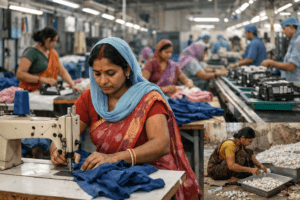
In the southern states, particularly Tamil Nadu and Karnataka, larger-scale garment and textile factories employ significant numbers of women. While these jobs offer slightly more regularity, they are often ensnared in rigid, patriarchal control—with factory gates and hostel accommodations regulating mobility and personal life under the guise of “safety.” Wages remain low, and unionization is rare.
Contrast this with the northern agrarian belt. Here, manufacturing work for women is far more sporadic and informal. It might involve seasonal work in food processing units, home-based zari or chikan embroidery, or assembly work in household sheds. This model seamlessly blends domestic duties with income generation, but at the cost of invisible labor, abysmal pay, and zero oversight. The worker is isolated, bearing the double burden of production and reproduction without recognition for either.
This regional patchwork means that the experience of a woman in a Coimbatore spinning mill and a woman doing piecework in her Moradabad home are worlds apart, yet united by their systemic undervaluation.
The Stagnant Sector and the Female Fix
India’s manufacturing sector’s contribution to GDP has remained stubbornly below 20% for decades. The sector’s inability to “take off” and move up the value chain is a well-documented puzzle. The proposed solution often involves policy pushes like Production-Linked Incentive (PLI) schemes and improving Ease of Doing Business. However, these macro-strategies frequently ignore the gender dynamics of labor supply.
The expectation that manufacturing expansion will automatically draw in women as a new labor reservoir is flawed. It assumes that barriers do not exist. The reality is a thicket of constraints: unsafe and unreliable public transport, the threat of harassment, the lack of dignified sanitation facilities at worksites, and the pervasive social stigma against women working outside the home, especially in night shifts. Furthermore, the burden of unpaid care work—childcare, elder care, housework—falls overwhelmingly on women, acting as a silent tax on their time and mobility.
Without a parallel revolution in care infrastructure (like crèches), urban planning, and social norms, simply creating more factory jobs will not lead to a sustained, productive influx of women workers. They will be forced into the most flexible and exploitative niches of the sector, perpetuating the cycle of informality.
Beyond Headcounts: Redefining “Quality” and “Value”
For India’s manufacturing dream to be inclusive and sustainable, the conversation must shift from counting women workers to valuing their work. This requires a multi-pronged approach:
- Formalization as Empowerment: Policy must aggressively incentivize the formalization of micro-enterprises and small units where women cluster. Simplified registration, access to formal credit, and linkage to social security schemes like PF and ESI are crucial first steps.
- Skills for the Future, Not the Past: Vocational training for women must escape the trap of traditional “feminine” trades. A concerted effort is needed to skill women for roles in emerging manufacturing sectors—electronics assembly, pharmaceutical production, green technology—where the value addition and wages are higher.
- Investing in the Care Economy: Public investment in affordable, quality childcare facilities is not a social welfare expense; it is critical economic infrastructure. It would release a massive amount of female labor time and enable fuller, more consistent participation.
- Gender-Responsive Urban Infrastructure: Safe transport, well-lit streets, and clean sanitation facilities at industrial clusters are non-negotiable for enabling women’s safe mobility. This is a fundamental prerequisite, not a perk.
- Amplifying Voice and Agency: Supporting women’s collectives, unions, and cooperatives within manufacturing can help move the needle from individual vulnerability to collective bargaining. When women can negotiate for better wages and conditions, the quality of their work life improves.
Conclusion: The Foundation of a Trillion-Dollar Dream
India’s $30 trillion GDP target is a formidable goal. Achieving it through manufacturing cannot be a gender-blind project that simply extracts more labor from women while maintaining the status quo. The current model, which relies on their cheap, flexible, and invisible labor, may yield short-term gains but will cement long-term inequalities and limit the sector’s innovative potential.
The true transformation will begin when we see women not as a latent resource to be tapped, but as central stakeholders whose dignity, safety, and economic progression are the very indicators of developmental success. Building a resilient, high-growth manufacturing sector and ensuring decent work for women are not separate objectives. They are two sides of the same coin. The road to $30 trillion must be paved with more than just output targets; it must be paved with equity, foresight, and a fundamental revaluation of whose work counts, and how.
You must be logged in to post a comment.