
The Domino Effect: How Conflict in the Strait of Hormuz is Choking India’s Gas Supply
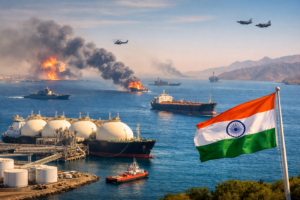
The Domino Effect: How Conflict in the Strait of Hormuz is Choking India’s Gas Supply
On the surface, it was a routine regulatory filing. Buried in the dry, legalistic language of a stock exchange disclosure on Thursday, GAIL (India) Ltd. dropped a bombshell that sent ripples through the country’s energy markets: the allocation of liquefied natural gas (LNG) from its long-term supplier, Petronet LNG, had been slashed to zero. The reason cited was a force majeure—an unforeseen catastrophe that frees a company from its contractual obligations—triggered by a conflict thousands of miles away from its New Delhi headquarters.
This wasn’t a problem with a pipeline, a labor strike, or a domestic policy shift. It was the grim echo of escalating warfare in the Middle East, specifically the U.S. and Israel’s campaign against Iran, which has turned the Strait of Hormuz, the world’s most critical energy artery, into a high-risk war zone.
While the news headlines speak of supply cuts and corporate maneuvering, the reality on the ground is far more visceral. This is the story of how geopolitical turbulence translates into flickering flames in factories, idle machinery in industrial parks, and anxious boardroom meetings across India. It’s a stark reminder that for a nation increasingly reliant on imported energy, security is not just a matter of signing long-term deals, but of navigating the unpredictable currents of global conflict.
The Strategic Chokepoint: Why Hormuz Matters to Your Dinner
To understand the gravity of the situation, one must first look at a map. The Strait of Hormuz, a narrow, 21-mile-wide passageway between Oman and Iran, is the gateway for almost a fifth of the world’s oil and a quarter of its LNG. For energy-hungry India, which imported 27 million metric tons of LNG in the last fiscal year, it is the primary maritime highway for the fuel that powers its fertilizer plants, city gas grids, and industrial complexes.
The “widening war” mentioned in the Reuters report isn’t abstract. It has manifested in very real terms: vessels in the area have been hit, and the transit of tankers has come to a “near halt.” For Petronet LNG, India’s premier gas importer, this meant its fleet of specialized LNG tankers, booked and scheduled for months, could not safely reach the loading terminal at Ras Laffan in Qatar—India’s single most important source of LNG.
When Petronet declared force majeure on Wednesday, it wasn’t just a legal notice to its Qatari supplier, QatarEnergy. It was the first falling domino. It triggered a cascade of contractual obligations that now threatens to disrupt the energy supply chain down to the very last mile. Petronet had to inform its own downstream customers—giants like GAIL and Indian Oil Corp (IOC)—that the gas they were expecting would not be arriving.
From Terminal to Tap: The Human and Industrial Impact
This is where the corporate jargon meets the real world. GAIL and IOC are not just companies; they are the arteries through which natural gas flows to thousands of customers. When their allocation from Petronet was cut to zero, they were left with a stark choice: absorb the massive financial hit of reneging on contracts, or pass the pain downstream.
As Reuters reported on Tuesday, even before the official force majeure notice, these companies had already begun reducing gas supplies to industrial customers. But who are these customers?
- The “Mothballed” Manufacturer: Consider a ceramic tile manufacturer in Gujarat’s Morbi cluster. Natural gas is the lifeblood of his kilns, firing tiles at over 1,200 degrees Celsius. A sudden, unplanned gas cut doesn’t just stop production; it can ruin an entire batch in progress and damage the kilns themselves. He now faces a choice: shut down completely, or buy gas on the volatile and exorbitantly priced spot market, erasing his profit margins. If the cuts persist, he may have to “mothball” his unit, laying off the hundreds of workers who depend on him.
- The Fertilizer Conundrum: A more critical impact is on the fertilizer sector. India is a major producer of urea, which is manufactured using natural gas as both a feedstock and a fuel. Any disruption here doesn’t just affect a company’s bottom line; it threatens the agricultural sector. With the critical rabi (winter) crop season underway, a shortage of domestic fertilizer could force India to increase imports, putting pressure on the government’s subsidy bill and potentially affecting food prices.
- The City Gas Dilemma: In India’s bustling cities, compressed natural gas (CNG) fuels buses, auto-rickshaws, and private cars, while piped natural gas (PNG) is used in millions of homes for cooking. City Gas Distribution (CGD) entities, which rely on a steady supply from GAIL and others, are at the end of this supply chain. While domestic households are often the last to be cut, they are not immune to the cascading effects. A prolonged crisis could lead to pressure drops in pipelines or even rationing, forcing a city-dweller to wait longer for a CNG refill or see their cooking gas flame weaken.
The Qatar Factor and India’s LNG Vulnerability
India’s predicament is amplified by its dependence on a single major supplier. While India has diversified its LNG sources in recent years, importing from the U.S., Australia, and Africa, Qatar remains the 800-pound gorilla, accounting for roughly half of all LNG imports. The contracts are long-term and pricing is complex, but the physical delivery relies on a clear path through the Gulf.
The current crisis highlights a dangerous asymmetry. India has invested heavily in building LNG import terminals (like Petronet’s Dahej and Kochi facilities) and a national gas grid. This infrastructure is world-class. However, all the import capacity in the world is useless if the ships carrying the molecules cannot dock at the export terminal.
The force majeure declared by Petronet is, in effect, a mirror image of the one its supplier, QatarEnergy, might be facing. If Qatari tankers can’t leave port, or if they are afraid to transit the Strait, the contract is impossible to fulfill. This is not a commercial failure; it is a geopolitical one.
What “Other Sources” Really Means
In its exchange filing, GAIL sought to calm nerves by stating that supplies from “other sources and suppliers are currently unaffected.” This is a crucial, yet fragile, caveat.
India’s other LNG sources, such as from the U.S. (Freeport, Sabine Pass) or Australia, travel through different, safer shipping lanes. In the short term, GAIL and IOC will scramble to reroute cargoes. They will dip into their portfolio of long-term contracts from these other geographies. They will also look to the spot market.
However, this is easier said than done. When the world’s largest LNG exporters are disrupted, the entire global market tightens. Asian spot LNG prices, which had been relatively stable, are already showing signs of upward pressure. The crisis effectively turns every available cargo into a bidding war between desperate buyers in India, price-sensitive buyers in China, and gas storage operators in Europe.
This is where the “human insight” becomes a story of cost. Even if GAIL secures alternative cargoes, they will likely be more expensive than the long-term Qatari contract. This higher cost will inevitably be passed on to the industrial customers who are still receiving gas. For those who are cut off, the spot market offers a lifeline, but at a price that could make their products uncompetitive.
A Broader Look: India’s Energy Security Revisited
This crisis should serve as a profound wake-up call for India’s energy planners. The narrative of “energy independence” often focuses on boosting domestic production of oil and gas. But for a country that must import such a large portion of its gas, “independence” is a misnomer. The real goal is “energy resilience.”
The current situation exposes the vulnerabilities in that resilience:
- Over-reliance on a Single Chokepoint: Even with diverse suppliers, the physical geography of the Gulf means that a significant portion of global supply must pass through the Strait of Hormuz. Until India can secure reliable overland pipelines (a politically fraught endeavor) or invest in a larger, more diversified fleet of its own LNG tankers, this vulnerability will persist.
- The Limits of Contracts: A 20-year LNG sale and purchase agreement (SPA) is a powerful commercial tool, but it is powerless against a missile strike or a naval blockade. The force majeure clause is the ultimate escape hatch, reminding us that in the end, physical delivery trumps legal obligation.
- The Strategic Importance of Storage: Unlike Europe, which is rapidly building cavernous gas storage facilities, India has minimal strategic gas storage. European countries can weather a short-term supply disruption by drawing from reserves. Indian industries and power plants have no such buffer. When the ship doesn’t come, the gas flow stops almost immediately.
The Path Forward: Between War and a Hard Place
As the world watches the conflict in the Middle East with bated breath, India’s gas consumers are caught in the crossfire. The government will likely step in to coordinate the response, perhaps asking priority sectors like fertilizers and power to be given preference over others. The Petroleum and Natural Gas Regulatory Board (PNGRB) may be forced to adjudicate disputes arising from these supply cuts.
For the common citizen, this crisis may seem distant. But its effects are tangible. It could mean slightly more expensive fertilizer, leading to higher food costs. It could mean that the “Make in India” initiative in sectors like ceramics, glass, and chemicals faces another headwind in the form of unreliable and expensive power and fuel.
The GAIL announcement is not an end, but a beginning. It marks the start of a challenging period where India’s energy managers must perform a high-wire act: keeping the lights on and factories running while navigating a global energy market thrown into chaos by war. The allocation to GAIL may have been cut to zero, but the need for innovative, resilient, and diversified energy solutions has just been reset to a hundred. The conflict in the Strait of Hormuz is not just a geopolitical headline; it is a hard lesson in the fragility of the interconnected world and a stark reminder that for a nation like India, energy security is, and always will be, national security.
You must be logged in to post a comment.