
The Diplomatic Storm Around Putin’s India Visit: A Clash of Strategic Worlds
The diplomatic storm surrounding Vladimir Putin’s 2025 visit to India exposed a deep strategic divide between Europe and New Delhi. In an unprecedented move, the ambassadors of the UK, France, and Germany published an op-ed in India condemning Russia’s actions in Ukraine, which India viewed as unacceptable interference aimed at undermining a long-standing partnership rooted in historical trust, defense dependence, and energy security. While Europe sees isolating Russia as a moral imperative driven by fear of war and geopolitical insecurity, India prioritizes strategic autonomy and pragmatic engagement essential for its national interests. The episode highlights Europe’s growing frustration and diminishing global leverage, India’s confidence in balancing great-power ties, and the broader reality of a multipolar world where Global South nations reject Western pressure and pursue nuanced, interest-driven foreign policies.
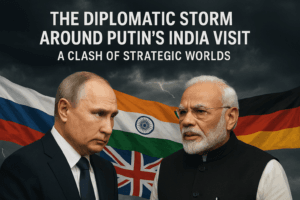
The Diplomatic Storm Around Putin’s India Visit: A Clash of Strategic Worlds
The Diplomatic Breach: Days before Russian President Vladimir Putin’s state visit to India in December 2025, the accredited ambassadors of three major European powers—the United Kingdom, France, and Germany—took an unprecedented step. They co-authored a blistering opinion article in an Indian newspaper, directly attacking Putin and Russia over the Ukraine conflict, accusing Russia of “total disregard for human life” and “malign global activity”.
India’s Firm Response: Indian officials swiftly and publicly labeled the ambassadors’ action as “unacceptable and unusual,” stating it was not acceptable diplomatic practice to give public advice on a host country’s relations with a third nation. Former Foreign Secretary Kanwal Sibal called it a “diplomatic insult” and “public grandstanding with an overt propagandist intent”.
This diplomatic incident was more than a last-minute protest; it was a stark, public collision between India’s doctrine of strategic autonomy and a Europe gripped by existential anxiety. The clash reveals a fundamental disconnect in how different powers navigate a fragmented world order, where old alliances are strained and national interest is being redefined in real-time.
The Incident: A Diplomatic Line Crossed
The op-ed, published just before Putin’s arrival, was a coordinated move by three of Europe’s heaviest hitters. The envoys accused Russia of launching a war of aggression, conducting indiscriminate attacks, and engaging in global destabilization through cyberattacks and disinformation. They placed the onus for peace solely on Putin, describing him as the “one leader who could end the war anytime he wishes”.
From the European perspective, this was a principled stand. A German Foreign Ministry spokesperson later defended the action, asserting it was a presentation of Germany’s position and not interference, and that Germany stood “fully behind our ambassadors”.
From New Delhi’s viewpoint, the breach was threefold:
- Timing: It was a deliberate attempt to cast a shadow over a planned state visit.
- Method: Diplomats directly appealed to the Indian public through local media, bypassing official channels.
- Substance: It was seen as a moral lecture on India’s foreign policy choices, a practice Indian leadership has repeatedly pushed back against on global stages.
A German newspaper later noted that the Indian government was “surprised, if not frankly offended, by this interference”.
Why India Stands Firm: The Pillars of the Russia Relationship
For Europe, the issue is black and white—a war of aggression that demands global condemnation. For India, relations with Russia are painted in shades of strategic gray, rooted in decades of necessity and solidified by contemporary realpolitik. Dismantling this partnership under external pressure is not an option for several compelling reasons.
- A Foundation of Historical Trust: The relationship is not a recent marriage of convenience. During the Cold War, the Soviet Union was a critical diplomatic shield for India, using its UN Security Council veto power in India’s favor, notably during the 1971 war that led to Bangladesh’s creation. This legacy forged a deep reservoir of trust. As one analyst noted, “From New Delhi’s perspective, recent developments have shown that if anything Russia is in some ways a more reliable partner compared to the U.S.’ fickle and sometimes unpredictable behavior”.
- The Hard Reality of Defense Dependence: Approximately 60-70% of India’s military hardware is of Russian origin. This includes frontline platforms like the Sukhoi Su-30MKI fighters, T-90 tanks, and the S-400 air defense systems. Severing this supply line would cripple India’s operational readiness. The partnership is now evolving from a “buyer-seller” model to include co-development and co-production, making the ties even more entwined.
- The Economics of Energy Security: Following the Ukraine invasion, India became one of the world’s largest buyers of discounted Russian crude oil. This was a pragmatic decision to insulate its economy from volatile global energy prices and meet the needs of 1.4 billion people. While recent U.S. sanctions have forced some Indian refiners to curtail purchases, energy remains a cornerstone of bilateral trade, with a new goal to reach $100 billion in total trade by 2030.
- The Strategic Autonomy Doctrine: At its core, this is about India’s right to make its own choices. Hosting Putin was a clear signal that India will not have its partnerships dictated by others. As Prime Minister Narendra Modi has consistently articulated, India is on the side of peace, but will engage with all sides to protect its national interest.
The table below summarizes the core disconnect between the European and Indian positions on this issue:
| Aspect | European Perspective (as reflected in the op-ed & policy) | Indian Perspective (as articulated in response & policy) |
| Core Issue | A moral and security imperative to isolate Russia for its aggression in Ukraine. | A pragmatic and strategic need to maintain a historic, multi-faceted partnership vital for national security and development. |
| Nature of Ties | Russia is a pariah state; engagement rewards aggression. | Russia is a “special and privileged strategic partner” of decades standing. |
| Primary Goal | Unite the global community to pressure Russia and support Ukraine. | Preserve strategic autonomy, ensure defense preparedness, and secure affordable energy. |
| View of Pressure | A necessary diplomatic effort to uphold a rules-based order. | Unwarranted interference and a failure to appreciate India’s unique security challenges. |
Europe’s Frustration: Fear, Impotence, and a Clash of Narratives
The European ambassadors’ unusual move did not emerge from a vacuum. It was an act of frustration from a continent facing a perfect storm of crises, making its confrontation with India particularly acute.
- The Shadow of War on European Soil: For Europe, the Ukraine war is an existential threat. A December 2025 poll revealed that a majority of citizens in Germany, France, and several other EU states see a “high risk” of war with Russia. This palpable fear explains the zero-sum, highly moralistic approach to diplomacy. When France announced the reintroduction of military service, President Emmanuel Macron explicitly framed it as a response to Russian aggression.
- The Sting of Strategic Irrelevance: There is a growing sentiment in European capitals that their continent’s fate is being decided by two non-European powers: the United States and Russia. The Trump administration’s direct peace negotiations with Moscow, often sidelining European input, have exacerbated feelings of impotence. The op-ed can be seen as an attempt to reclaim agency and demonstrate relevance on a global stage.
- Economic and Political Strain: Europe has poured over €100 billion into supporting Ukraine. Coupled with the self-imposed energy crisis from cutting off Russian gas, this has strained economies, with Germany flirting with recession and France grappling with heavy debt. In this context, seeing a major democracy like India deepen economic ties with Russia is politically and emotionally jarring.
The Bigger Picture: A World Not Aligning into Blocs
The friction over Putin’s visit is a microcosm of a larger global trend: the hesitant emergence of a multipolar world where non-alignment is making a vigorous comeback.
- The Global South’s Calculated Neutrality: India is not alone. Many nations in Africa, Asia, and Latin America have refused to join Western sanctions against Russia. They view the conflict through a lens of post-colonial sovereignty and are prioritizing their own economic and developmental needs. Europe’s challenge is that its moral framework does not resonate universally.
- The Limitations of European Leverage: Despite being major trade and investment partners for India, Germany, France, and the UK discovered the limits of their influence. India’s muted but firm response—calling the action “unacceptable” but not escalating further—showed a confidence in its strategic positioning. It can absorb European displeasure because the relationship with Russia is deemed non-negotiable for core security interests.
- A Diplomatic Lesson in the Making: The incident may serve as a case study in what not to do. By publicly admonishing India, the European envoys likely hardened New Delhi’s position and validated its narrative of resisting Western pressure. More effective diplomacy would require a deeper understanding of India’s historical binds and security dilemmas, engaging with them as strategic realities rather than moral failings.
The Road Ahead: Managed Differences or Growing Divide?
Putin’s visit concluded with agreements on trade corridors, nuclear energy, and a deal to facilitate the flow of Indian workers to Russia. The hug and the state dinner proceeded as planned. The diplomatic spat did not derail the summit, proving India’s resolve.
The path forward is one of managed divergence. India will continue to walk its tightrope, balancing ties with Russia and the West. Europe must decide whether to continue a confrontational approach that yields little, or to pragmatically engage with India’s complex strategic calculus. As one European analyst lamented, Europe should perhaps be asking India “how it has managed to maintain stable ties with both Washington and Moscow without provoking either”.
The ultimate insight from this diplomatic storm is that the 21st-century world order will not be a tidy alignment of democracies versus autocracies. It will be messier, populated by sovereign states fiercely guarding their right to define their own interests, even when those definitions clash dramatically with the moral and strategic visions of their friends. Recognizing this complexity, rather than railing against it, is the first step toward effective statecraft in a fractured age.
You must be logged in to post a comment.