
The Diplomatic Gambit: How a Bid for the UN’s Podium Exposes the New Front in the Israeli-Palestinian Conflict
The Palestinian bid for the presidency of the UN General Assembly, spearheaded by envoy Riyad Mansour, represents a strategic diplomatic maneuver to elevate Palestine’s international standing by seeking a high-profile role traditionally reserved for full member states, a move Israel condemns as a “back door” attempt to bypass direct negotiations and Security Council vetoes on full membership; this unprecedented candidacy, enabled by a contested 2024 UN resolution and a favorable interpretation from the Secretary-General, sets up a major political and procedural clash that tests UN norms, forces member states to choose between precedent and sympathy, and underscores the conflict’s shift toward a battle for institutional legitimacy within multilateral forums.
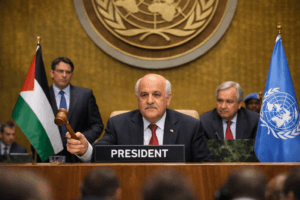
The Diplomatic Gambit: How a Bid for the UN’s Podium Exposes the New Front in the Israeli-Palestinian Conflict
In the hushed, marble halls of the United Nations, a quiet campaign is unfolding that could redefine the boundaries of international diplomacy and ignite a fresh political firestorm. Riyad Mansour, the Permanent Observer of the State of Palestine to the UN, has been nominated by the Arab Group to become the President of the 81st session of the UN General Assembly (UNGA). This seemingly procedural move has been met with a sharp accusation from Israeli Ambassador Danny Danon: a “blatant attempt” to upgrade Palestinian status “through the back door.” This is more than just diplomatic jostling; it is a high-stakes maneuver that tests the very architecture of the UN system and reveals the evolving, multilateral battlefield of the Israeli-Palestinian conflict.
Beyond Symbolism: The Weight of the Gavel
The President of the UN General Assembly is more than a ceremonial figure. This officer sets the agenda, chairs plenary meetings, and acts as a global diplomatic facilitator. While the position rotates geographically, it has always been held by representatives of full UN Member States. Mansour’s candidacy, representing a Permanent Observer entity, is unprecedented. It directly challenges a foundational UN norm: that the highest offices are reserved for states.
Israel’s objection, as voiced by Danon, hinges on this precise point. He frames the bid not as a quest for neutral leadership, but as a “platform for anti-Israel propaganda” designed to “drain the General Assembly of substance.” From Israel’s perspective, granting the presidency to the Palestinian delegation would effectively legitimize and elevate their standing without requiring the concessions typically demanded for statehood, particularly direct negotiations. It’s seen as an end-run around the UN Security Council, where the United States has historically wielded its veto to block full Palestinian membership, most recently in April 2024.
The Legal Labyrinth: How We Got Here
To understand why this bid is even possible, one must revisit the controversial UNGA Resolution ES-11/1 of May 2024. That resolution bestowed upon the Palestinian delegation a suite of new procedural privileges “on an exceptional basis and without setting a precedent.” These included the right to speak on any agenda item (not just those pertaining to Palestine), the right to submit proposals and amendments, and the right to be seated among member states in alphabetical order.
Critically, the resolution was ambiguous on whether these new rights extended to holding offices like the UNGA Presidency. The subsequent interpretation by UN Secretary-General António Guterres, suggesting it could be possible, opened the door Mansour is now attempting to walk through. This legal gray area is where the battle is being fought. The U.S. State Department has already stated its opposition, setting the stage for a potential clash not just over a candidacy, but over the interpretation of international parliamentary procedure itself.
A Strategic Pivot in Palestinian Diplomacy
The Palestinian pursuit of the UNGA presidency is a masterclass in pragmatic, multilateral statecraft. It represents a strategic pivot from a stalled bilateral peace process to a concerted effort to build institutional facts on the ground within the international system. After the U.S. veto at the Security Council blocked the front-door approach to full membership, Palestinian diplomats have adeptly shifted to leveraging their overwhelming support in the General Assembly.
This “internationalization” strategy serves multiple purposes:
- Normalization: Placing a Palestinian representative in one of the UN’s most visible chairs would normalize Palestine’s role as a quasi-state actor, eroding the distinction between observer and member.
- Agenda-Setting: It would grant Palestine significant influence over the global conversation, potentially prioritizing issues like the humanitarian situation in Gaza, settlements, and self-determination.
- Pressure Tactics: It systematically isolates Israel and its allies in multilateral forums, creating a continuous diplomatic cost for the status quo.
The Regional Chessboard: Not a Coronation
Mansour’s path is not guaranteed. He faces competition within the Asia-Pacific Group from Bangladesh and Cyprus. Bangladesh, having campaigned for years, presents a formidable, consensus-driven alternative. Cyprus, an EU member, offers a more neutral candidate who might be palatable to Western blocs wary of the politicization Danon warns of.
The vote, scheduled for June 2026, will be a revealing test of global allegiances. While the 22-member Arab Group is unified, and the 57-member Organisation of Islamic Cooperation (OIC) is likely supportive, securing the broader Asia-Pacific Group’s endorsement—and ultimately the majority of the 193-member General Assembly—requires broader diplomacy. Nations may be sympathetic to the Palestinian cause but hesitant to breach the precedent of the presidency, fearing it could destabilize UN protocols.
The Broader Implications: A Test for the UN Order
This episode transcends the Israeli-Palestinian conflict. It poses a fundamental question to the United Nations: how flexible are its rules in the face of persistent political deadlock? If a non-member observer can assume one of the organization’s highest offices based on a contested interpretation of a resolution, it sets a powerful precedent. Other entities or territories with observer status may see a new path to influence.
Conversely, blocking the bid could be framed as denying a right granted by the majority of members, fueling accusations that the UN system is inherently biased and resistant to the will of its general membership. It places the institution in a no-win situation, caught between its own rules and the political momentum of a majority of its members.
Conclusion: The Gavel as Battleground
The contest for the 2026-2027 UNGA presidency is far more than a diplomatic sidebar. It is a concentrated manifestation of a decades-long conflict now being waged with procedural weapons and symbolic victories. For Palestine, it is a chance to solidify its international persona and wield tangible institutional power. For Israel, it is a fight to prevent what it sees as the unilateral erosion of its standing and the circumvention of agreed-upon diplomatic processes.
As the campaign unfolds, the world will witness a profound test of international law, diplomatic norms, and raw political will. The outcome will not resolve the core issues of borders, security, or refugees, but it will decisively shape the arena in which those future battles are fought. The gavel of the General Assembly has become the latest, and perhaps most symbolically potent, piece of territory in dispute.
You must be logged in to post a comment.