
The Diplomat and the Activist: Inside Canada’s Risky Reset with India
The article contrasts the Canadian government’s new diplomatic stance—asserting that India is no longer linked to violent crimes on Canadian soil as Prime Minister Mark Carney prepares for a high-stakes trade trip to New Delhi—with the lived reality of Sikh activist Moninder Singh, who recently received his fourth police warning of an imminent threat to his and his family’s lives since his friend Hardeep Singh Nijjar was murdered in 2023. While Ottawa frames the rapprochement as pragmatic economic necessity amid an unreliable United States, pointing to law enforcement collaboration and a desire to reset relations, Singh and other Khalistan advocates see it as a betrayal that ignores RCMP allegations of Indian government involvement in homicides and the ongoing fears within Canada’s Sikh community, highlighting the profound tension between securing trade deals and ensuring the safety of those who feel targeted by foreign repression.
The Diplomat and the Activist: Inside Canada’s Risky Reset with India
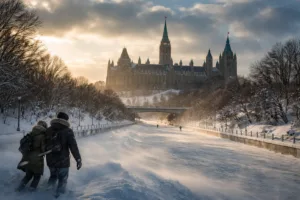
The frigid Ottawa wind whips across Parliament Hill, carrying with it the chants of a crowd that feels betrayed. Below the Peace Tower, a massive Indian flag lies spread on the ground, a symbolic canvas for a protest steeped in grief and defiance. At the center of it all, Moninder Singh watches the seat of government with weary eyes. For him, the news emanating from this very building is not just a political shift; it is a personal earthquake.
Just days before Prime Minister Mark Carney is set to depart on a historic nine-day trip to India, a senior Canadian official dropped a diplomatic bombshell: the government is now confident that India is no longer linked to violent crimes in Canada. It is a statement designed to clear the air for trade talks, a pragmatic move in a volatile world. But for Singh, a religious leader and outspoken Khalistan activist in British Columbia, it feels like the ultimate gaslighting. As he stood on the frozen ground, he couldn’t shake the memory of the Vancouver police officer who had just appeared at his door with another chilling warning: there is an imminent threat to the lives of him, his wife, and his children.
This is the fourth such warning he has received since his friend, Hardeep Singh Nijjar, was shot dead in his truck outside a gurdwara in Surrey, B.C., in June 2023. The contrast could not be starker. In the halls of power in Ottawa, officials speak of “robust diplomatic engagement” and “progress.” In the Sikh community of British Columbia’s Lower Mainland, families are looking over their shoulders, and activists are being told by police that their lives are in danger. This is the human fissure running beneath the smooth veneer of Prime Minister Carney’s diplomatic reset.
The Pragmatist’s Gambit
To understand why Ottawa is making this move, one must look south of the border. The re-election of Donald Trump has thrown the foundations of Canadian foreign policy into disarray. The United States, long Canada’s most reliable economic and security partner, has become an unpredictable, “unreliable” force. For a trading nation like Canada, this is an existential threat. The need to diversify trade partners has shifted from a long-term aspiration to an immediate, desperate necessity.
Enter India: a booming economic giant of 1.4 billion people, with a seemingly insatiable appetite for resources, technology, and investment. From Canadian oil and gas to AI collaboration and education, the potential for commerce is staggering. Mark Carney, a former central banker who built his career on navigating global economic storms, is the ideal leader to sell this “pragmatic” vision. His government’s message is clear: we can walk and chew gum at the same time. We can keep our communities safe through law enforcement dialogue while shaking hands with world leaders to secure our economic future.
On paper, it makes sense. The senior official’s statement that India is no longer linked to violent crime is the ultimate olive branch, a necessary precondition for the kind of warm reception Carney hopes to receive from Prime Minister Narendra Modi. The official doubled down, stating that the previous concerns about “active foreign interference and repression” no longer apply, adding, “I really don’t think we’d be taking this trip if we thought these kinds of activities were continuing.”
It is a definitive, clean break from the Trudeau era. But is it accurate? Or is it a convenient political declaration designed to pave the way for photo-ops in New Delhi?
The Man Living with the Threat
Back in Surrey, Moninder Singh isn’t buying it. His reality is not shaped by diplomatic briefings in Ottawa but by the cold dread of a police cruiser pulling into his driveway. The latest warning was different, he says. It wasn’t just about him anymore. It was about his wife. His children.
The Vancouver Police Department, citing operational reasons, declines to say who they believe is behind the threat. But for Singh, the source is obvious. His activism for Khalistan—a proposed sovereign Sikh state—is what put him in the crosshairs after Nijjar’s murder. He sees the Carney government’s about-face not as diplomacy, but as a betrayal of a murdered friend and a community under siege.
“With what this current government’s doing right now, it shouldn’t be this difficult to understand that you’re going to shake hands with the very people that have Canadian blood on their hands,” Singh said, his voice a mix of anger and exhaustion.
He is not just speaking rhetorically. He is pointing to the evidence trail that the Carney government seems eager to move past. In October 2024, the RCMP issued an extraordinary public statement, directly linking agents of the Indian government to “homicides and violent acts” on Canadian soil. They spoke of a coordinated campaign targeting Khalistani activists, involving organized crime, intimidation, and death threats. Shortly after, a senior Canadian official confirmed the government believed India’s Home Minister, Amit Shah, was involved in the alleged activities.
Then there is the American case. Just last month, a man named Nikil Gupta pleaded guilty in a New York court to plotting to murder a Sikh separatist on U.S. soil, at the direction of an Indian government employee. The U.S. handled the situation with quiet diplomacy, leading to arrests and a conviction. Canada, as India’s High Commissioner to Ottawa, Dinesh Patnaik, put it this week, reacted “immaturely” by going public and “destroy[ing] the relationship.”
For Singh, the U.S. outcome is not a sign of Canadian immaturity; it is proof that the Indian intelligence apparatus is real, active, and lethal. The fact that a plot was hatched in one country and thwarted in another doesn’t make the threat any less real for those living under its shadow in Canada.
The Sikh Dilemma: Extremism vs. Advocacy
The Indian government has long maintained that Canada harbors “Sikh extremists” and “Khalistani terrorists.” They point to the 1985 Air India bombing—the deadliest act of aviation terrorism before 9/11, carried out by Canadian-based Khalistani militants, killing 329 people—as the permanent, tragic backdrop to this conflict. For New Delhi, national security is non-negotiable. They view the Sikh separatist movement as a direct threat to the sovereignty and territorial integrity of India.
This is the counter-argument that complicates Canada’s moral standing. Jody Thomas, who served as Prime Minister Trudeau’s national security advisor, acknowledges this reality. She suggests that Canada and India need to reach a mutual understanding: India must address Canada’s concerns about transnational repression, and Canada must address India’s concerns about criminal separatist activity being planned or glorified on its soil.
“The intelligence is enough for accountability and responsibility to be assigned,” Thomas said of the Nijjar case, insisting the security concerns are still a “live issue.” However, she also pragmatically notes that it is “possible to continue to have conversations with India about trade.”
But for the activists on the ground, this distinction feels impossible. They see the Canadian government conflating their peaceful advocacy—the right to hold a referendum, to wave a flag, to hold a rally—with the violent extremism of the past. Moninder Singh argues that his right to advocate for Khalistan is protected by the Canadian Charter of Rights and Freedoms. To be targeted for that advocacy, he argues, is an attack on Canadian sovereignty itself.
Politics on the Precipice
The political calculus in Ottawa is fraught with risk. While Carney jets off to Mumbai, the opposition is sharpening its knives. Supriya Dwivedi, a former senior adviser to Justin Trudeau, voices a concern that resonates with many who feel the reset is too hasty. She recalls that Jagmeet Singh, the leader of the NDP and a practicing Sikh, required personal protection in 2023 after the RCMP warned of a threat to his life—a threat later reported to be linked to India.
“I can’t picture another country being alleged to have followed a leader of the opposition to the point where the RCMP gets involved, and we all just sort of forget about that,” Dwivedi said.
Her point cuts to the heart of the matter: If the intelligence was credible enough to warrant protection for the leader of the opposition less than three years ago, what has fundamentally changed to make it disappear now? Has the threat truly been neutralized, or has it simply been deprioritized in favor of commercial interests?
The government insists it is doing both. Maninder Sidhu, the International Trade Minister who will be on the trip, represents Brampton East, a riding with one of the largest South Asian populations in the country. He is acutely aware of the fears in his community, which has been rattled by a wave of extortion and violence. He points to the recent agreement between Canadian and Indian officials to appoint “liaison officers” in each other’s countries to collaborate on law enforcement.
“I do believe we can do two things at the same time,” Sidhu said. “We can keep our community safe. We can have law enforcement dialogue… and we can continue to engage with partners around the world economically.”
It is the diplomatic equivalent of patting your head and rubbing your stomach. But when the stakes involve人命 (human lives), can it really be done simultaneously?
A Testimony to Fear
The protest on Parliament Hill was a visual reminder that for a significant portion of the Sikh diaspora, this is not a geopolitical game. The demonstrators from Sikhs for Justice, the group Nijjar was involved with, see Carney’s trip as a capitulation. They held placards, chanted slogans, and stood defiantly on the Indian flag, a deeply provocative act that would infuriate New Delhi, perfectly illustrating the impossible position Canada is in.
How do you build trust with a partner whose red lines you cannot control your own citizens from crossing?
As Carney’s plane prepares to depart, the disconnect between Ottawa and Surrey remains a chasm. The government sees a rising tide of economic opportunity in the Indo-Pacific. Moninder Singh sees a government willing to overlook murder for the promise of profit.
When asked about his own safety, staring down a fourth credible threat, Singh does not flinch. He thinks of his friend, gunned down in a parking lot on a summer evening.
“I’ll continue on that path just like my friend did,” he says quietly. “If the end is the same, then I’m definitely willing to accept that.”
It is a chilling testament to his conviction. And it serves as a stark, human counterpoint to the optimistic press releases set to emerge from New Delhi. Mark Carney is traveling to India to sell a vision of the future. But for Moninder Singh, and the community he represents, the past hasn’t even passed yet. It is standing on his doorstep, threatening his family. And until that changes, no amount of diplomatic pragmatism will feel like progress.
You must be logged in to post a comment.