
The Digital Propaganda War: How Israel Fights for Global Opinion Online
Israel’s Hasbara represents a sophisticated, state-coordinated digital propaganda machinery funded by tens of millions of euros and operating across government ministries to control the international narrative, particularly regarding Gaza; it employs tactics like emotional manipulation, the creation of “engineered truths,” and targeted advertising on platforms like Google and YouTube, yet faces a significant challenge from organic, grassroots pro-Palestinian content—especially on TikTok—where hashtags like #StandWithPalestine garner billions more views than their pro-Israel counterparts, leading to political pressure and platform censorship against Palestinian voices, which highlights a profound contradiction: despite Israel’s institutional advantage and attempts to dominate online discourse, authentic, firsthand testimony from Gaza persistently breaches this curated narrative, revealing the limits of propaganda and fostering a global shift in public opinion, especially among younger demographics, while also exacerbating real-world polarization and hate crimes.
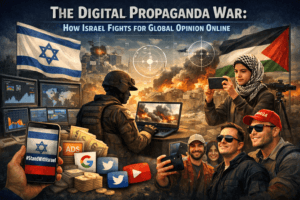
The Digital Propaganda War: How Israel Fights for Global Opinion Online
Introduction: The New Battlefield
In today’s conflicts, the fight for global public opinion is waged as fiercely online as any military campaign on the ground. For Israel, this effort is institutionalized through “Hasbara” — a Hebrew term meaning “explanation” or “clarification” that describes a sophisticated state strategy of public diplomacy and propaganda. This digital offensive, coordinated from the Prime Minister’s Office and involving multiple ministries, aims to shape the international narrative, particularly regarding military operations in Gaza. As social media becomes the primary news source for billions, Israel’s hasbara apparatus represents a multi-million euro investment in controlling the story, revealing a modern front of warfare fought with pixels, influencers, and targeted advertisements rather than just bullets and bombs.
The Institutional Engine of Hasbara
Israel’s hasbara is not an ad-hoc effort but a well-funded government machinery. Operating from the Prime Minister’s Office with units in Defense, Foreign Affairs, and Tourism ministries, it coordinates a global network of pro-Israel individuals and organizations. At its core is the Israeli Government Advertising Agency (Lapam), which executes paid media campaigns. Documents reveal a procurement system that often prioritizes urgency and “special trust” over standard competitive bidding, allowing for agile and sometimes opaque operations.
The financial commitment is staggering. An investigation found that in 2024 alone, Israel allocated approximately €42.8 million to Google for advertising campaigns. This included €8.5 million for YouTube and its ad platform, €2.56 million for campaigns on X (formerly Twitter), and additional funds for platforms like Outbrain and Teads. This massive spending funds a strategy that one European journalism alliance described as “sophisticated, well-funded, and often unconventional,” aimed squarely at molding global perception.
The Hasbara Playbook: Tactics and Narratives
The digital strategy employs several key, interlocking tactics designed to dominate online discourse:
- Emotional Manipulation and Victimhood: Central to the narrative is positioning Israel as the sole victim. This includes the selective release of graphic footage from Hamas attacks to international leaders and media, and viral campaigns like “Kidnapped from Israel” to humanize Israeli victims and justify military responses. The narrative often reduces the complex conflict to a simple binary: innocent Israeli victims versus Palestinian aggressors.
- Creating “Engineered Truths”: Hasbara frequently involves repeating debunked claims until they gain traction. A notorious example was the widely circulated but false claim that Hamas beheaded infants on October 7, 2023. Another tactic is accusing Palestinians of staging suffering, using the derogatory term “Pallywood” to cast doubt on authentic documentary evidence.
- Countering On-the-Ground Realities: A stark example involves the famine in Gaza. After the UN-backed Integrated Food Security Phase Classification (IPC) declared a famine in August 2025, Lapam launched ads across Google and YouTube showing bustling Gaza markets with the message “There is food in Gaza.” These ads were strategically placed above search results for the IPC report itself in several European countries. Simultaneously, Israel organizes tightly controlled tours for influencers and journalists to curated sites to promote the narrative that aid shortages are the fault of international organizations, not Israeli restrictions.
- Cultivating Influence and Allies: The strategy extends to direct engagement with tech leaders and sympathetic influencers. Prime Minister Benjamin Netanyahu met with Elon Musk in late 2023, and his government has courted pro-Trump “MAGA” influencers, funding trips to Israel and occupied territories through no-bid contracts. A 2025 government tender even sought a firm to help bring 10,000 influential visitors to Israel to improve its global image.
The Social Media Battleground: TikTok as a Case Study
Perhaps no platform illustrates the digital propaganda clash better than TikTok. The app’s algorithm-driven, visually-centered format has made it a powerful space for grassroots Palestinian narratives, much to the alarm of Israeli officials and their allies.
- A Platform Under Fire: In late 2023, U.S. lawmakers like Senators Josh Hawley and Marco Rubio renewed calls to ban TikTok, alleging it was a “cesspool” of pro-Hamas misinformation and “brainwashing” young Americans. They pointed to polls showing that a majority of Americans aged 18-24 believed Palestinian grievances could justify the October 7 attacks—a view they attributed to TikTok’s “ubiquity of anti-Israel content”.
- The Hashtag War: The data reveals a clear disparity. In late 2023, the hashtag #StandWithPalestine had 3 billion views on TikTok, compared to 200 million for #StandWithIsrael. Another analysis showed #FreePalestine appeared in 177,000 posts with 946 million views, dwarfing pro-Israel hashtags.
- Direct Targeting and Censorship: The pressure on TikTok has had direct consequences. In January 2026, award-winning Palestinian journalist Bisan Owda—who gained 1.4 million followers by documenting life in Gaza—reported her TikTok account was permanently banned. She linked the ban to remarks by Netanyahu, who in September 2025 told pro-Israel influencers that “the most important purchase… is TikTok,” hoping its U.S. acquisition would be “consequential”. Furthermore, the new CEO of TikTok’s U.S. arm stated that using the term “Zionist” as a proxy for a protected attribute was designated as hate speech on the platform.
- Systemic Digital Violations: Owda’s case is not isolated. Palestinian digital rights monitors reported 960 digital violations targeting Palestinian content on social media in January 2026 alone. This creates a “digital occupation,” where infrastructure damage and power outages in Gaza physically limit Palestinian voices, while online platforms systematically suppress them.
The Hashtag War: A Snapshot of Digital Sentiment
| Metric | Pro-Palestine Hashtag (#StandWithPalestine) | Pro-Israel Hashtag (#StandWithIsrael) | Notes |
| Views (Late 2023) | 3 billion | 200 million | Global TikTok data |
| Posts (Oct-Nov 2023) | 13,000 posts | 6,000 posts | Over a 30-day period |
| Engagement Trend | Consistently higher | Lower, prompting political concern | Led to US Congressional hearings |
The Offline Impact and Global Repercussions
This digital warfare has tangible, often dangerous, consequences in the physical world. The polarizing algorithms of social media create echo chambers that amplify extreme views. Researchers note that online dehumanization can signal that physical acts of hate are more acceptable.
Since October 2023, there has been a documented global rise in both antisemitic and Islamophobic hate crimes, a trend experts link to the toxicity of online discourse. Tragic examples include the murder of a six-year-old Palestinian-American boy in Illinois by a landlord consumed by media reports on the war and a terrorist attack on Jews celebrating Hanukkah at Bondi Beach in December 2025.
Furthermore, the hasbara effort highlights a profound Western complicity. By investing millions in the very ad platforms that shape global discourse, and by lobbying for the restriction of apps where Palestinian voices find an audience, Israel’s campaign is deeply intertwined with Silicon Valley’s infrastructure and Western political agendas.
Conclusion: An Uphill Battle for Control
Israel’s hasbara represents one of the world’s most advanced state propaganda operations, leveraging vast resources, emotional manipulation, and strategic alliances to maintain narrative dominance. However, its very sophistication reveals a core vulnerability: it is a reaction to a growing grassroots shift. The disproportionate investment in digital propaganda underscores an anxiety that traditional narratives are failing, especially among younger, digitally-native generations who access information outside legacy media filters.
Despite the bans, shadow-banning, and multi-million euro ad campaigns, the organic, personal testimony from Gaza—the very content creators like Bisan Owda risk their lives to produce—continues to reach a global audience. This persistent flow of firsthand evidence challenges even the most well-funded hasbara, proving that in the digital age, while propaganda can be systematized, authentic human experience remains a formidable counter-force. The digital battlefield is thus a paradox: a space of extreme asymmetry in funding and access, but also one where a single powerful image or story can, against all odds, breach the fortress of curated narrative.
You must be logged in to post a comment.