
The Diaspora Dividend: How Modi’s Johannesburg Engagements Forge a New India-South Africa Alliance
During his visit to Johannesburg for the G20 Summit, Prime Minister Narendra Modi engaged in a multi-faceted diplomatic offensive aimed at strengthening the India-South Africa relationship by strategically leveraging the Indian diaspora as a “living bridge.”
This effort included courting Indian-origin tech entrepreneurs to foster knowledge transfer and investment in key sectors like FinTech and healthcare; empowering community organizers to promote Indian cultural practices such as Yoga and Ayurveda to deepen people-to-people ties; and holding high-level talks with the leadership of South African tech giant Naspers to secure further investment in India’s digital, AI, and startup ecosystems. This comprehensive approach, complemented by potent cultural symbolism like the gift of a millet-filled ‘Kalash,’ demonstrated a modern statecraft model that intertwines economic, cultural, and community bonds to build a robust, synergistic partnership for the future.
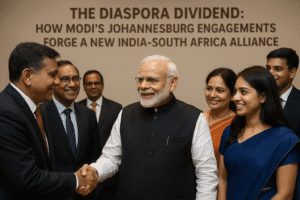
The Diaspora Dividend: How Modi’s Johannesburg Engagements Forge a New India-South Africa Alliance
In the bustling economic heart of South Africa, a meeting of minds was underway that encapsulated a modern vision of diplomacy—one built not just on statecraft, but on the potent bonds of heritage, technology, and shared ambition. During his visit to Johannesburg for the G20 Leaders’ Summit, Indian Prime Minister Narendra Modi’s schedule was a masterclass in 21st-century statecraft, strategically engaging with the Indian diaspora and global tech titans to weave a stronger, more dynamic fabric between India and South Africa.
Beyond the formal summit halls, Modi’s interactions with Indian-origin tech entrepreneurs, community pillars, and corporate leaders revealed a multi-pronged strategy: to leverage the diaspora as a “living bridge,” attract cutting-edge investment, and position India as a central player in the global digital and cultural economy.
The Tech Vanguard: From Silicon Savannah to Silicon Valley
The meeting with Indian-origin tech entrepreneurs was far more than a photo opportunity; it was a strategic convening of a vanguard. These are individuals who have taken the lessons of their heritage and combined them with the opportunities of the South African and global markets. The sectors represented—FinTech, social media, agriculture, healthcare, and education—are not random. They are the very pillars of both India’s domestic development agenda and its exportable soft power.
When Modi listened to their work, he was doing more than just being polite. He was conducting a live audit of Indian talent thriving in a competitive ecosystem. His subsequent call for them to “deepen their engagement with India” is a key part of India’s economic narrative. The Indian government is not merely seeking remittances; it is actively courting knowledge transfer, joint ventures, and reverse innovation.
Consider the potential: A FinTech startup founded by an Indian-South African, having cut its teeth in Johannesburg’s complex financial landscape, could partner with India’s UPI infrastructure to create novel payment solutions for emerging markets. An agri-tech entrepreneur could bring water-saving smart farming technologies back to Indian fields. This engagement moves the diaspora relationship from one of sentimental support to one of symbiotic economic partnership. Modi isn’t just celebrating their success abroad; he is inviting them to become stakeholders in the India growth story, offering them the world’s largest and most digitally connected laboratory for innovation.
The Community Pillars: Weaving the Social Fabric
Parallel to the tech meeting was Modi’s interaction with the bedrock of the Indian presence in South Africa: the community organization workers. This segment of the engagement addressed the cultural and social dimension of the relationship. The over 1.7 million-strong Indian diaspora in South Africa is a unique community, with roots stretching back to the indentured labourers of the 19th century. They carry within them a living history that intertwines with the struggles of Mahatma Gandhi and Nelson Mandela.
By urging these community leaders to “boost the popularity of Indian culture,” including Yoga and Ayurveda, Modi is empowering them as cultural ambassadors. This is a soft power strategy with tangible benefits. Yoga and wellness are global industries, and positioning them through the trusted channel of the local diaspora gives them authenticity and reach that state-sponsored campaigns often lack. It transforms community centres into hubs of cultural exchange, fostering goodwill and deepening people-to-people linkages that outlast political cycles.
The emphasis on connecting the youth with the legacies of Gandhi and Mandela is particularly astute. It grounds the younger generation in a powerful narrative of ethical leadership and resilience, providing them with a moral compass and a sense of pride in their dual heritage. This isn’t just about preserving the past; it’s about equipping the future leaders of the diaspora with a strong identity.
Symbolism and Sustenance: The Kalash of Shared Annas
One of the most poignant, yet understated, moments of the day was the presentation of a ‘Kalash’ (a sacred pot) from the Chinmaya Mission. This was not a typical diplomatic gift. The pot contained ‘Shree Anna’—millets from both India and South Africa—and was destined for the Annapoorna Devi Temple in Durban.
The symbolism here is profound and multi-layered.
- Spiritual Connection: A Kalash is a Vedic symbol of abundance and life. Placing it in a temple sanctifies the India-South Africa relationship, giving it a spiritual dimension.
- Agricultural Partnership: The contents, millets, are a direct nod to India’s International Year of Millets initiative. Millets are climate-resilient, nutritious grains that represent food security and sustainable agriculture—key concerns for both nations.
- Unity in Diversity: The fact that the millets were sourced from both countries physically represents a blending of soils and souls. It’s a metaphor for a partnership that is rooted in local contexts but shared in its objectives. This single act transformed a diplomatic engagement into a culturally resonant ritual, speaking volumes to the community in a language they deeply understand.
The Corporate Cornerstone: Deepening Investment Linkages
If the diaspora is the bridge, then corporate investment is the traffic that flows across it. Modi’s meeting with Koos Bekker and Fabricio Bloisi of Naspers was a critical piece of the puzzle. Naspers, through its investment arm Prosus, is a behemoth in the tech world and an early investor in Indian giants like MakeMyTrip and, most famously, Swiggy. The discussion on expanding investments in India’s digital ecosystem, AI, startups, and space is a signal of confidence.
When the Ministry of External Affairs states that “Naspers’ success in India reflects ease of doing business and the strength of the Startup ecosystem,” it is a powerful testimonial aimed at other global investors. This meeting was as much about securing Naspers’s next billion-dollar investment as it was about using their success as a case study to attract others. For a South African company to have reaped monumental rewards from India’s growth is the most compelling advertisement for the “Make in India” and “Digital India” campaigns.
A Grand Strategic Tapestry
Viewed in isolation, each meeting—tech entrepreneurs, community workers, corporate CEOs—is a positive news item. But when woven together, they reveal a comprehensive and sophisticated diplomatic strategy.
Prime Minister Modi’s day in Johannesburg was a demonstration of multi-track diplomacy. He engaged with:
- The Economic Track (Naspers): Securing large-scale investment and technology transfer.
- The Knowledge Track (Tech Entrepreneurs): Fostering innovation and entrepreneurial synergy.
- The Socio-Cultural Track (Community Organizations): Strengthening soft power and people-to-people bonds.
- The Future Track (Bharat Ko Janiye Winners): Ensuring the diaspora youth remain connected to their roots.
This approach recognizes that in today’s world, a nation’s strength is not just measured by its military or GDP, but by the global network it cultivates—a network of capital, talent, culture, and shared values. By empowering the Indian diaspora as a “living bridge,” Prime Minister Modi is not just building a relationship with South Africa; he is architecting a global Indian community that is an active, invested, and powerful participant in the nation’s journey forward. The message from Johannesburg is clear: India is open for business, partnership, and cultural collaboration, and its greatest ambassadors are already living and innovating around the world.
You must be logged in to post a comment.