
The Devil’s Bargain: Hamas’s Offer to Disarm and the Grim Reality of Gaza’s Power Vacuum
In a significant yet contentious declaration from the rubble of Gaza, a Hamas spokesperson has stated the militant group is willing to disarm, but only on the maximalist condition that a fully independent Palestinian state based on 1967 borders is established first—a demand Israel flatly rejects. This offer comes even as Hamas, severely weakened by the war, has violently reasserted its control on the ground, executing alleged collaborators and brutalizing opponents to fill the security vacuum, demonstrating that its pledge is less a sincere roadmap for peace and more a strategic positioning to maintain its role as the primary resistance force.
For Israel and the international community, this creates an impossible dilemma: a Hamas-influenced Gaza is untenable, but the alternative—a descent into warlord-led anarchy—may be worse, leaving the trapped civilian population, whose support for Hamas has fluctuated wildly, caught between the group’s intimidation and the devastating aftermath of a war with no viable political solution in sight.
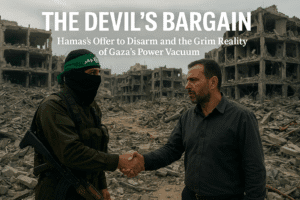
The Devil’s Bargain: Hamas’s Offer to Disarm and the Grim Reality of Gaza’s Power Vacuum
The air in Deir al-Balah is thick with dust and desperation. Between the sagging plastic walls of makeshift tents, Hazem Qasem, a man once accustomed to the authority of a suit and a government office, now yells at children to be quiet. His thinning frame and T-shirt are a stark symbol of a dramatic fall from power. For nearly a decade, Qasem was a public face of Hamas, the militant group that ruled Gaza with an iron fist. Today, he is a spokesman in hiding, embodying his organization’s precarious state: battered but far from broken.
In this landscape of rubble and ruin, Qasem has delivered a message that the world has longed to hear, yet delivered in a context that makes it almost impossible to trust. Hamas, he tells the ABC, is willing to lay down its weapons. But the price is the very thing that has eluded Palestinians for generations: a sovereign, independent state on the 1967 borders with Jerusalem as its capital.
This offer, made from the ashes of a war that has killed tens of thousands and displaced nearly everyone in Gaza, is the ultimate political tightrope. It is simultaneously a significant rhetorical concession and a potential trap, a seeming olive branch wrapped around the same core of ideological resistance that has defined Hamas since its inception. To understand whether this is a genuine path to peace or a tactical feint, one must look past the headline and into the grim, complex reality of power, survival, and fear on the ground in Gaza.
The Calculated Retreat: Survival as a Political Strategy
On the surface, Hamas appears decimated. Israel’s military campaign specifically targeted its leadership, its government infrastructure is pulverized, and a significant portion of its fighting force lies dead. The group that orchestrated the October 7th attacks, which killed approximately 1,200 Israelis and sparked the war, is a shadow of its former self.
Yet, within days of the recent ceasefire, a familiar, chilling scene unfolded on the streets of Gaza City. Masked gunmen, their identities concealed but their allegiance clear, publicly executed men accused of collaborating with Israel. Graphic videos circulated on Telegram channels linked to Hamas security forces, showing brutal punishments for alleged crimes like theft—a stark reminder that while Hamas’s military capacity may be degraded, its will to govern through fear remains potent.
This swift and violent reassertion of control reveals a critical truth: Hamas is engaging in a calculated political and military retreat. It is shedding the burdens of direct governance, which had grown unpopular even before the war, while fiercely clinging to its identity as the vanguard of armed resistance.
“Hamas says clearly that it does not want to be in any of the administrative arrangements that deal with governing the Gaza Strip,” Qasem stated, proposing instead a committee of “independent figures” to run the enclave. This is a strategic pivot. By ostensibly stepping back from daily administration—a role that involves collecting garbage, paying salaries, and dealing with chronic poverty—Hamas hopes to sidestep public blame for the Herculean task of rebuilding while freeing itself to remain an armed opposition force.
As Oded Ailam, former head of counterterrorism for Mossad, succinctly put it, Hamas is working to regain power. Its offer to disarm is not an admission of defeat but a repositioning for a longer game.
The Arms Compromise: Rockets for Rifles, Resistance for Statehood
The devil, as always, is in the details of the disarmament offer. Qasem’s statement that Hamas would give up its weapons only after a Palestinian state is established is a maximalist demand that he knows is a non-starter for the current Israeli government. It is a classic negotiating tactic: anchor your position at the furthest possible point.
However, a more nuanced and potentially more revealing discussion is happening in the background. Analysts like Dr. Erik Skare of the Norwegian Institute of International Affairs suggest that Hamas may be willing to accept a partial disarmament as an interim compromise. This would likely involve surrendering its arsenal of rockets, which has been largely depleted and is difficult to re-smuggle or rebuild under a tight blockade, while retaining small arms and anti-tank missiles.
Why this distinction? For Hamas, rockets represent an offensive capability—a tool for attacking Israeli cities. Small arms, however, are symbolic of defensive resistance and internal control. Giving up rockets could be framed as a confidence-building measure. Keeping rifles and RPGs allows Hamas to maintain its raison d’être—”resistance”—and, just as importantly, to defend its turf against rivals and enforce its will inside Gaza.
This proposed compromise is a telling insight into Hamas’s priorities. It is willing to negotiate away its ability to project force beyond Gaza’s borders if it can retain the tools to dominate within them. It’s an offer to cease being a strategic threat to Israel in exchange for remaining the primary power broker in Palestinian politics.
The Ghost in the Machine: Why a Power Vacuum is Israel’s Worst Nightmare
Israel’s stated war aim has been the “complete destruction” of Hamas’s military and governing capabilities. The re-emergence of masked gunmen on Gaza’s streets just hours after the ceasefire began is a clear indicator that this goal has not been achieved. But the alternative to Hamas control, as Israel has recently discovered, may be even more chaotic and dangerous.
In a stunning admission, the Israeli government confirmed it had been arming and funding powerful Gazan clans to serve as a local alternative to Hamas for securing aid convoys. This backfired spectacularly. These clans, which Ailam compared to letting “Tony Soprano run New Jersey,” were often criminal enterprises, unpopular and unable to provide real security. Hamas’s recent bloody crackdown was not just on “collaborators,” but on these rival power centers.
This creates an impossible dilemma for Israel and the international community. A Hamas-controlled Gaza, even a weakened one, is politically untenable for Israel after October 7th. But a Gaza with no central authority fragments into a patchwork of warlords, criminal gangs, and jihadist groups potentially more extreme than Hamas. The Islamic State’s rise in the power vacuum of Syria and Iraq is a grim precedent.
Hamas, acutely aware of this dynamic, is positioning itself as the only entity capable of preventing total anarchy. Its violent return to the streets, while brutal, was partially welcomed by some Gazans desperate for a semblance of order amidst the looting and lawlessness. In the grim calculus of survival, a familiar devil can be preferable to an unknown chaos.
The People in the Crossfire: Fluctuating Loyalties and the Silence of Fear
Amidst these high-stakes political maneuvers, the will of Gaza’s 2.3 million people is often the quietest and most suppressed voice. Polling throughout the conflict has shown wildly fluctuating support for Hamas. It spiked in the immediate, defiant aftermath of October 7th, then plummeted to as low as 21% in January as the horrific cost of the war became clear. A 2024 Zogby poll found a staggering 89% of Gazans held Hamas responsible for the conflict, with only 7% wanting it to govern in the future.
These numbers, however, tell only part of the story. Public opinion in a totalitarian environment under bombardment is not expressed through polls or protests, but through survival. The Palestinians who spoke to the ABC did so through a local journalist, terrified of reprisals. The public executions, the leg-breaking punishments, the sudden disappearances—these are not just acts of vengeance but powerful tools of political intimidation.
Hamas’s offer to disarm is made for an international audience, but its violent reassertion of control is a message for a domestic one: We are still here. We are still watching. We are still in charge.
A Path Forward or a Dead End?
Hazem Qasem’s offer from the dust of Deir al-Balah presents the world with a profound and difficult question: Is this a genuine opportunity to trade guns for statehood, or is it a cynical ploy to buy time, rearm, and reconsolidate under the guise of diplomacy?
The evidence points to the latter, but with a critical caveat. Hamas has been forced into a position of unprecedented weakness. Its offer, while likely insincere in its maximalist form, reveals a potential opening. The group is signaling that it is feeling the pressure and is willing to negotiate its role in a future Palestine.
The true test will be whether the international community can unite around a plan that isolates Hamas’s militant wing while empowering a legitimate, unified Palestinian leadership that can deliver on the promise of statehood, security, and dignity. This would require a credible political horizon so compelling that it forces Hamas to choose between clinging to its weapons and fading into irrelevance, or accepting a political solution and integrating into a broader national project.
Until then, the offer to disarm remains what it has always been: a devil’s bargain, proposed from the ruins, with the people of Gaza trapped in the middle. The guns may one day fall silent, but the peace they bring will be hollow if it is built on the same foundations of fear and violence that started the war.
You must be logged in to post a comment.