
The Descent from Manakamana: A Himalayan Journey Ends in Tragedy
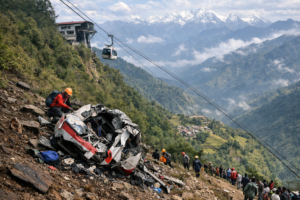
A passenger bus carrying Indian pilgrims back from the revered Manakamana Temple in central Nepal slipped off a mountainous road and plunged 150 meters into a ravine late Saturday night, killing seven devotees and injuring nine others, including the Nepali driver and his assistant. The victims, who had visited the popular Hindu shrine where devotees believe a goddess grants their wishes, died as the bus lost control on a treacherous curve near Shahid Lakhan village, highlighting the ever-present dangers of Nepal’s poorly maintained mountain roads where such accidents are tragically common, while local villagers heroically scrambled down the slope to rescue the injured before authorities could arrive.
The Descent from Manakamana: A Himalayan Journey Ends in Tragedy
By [Your Name/AP Adaptation] Updated: March 17, 2026
The Prithvi Highway, a ribbon of asphalt clinging to the rugged topography of central Nepal, is a artery of life and commerce. It carries rumbling trucks laden with goods from India, tourist buses ferrying adventurers to Pokhara, and local commuters navigating the steep chasms between villages. But for countless devotees, this road is also a pilgrimage route, a necessary passage of endurance before a moment of divine grace. On a cool Saturday evening, March 14, 2026, one such journey of faith came to a harrowing end on a feeder road near Shahid Lakhan village.
A bus, its passengers filled with the spiritual satisfaction of a visit to the revered Manakamana Temple, slipped its grip on a mountain curve. It plunged 150 meters (nearly 500 feet) down a slopeside, tumbling into a ravine and leaving a scar on the landscape and on the hearts of families across the border in India. The final toll, confirmed by police on Sunday, was seven pilgrims killed, all from India, and nine others injured—a stark reminder of the fragility of life in the shadows of the Himalayas.
The Pilgrims’ Last Journey
To understand the weight of this tragedy, one must first understand the destination. The Manakamana Temple is not just another shrine; it is a nexus of faith, hope, and profound belief. Perched on a ridge overlooking the confluence of the Trishuli and Marshyangdi rivers, its name itself—”Manakamana”—means “the heart’s wish.” For centuries, devotees, primarily from Nepal and India, have made the arduous trek to its steps, believing that the Hindu goddess Bhagwati, an incarnation of Parvati, has the power to grant the deepest desires of her visitors.
For the seven individuals who perished, and the seven other Indian pilgrims now recovering in Nepali hospitals, this visit was an act of profound personal significance. They were not mere tourists; they were seekers. They had likely saved for this trip, coordinated with family, and left behind the bustling realities of their lives in India for a few days of spiritual respite. They had climbed the steps to the temple, perhaps rung the bells, tied a red thread on a grille, and whispered their most intimate wishes to the goddess. They had made the offering, performed the puja, and were returning home, their hearts full, carrying the belief that their prayers had been heard.
This narrative of faith is crucial. It transforms the victims from statistics in a police report into individuals on a deeply human quest. Their presence on that bus was an act of love for their families, a hope for a better future, a plea for health or happiness. The bus was not just a vehicle; it was a vessel carrying these hopes back across the border.
The Moment of Descent
The accident did not occur on the main highway, but on the final, winding approach to the temple. The access road, like many in Nepal, is a steep, narrow path that snakes down from the highway to the temple complex. For many, this final leg is often completed by a thrilling ride on a cable car that soars over the same terrain. But for those who choose or need to take the road, the journey down is a test of nerve and machinery.
According to police, the bus was heading downhill in the darkness when it approached a curve near Shahid Lakhan village. Downhill driving on Himalayan roads is a specialized skill, requiring low gears and constant, gentle braking to prevent the vehicle’s brakes from overheating and failing. For reasons still under investigation, the bus failed to negotiate the turn. It slipped off the unpaved shoulder and began a violent, tumbling descent into the void.
For the passengers inside, the world would have turned upside down in a terrifying cacophony of tearing metal, shattering glass, and human screams. The bus rolled 150 meters, a distance longer than a football field, before finally coming to a rest, a crumpled wreck in a dark ravine. In that moment, the peace of the pilgrimage was replaced by the chaos of survival and the silence of loss.
The Immediate Aftermath: Villagers as First Responders
In the remote stretches of Nepal, the first responders are rarely professionals. They are the villagers who hear the crash, the farmers working late, and the shopkeepers closing for the night. When the bus came to rest, the silence that followed was quickly broken by the shouts of locals from Shahid Lakhan village who rushed to the scene, flashlights cutting through the pitch-black night.
This is a scene that plays out all too often in Nepal’s mountains. Ordinary citizens become impromptu rescue workers, scrambling down steep slopes with ropes, blankets, and water. They are the ones who first reached the mangled bus, pulling out the injured and the dead. They comforted the dazed survivors, many in shock and far from home, speaking a different language. They helped carry the wounded up the treacherous slope on makeshift stretchers, coordinating with police and waiting for ambulances that would have to navigate the same dangerous roads to reach them.
Their heroism is a quiet, essential part of the story. They are the human chain that connects the site of a tragedy to the hope of a hospital. It was their efforts that ensured the nine injured—the Nepali driver and his assistant, and the seven other Indian pilgrims—were transported to nearby medical facilities for treatment.
A Broader Crisis: The Perils of Mountain Roads
This incident, while devastating, is not an isolated one. Bus accidents in Nepal are tragically common. The same geography that makes the country a breathtaking destination also makes it one of the world’s most challenging places to drive. The police statement after the crash pointed to the core, systemic issues: “poorly maintained roads and vehicles.”
The statement is a grim summary of a national crisis.
- The Terrain: Nepal’s topography is extreme. Roads are carved into the sides of unstable mountains, making them perpetually vulnerable to landslides, erosion, and washouts. The curves are sharp, the gradients are severe, and the shoulders are often non-existent.
- The Infrastructure: While major highways are being upgraded, many secondary and feeder roads, like the one where this accident occurred, remain narrow, poorly paved, and lack basic safety features like guardrails. A single mistake, a patch of loose gravel, or a mechanical failure can be catastrophic.
- The Vehicles: The bus fleet in Nepal is a mixed bag. Many vehicles are older models, imported second-hand, and subjected to the immense strain of mountain driving. Regular maintenance is not always a priority for cash-strapped operators, and rigorous safety inspections can be inconsistent.
- The Human Factor: Driving these roads demands immense concentration and skill. Long hours, nighttime driving, and the pressure of schedules can lead to driver fatigue.
Echoes Across the Border
For India, this tragedy hits close to home, both geographically and emotionally. Manakamana is a cornerstone of the shared Hindu culture that binds the two nations. For millions of Indians, especially those from the northern states of Uttar Pradesh, Bihar, and West Bengal, Nepal is not just a foreign country; it is a sacred geography dotted with sites of immense religious significance—Pashupatinath, Lumbini, Janakpur, and Manakamana.
The pilgrimage to Nepal is a tradition passed down through generations. News of such an accident sends a shockwave through the communities these pilgrims come from. Families who saw their loved ones off with prayers and tikas are now waiting for the return of bodies instead of blessings. The seven dead are not just statistics; they are parents, grandparents, breadwinners, and the spiritual anchors of their families.
The process of repatriating the bodies will now begin. Autopsies will be performed in Nepal, a legal formality that adds days of agonizing waiting for the families. Then, the bodies will be transported back to India, a long and somber journey home that mirrors the one the pilgrims had just completed. The injured, too, face a difficult path. While they receive treatment in Nepal, their families will rush to the border, anxious to bring them back to the familiar comfort of their own homes.
The Unanswered Questions and the Lingering Sorrow
As the sun rose over the Manakamana temple on Sunday, the cable cars began their silent glide up the mountain, carrying a new set of devotees with their own wishes and dreams. But in the ravine below, investigators picked through the wreckage of the bus, searching for a mechanical cause—a brake failure, a steering column snap—that could explain the inexplicable.
For the survivors, the trauma will linger long after their physical wounds heal. A journey that began with hope and devotion will forever be bookended by the horror of the crash, the screams in the dark, and the loss of their traveling companions.
The accident is a call to action, a plea for safer infrastructure and stricter regulation that has been made many times before, often followed by periods of inaction. It highlights the immense gap between the spiritual infrastructure of faith that draws people to these holy sites and the physical infrastructure that is meant to get them there safely.
Ultimately, the story of the seven pilgrims who died near Shahid Lakhan village is a profound and heartbreaking paradox. They came to the “Temple of Wishes” to ask for their heart’s desires. They left with their souls, leaving behind only a tragic reminder that in the mountains, the journey itself can demand the ultimate price. Their final, unanswered wish was for a safe return home.
You must be logged in to post a comment.