
The Demographic Blueprint: What the Barak-Epstein Recording Reveals About Israel’s Identity Crisis
The secret recording of former Israeli Prime Minister Ehud Barak speaking with Jeffrey Epstein reveals a stark vision of demographic engineering, where Barak advocated for bringing “one more million” Russian immigrants to Israel to dilute the Palestinian presence and reshape the country’s character, while outlining a hierarchical view of citizenship that prioritizes equality for Druze and Christian citizens over Muslim Arab citizens, reflecting long-standing institutional biases and the central, often unspoken, role of demographic strategy in maintaining Israel’s Jewish majority amidst ongoing internal and external challenges.
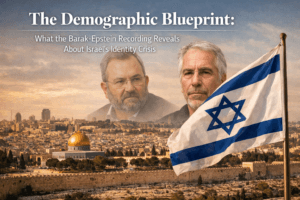
The Demographic Blueprint: What the Barak-Epstein Recording Reveals About Israel’s Identity Crisis
The recent release of Jeffrey Epstein files has offered more than salacious details of a convicted sex offender’s network. One secret recording features former Israeli Prime Minister Ehud Barak revealing, with startling candor, a sophisticated vision for demographic engineering designed to preserve Israel’s Jewish character. In a conversation with Epstein and former U.S. Treasury Secretary Larry Summers, Barak detailed lobbying Russian President Vladimir Putin for “one more million” Russian immigrants to “change Israel in a dramatic manner” while expressing hierarchical views on which minority groups deserve equality within Israeli society. This revelation opens a window into the often-unspoken calculations that have shaped Israel’s demographic policies for decades.
Barak’s Demographic Blueprint: A Calculated Hierarchy
The audio recording captures a striking political calculation. Barak, Israel’s prime minister from 1999 to 2001 and former military chief, presents immigration not merely as a humanitarian project but as a strategic tool. His specific focus on Russian immigrants is telling. He suggests they could be absorbed “without conversion being made a precondition” and that “under the social pressure… to adapt. It will happen. And we can control the quality”.
These comments reveal a preference for immigrants who are culturally European and can be integrated in ways that serve a particular vision of the state. Barak’s remarks extend beyond immigration strategy to outline a tiered system of citizenship within Israel’s existing population:
- First to the Druze: “They are about one percent, they are totally Israelis in their behaviour,” citing their mandatory military service.
- Then the Christian minority: “They’re about another two percent. They… have an education system which is better than ours”.
- Palestinian Muslims (Arab citizens of Israel): Conspicuously absent from this list of groups deserving accelerated equality, despite comprising approximately 17-20% of Israel’s population.
This hierarchy is not merely personal opinion but reflects deep-seated institutional realities. As legal analyses show, Israel distinguishes between citizenship and nationality, with many rights stemming from Jewish nationality rather than Israeli citizenship.
Barak’s View on Mizrahi and Sephardic Jews
Perhaps equally revealing are Barak’s comments about Israel’s founders taking Jews from “North Africa, from the Arabs, from whatever”. He contrasts this with the present, stating, “Now we can be selective”. This reflects what scholars have long documented: a history in which Israel’s Ashkenazi (European Jewish) leadership often looked down upon Jews from Arab and Muslim countries (Mizrahi and Sephardic Jews), treating them as culturally inferior.
Table: Tiered Vision of Equality According to Barak’s Recording
| Population Group | Approx. % of Israeli Pop. | Barak’s Characterization | Implied Status in Hierarchy |
| Jewish Citizens | ~73% | Primary demographic to be fortified | Core of state identity |
| Druze Citizens | ~1% | “Totally Israelis in their behaviour” | Deserving of first equality |
| Christian Arab Citizens | ~2% | Praised education system | Secondary for equality |
| Muslim Arab Citizens | ~17-20% | Not mentioned for equality; noted as growing demographic concern | Outside stated equality framework |
Historical Roots: Demography as Destiny in Zionist Thought
Barak’s comments are not an anomaly but a continuation of a central pillar of Zionist and Israeli statecraft. The concern with establishing and maintaining a Jewish majority has been a driving force since before the state’s founding. This has manifested in two primary ways:
- Encouraging Jewish Immigration (Aliyah): Israel’s Law of Return (1950) grants any Jew the right to immigrate and receive citizenship, a powerful legal mechanism for demographic growth.
- Controlling the Non-Jewish Population: This includes the prevention of Palestinian refugee return after 1948, the imposition of military rule over Palestinian citizens until 1966, and ongoing policies of land confiscation and restrictive planning that hem in Palestinian towns.
The mass immigration of Jews from Arab and Muslim countries in the mid-20th century—nearly 900,000 people between 1948 and the early 1970s—was seen as crucial to this demographic mission. Barak’s blunt assessment that these immigrants were taken out of necessity, and that Israel can now afford to be “selective,” highlights how this history is viewed through a purely instrumental lens by some in the establishment.
The System Today: Legalized Inequality
The hierarchy Barak describes is embedded in Israel’s legal and political architecture. Over 60 Israeli laws directly or indirectly discriminate against Palestinian citizens based solely on ethnicity. Key examples include:
- The Nation-State Law (2018): A quasi-constitutional Basic Law that establishes the right to national self-determination as “unique to the Jewish people” and prioritizes Jewish settlement as a national value.
- The Admissions Committees Law: Allows hundreds of small, predominantly Jewish communities to reject applicants for residency based on vague “social suitability,” effectively barring Palestinian citizens.
- Land Allocation: Approximately 80% of Israel’s land is off-limits or extremely difficult for Palestinian citizens to lease or purchase, controlled by state authorities and the Jewish National Fund, which has a mandate to lease land only to Jews.
This systemic discrimination creates tangible disparities. Nearly half of all Palestinian citizens of Israel live in poverty, they have less access to state funding for education and municipal services, and tens of thousands of their homes face demolition orders because building permits are systematically denied.
The Russian Immigration Strategy and Its Mixed Legacy
Barak’s specific focus on Russian immigrants refers to a very real and transformative chapter in Israeli history. Following the collapse of the Soviet Union, roughly one million immigrants arrived in Israel during the 1990s. This wave was celebrated for boosting Israel’s scientific, cultural, and military sectors. However, Barak’s recording hints at a less-discussed aspect: a significant portion were not Jewish according to Orthodox religious law (Halakha), with less than half considered Jewish or Jews by the early 2000s.
Barak saw this not as a problem, but as an opportunity to “break the monopoly of the orthodox rabbinate on marriage and funerals and whatever, and the definition of a Jew”. He envisioned a form of mass, streamlined conversion that would incorporate these immigrants into the Jewish national fabric while diluting the power of religious authorities—a clear example of using demography to engineer both population numbers and domestic political structures.
A State at a Demographic Crossroads
Barak’s conversation, though from 2015, speaks to anxieties that remain potent today. Israel recently passed the symbolic threshold of 10 million inhabitants, with Jews constituting about 77% of citizens within its pre-1967 borders. However, when considering the total population under Israeli control from the Jordan River to the Mediterranean Sea—including occupied Palestinian territories—the numbers tell a different story. In this area, Jews and non-Jews are approaching numerical parity, a reality that challenges the vision of a democratic state with a stable Jewish majority.
Recent events have intensified these demographic calculations. The war that began in October 2023 led to an unusual negative migration balance in 2024, with more people leaving Israel than moving to it—a phenomenon previously seen only during deep economic crises. This underscores how security and stability are prerequisites for the demographic engineering Barak advocated.
The Epstein files recording of Ehud Barak provides a rare, unfiltered look at the demographic calculus that has long underpinned Israeli policy. It reveals a vision where people are viewed as strategic assets or challenges, where equality is tiered along ethnic and religious lines, and where the state’s character is something to be actively engineered rather than organically developed. This recording does not expose a secret conspiracy, but rather the unvarnished logic of maintaining an ethnocratic state in a contested land. As Israel continues to grapple with its identity, security, and democracy, these demographic imperatives—now laid bare in a convicted pedophile’s Manhattan townhouse—will remain at the very heart of its political struggles.
You must be logged in to post a comment.