
The Delhi Tightrope: Inside Carney’s Diplomatic Gambit to Reset Canada-India Relations
Prime Minister Mark Carney’s recent diplomatic mission to India represented a high-stakes attempt to reset a relationship fractured by allegations of state-sanctioned murder and foreign interference, forcing him to walk a precarious line between pursuing economic gains—such as a $2.6-billion uranium deal—and addressing Canadian concerns over the 2023 killing of Hardeep Singh Nijjar. While Carney characterized his talks with Narendra Modi as “frank” and insisted on vigilance against foreign meddling, he strategically avoided commenting on specific allegations to protect an ongoing criminal trial, a balancing act complicated by his own government’s premature claim that Indian interference had ceased—a statement Carney was forced to disavow. Ultimately, his pragmatic, future-focused approach prioritizes de-escalation and trade diversification, but leaves the deep wounds of trust within the Sikh Canadian community unhealed and the potential for future diplomatic ruptures very much alive.
The Delhi Tightrope: Inside Carney’s Diplomatic Gambit to Reset Canada-India Relations
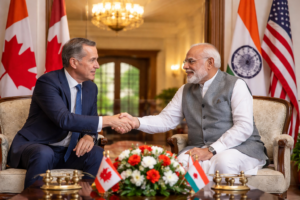
The photograph is designed to project statesmanship and economic promise. Prime Minister Mark Carney, in a crisp business suit, sits across from Indian Prime Minister Narendra Modi in New Delhi. The backdrop is the opulent Hyderabad House, a venue typically reserved for the highest level of diplomatic engagement. On the surface, it’s a picture of a new beginning—a trade mission personified.
But beneath the handshake and the smiles, the ghosts of a diplomatic war linger in the room.
When Mark Carney touched down in India late last month for his first major overseas trip as Prime Minister, he wasn’t just carrying a briefcase full of trade proposals for a $2.6-billion uranium deal. He was carrying the weight of a relationship shattered by allegations of murder, foreign interference, and a diplomatic expulsions crisis that had frozen communications for nearly three years. His mission was not merely to sell Canadian resources, but to perform a high-stakes act of diplomatic tightrope walking.
The question hovering over every moment of his visit was simple yet profound: How do you reset a relationship with a partner you have publicly accused of being a state sponsor of violence on your own soil?
A “Frank” Talk in a Fragile Context
Speaking to reporters in Sydney, Australia, following the conclusion of his India visit, Carney offered a glimpse into the nature of his conversations with the Indian leader. He described them as “frank discussions.” In the carefully calibrated lexicon of diplomacy, “frank” is a powerful word. It is code for a conversation that is direct, honest, and likely uncomfortable—where pleasantries are set aside to address the elephant in the room.
Carney confirmed he raised Canadian concerns about foreign interference. However, in a move that reveals the extreme sensitivity of the current climate, he declined to specify whether that included the alleged role of Indian government agents in the June 2023 slaying of Hardeep Singh Nijjar on Canadian soil.
This is the core of the Carney conundrum. To ignore the Nijjar killing would be to betray the trust of the Canadian intelligence community and the Sikh diaspora, who have been living in fear. To harp on it would be to slam the door shut on the very economic opportunities he travelled thousands of miles to open.
Carney’s strategy, it appears, is to separate the justice track from the diplomatic track—at least publicly. He invoked the sanctity of the ongoing criminal proceedings in B.C. Supreme Court, where four Indian nationals await trial. “My job at this point with respect to that process is to make sure that I do not say anything that prejudices the prospect of justice being served,” he stated, providing a legal shield for his diplomatic silence.
The Ghosts of the Past: Why Trust is the Real Issue
To understand the tightrope Carney is walking, one must understand the depth of the chasm left by his predecessor, Justin Trudeau.
In September 2023, Trudeau dropped a political bombshell in the House of Commons, announcing that Canadian intelligence agencies had “credible allegations” linking “agents of the government of India” to the murder of Hardeep Singh Nijjar, a Canadian citizen and vocal advocate for a Sikh homeland.
The reaction from New Delhi was swift and furious. India dismissed the claims as “absurd” and politically motivated, designed to pander to a voting bloc in Canada. The diplomatic fallout was immediate and brutal: India suspended visa services for Canadians, demanded a drawdown of Canadian diplomats, and expelled senior Canadian envoys. For nearly 2.5 years, the relationship was effectively in a deep freeze.
The allegations were not just political rhetoric. Investigative reporting, including work by The Globe and Mail, has since painted a damning picture of intelligence failures and alleged state-sponsored activities. Reports emerged suggesting that Indian consular staff in Vancouver—individuals ostensibly in Canada to issue visas and assist citizens—had allegedly gathered intelligence on Nijjar from the diaspora in Surrey, B.C., information that reportedly aided those who would later assassinate him.
For the Sikh community in Canada, the largest outside of Punjab, these are not abstract geopolitical chess moves. They are lived realities. Balpreet Singh, legal counsel for the World Sikh Organization (WSO), didn’t mince words in his assessment of the current situation, directly contradicting any notion that the threat has subsided. “We are seeing individuals being harassed by Indian officials and families being intimidated. I can say with complete conviction that the claim by the government official is utterly false,” he said.
This is the human element that no trade deal can paper over. When Carney sat down with Modi, he wasn’t just facing a diplomatic adversary; he was facing the profound fear and anger of hundreds of thousands of his own citizens.
The Unforced Error: A Background Briefing Backfires
If Carney’s strategy was to quietly rebuild bridges while acknowledging past wrongs, the plan was almost immediately undermined by his own government.
Just days before Carney landed in New Delhi, a senior Canadian official held a background briefing with journalists. The message was astonishing in its absoluteness. The official asserted that Ottawa now believes India is no longer conducting foreign interference or transnational repression in Canada. The logic was circular: Carney wouldn’t be going if they were still meddling.
The statement was a gift to the Indian government, suggesting that Canada was willing to turn the page entirely. But it was a disaster at home.
National security experts immediately pushed back, calling the claim implausible. Intelligence gathering and influence operations are not light switches that can be turned off at the border; they are persistent features of international relations. The comment also deeply undercut the Sikh community, gaslighting their lived experiences of intimidation.
Carney, visibly irritated by the unforced error, was forced to clean up the mess from halfway around the world. “I would not use those words,” he said firmly in Sydney, distancing himself from the official’s comments. While he stopped short of saying India was still actively interfering, his refusal to endorse the “all clear” signal was a deliberate attempt to re-establish credibility with Canadian stakeholders who felt betrayed by the initial leak.
The Geopolitical Chessboard: Why This Reset Matters
So why go? Why invest so much political capital in a relationship so fraught with peril? The answer lies in the shifting tectonic plates of the global economy and security.
For Canada, the relationship with India is no longer just about curry and caucuses; it is about counterbalancing China. As Ottawa seeks to diversify trade away from an increasingly protectionist United States, the Indo-Pacific region is the obvious target. India, with its 1.4 billion people and booming economy, is a critical piece of that puzzle.
Carney returned from Delhi with tangible wins to tout. He secured a $2.6-billion uranium supply deal, ensuring Canadian resources fuel India’s clean energy transition. He launched talks for a potential Comprehensive Economic Partnership Agreement (CEPA). For a Prime Minister who brands himself as a skilled economist and crisis manager, these are the metrics of success.
However, the trip also highlighted the transactional nature of the new relationship. While Canada needs markets, India needs technology, capital, and resources. More importantly, India needs Canada to stop being a perceived headache. For Modi’s government, the Khalistan movement is an existential red line. They view Canada’s tolerance for peaceful advocacy of Sikh sovereignty as direct interference in their internal affairs.
Carney’s visit suggests a new modus operandi: de-escalation. By keeping his public comments on the Nijjar case vague and focusing on the future, he is signaling to Modi that while Canada won’t drop the criminal case, the era of public shaming from the Prime Minister’s Office is over.
The Unanswered Questions and the Path Forward
As Carney flies from Sydney to Japan, the final leg of his first international tour, he leaves behind a relationship that has been technically reset but not yet healed. The path forward remains littered with unresolved tensions.
The core issue of trust remains unaddressed. How can Canada conduct intelligence-sharing with a nation it believes ran a covert campaign on its soil? How can Indian diplomats operate in Canada without the shadow of surveillance and suspicion?
Furthermore, the criminal trial of the four men accused of killing Nijjar looms on the horizon. As evidence is presented in open court in British Columbia, the potential for new, embarrassing revelations that could re-ignite the diplomatic firestorm is high. Carney’s “justice will take its course” strategy may hold for now, but it offers no protection against future headlines.
Perhaps the most significant shift Carney has introduced is a tonal one. Where Trudeau’s approach was moralistic and public, Carney’s is pragmatic and private. He is betting that a stable, if cool, relationship is preferable to a hot war of words. He is betting that economic interdependence can create a buffer strong enough to absorb future shocks.
But for the families in Surrey who attend temple under the watchful eye of security cameras, and for the community leaders who still receive threatening phone calls, the reset feels distant. They are watching Carney’s tightrope act not with relief, but with a wary eye, hoping that in his quest for trade deals and diplomatic stability, the Prime Minister does not forget the Canadian lives caught in the geopolitical crossfire.
The photograph from Hyderabad House captured a moment of diplomacy. But the full picture—the one that includes justice, sovereignty, and the safety of citizens—remains very much out of frame.
You must be logged in to post a comment.