
The Delhi-Jerusalem-Washington Triangle: Decoding India’s Balancing Act in a Multipolar World
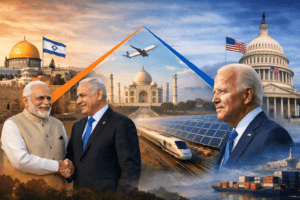
The interconnected news stories from February 25, 2026, collectively illustrate India’s complex navigation of a multipolar world, where Prime Minister Modi’s visit to Israel aims to deepen a strategic partnership beyond mere defence ties into co-development and technology sharing, all while maintaining relationships with Arab nations. Simultaneously, India’s domestic ambitions are showcased through massive airport capacity expansion projects designed to fuel economic growth, even as the nation confronts the harsh realities of global trade protectionism, exemplified by the 126% U.S. tariff on Indian solar imports. Together, these developments reveal India’s delicate balancing act: leveraging strategic diplomacy to secure technological advantages, investing heavily in domestic infrastructure to drive internal growth, and building economic resilience to withstand external shocks in an increasingly fragmented global order.
The Delhi-Jerusalem-Washington Triangle: Decoding India’s Balancing Act in a Multipolar World
By [Your Name/Publication] Date: February 26, 2026
On a single day, February 25, 2026, three seemingly disparate news stories emerged from the wires, painting a vivid and complex portrait of India’s current geopolitical and economic reality. Prime Minister Narendra Modi departed for a high-stakes visit to Israel, aiming to deepen a “robust strategic partnership.” A ratings agency projected a massive expansion of India’s airport capacity, signaling unabated domestic growth ambitions. And in a stark reminder of the headwinds facing that growth, the United States slapped a preliminary duty of nearly 126% on Indian solar imports.
These are not isolated events. They are the interlocking pieces of a grand chessboard where India is striving to assert itself as a leading power. It is a story of strategic realignment, infrastructural ambition, and the inevitable friction of global trade. To understand where India is headed, one must look at these three narratives not as separate headlines, but as a single, compelling story of a nation navigating its way through a fragmented world.
Part I: The Strategic Pivot – More Than Just a Photo-Op in Jerusalem
When Prime Minister Modi lands in Israel for his second state visit, the images will be familiar: warm handshakes with Prime Minister Benjamin Netanyahu, a call on President Isaac Herzog, and the historic address to the Knesset. But beneath the diplomatic protocol lies a relationship that has quietly transformed from a back-channel camaraderie into a front-page alliance.
The summary of the talks—covering science and technology, agriculture, water management, and defence—only hints at the depth of the engagement. For decades, India’s policy in West Asia was viewed primarily through the lens of its energy dependence on Gulf nations and its large, valuable diaspora there. Relations with Israel were conducted almost furtively, a legacy of Cold War politics and domestic considerations.
That era is decisively over. This visit signifies the maturation of a partnership that is no longer apologetic but is instead proudly pragmatic.
The Defence Dimension: Beyond Buyer-Seller Dynamics
The most significant, yet often understated, pillar of this relationship is defence and security. For years, Israel was content to be a reliable “supplier” of military hardware to India, stepping in when Western powers imposed sanctions or hesitated. From Phalcon AWACS radar systems to Spike anti-tank missiles and Barak-8 surface-to-air missiles (co-developed with the Defence Research and Development Organisation, DRDO), Israeli technology has become a critical component of India’s military modernization.
However, the relationship is evolving. The conversation is no longer just about procurement; it is about co-development and co-production. Aligned with India’s “Make in India” and “Atmanirbhar Bharat” (Self-Reliant India) initiatives, the focus is shifting to joint research, development, and manufacturing. This transforms India from a customer into a partner, creating a high-tech industrial base that benefits both economies. The discussions on “defence and security” in this visit are likely to delve deeper into this paradigm, exploring how Israeli innovation can be married with Indian manufacturing scale and market access.
The Tech and Water Nexus: Solving 21st-Century Problems
Beyond missiles and drones, the partnership is a laboratory for solving some of India’s most pressing domestic challenges. The emphasis on “innovation” and “water management” is not diplomatic fluff. Israel, a country born in a desert, has become a world leader in water conservation, drip irrigation, and desalination. For a water-stressed India, where farmers struggle and cities grapple with shortages, Israeli agri-tech and water-tech are not luxuries; they are necessities.
The visit will likely see announcements of new partnerships in this sector, scaling up successful pilot projects in “Centers of Excellence” across India. This is where the “people-to-people” ties, which Modi mentioned, become tangible. It’s about an Israeli agricultural expert teaching a farmer in Gujarat how to grow a better crop with less water. It is a partnership that has a direct impact on human lives, making the strategic relationship resilient to political winds.
Addressing the Knesset: A Message to the World
Modi’s address to the Israeli Parliament is a symbolic masterstroke. As the first Indian Prime Minister to do so, he is not just speaking to Israel; he is speaking to the world, particularly the powerful Jewish diaspora in the West. The message is clear: India is a reliable, long-term partner that does not view its relationships through a zero-sum lens.
This is the crucial nuance. India’s deepening ties with Israel are not at the expense of its traditional relationship with Arab nations. In fact, New Delhi has skillfully maintained and even elevated its strategic partnerships with the UAE and Saudi Arabia, focusing on trade, investment, and energy. This multi-alignment strategy, often called “de-hyphenation,” allows India to engage with all parties in a complex region based on mutual interest, free from the constraints of the past. This visit is a powerful reaffirmation of that capability.
Part II: The Domestic Engine – Building the Runways for Growth
While the Prime Minister engages in high diplomacy, the news from Crisil Ratings back home serves as a grounding counterpoint. India’s domestic story is one of sheer physical expansion. The projection that new airports will add nearly 40 million passengers in annual capacity by the end of the fiscal year is a testament to the country’s unrelenting demand for mobility and connectivity.
The report’s details offer a fascinating glimpse into India’s urban future. The story of Mumbai and Delhi’s older airports running at 87% capacity is a metaphor for India’s broader infrastructural challenge: existing systems are bursting at the seams. The solution—alternate airports like the Navi Mumbai International Airport (which began operations in December 2025) and the Noida International Airport in Jewar—represents a bold, forward-thinking approach to urban planning.
The Challenge of Seamless Connectivity
However, the report wisely cautions that building the airport is only half the battle. The real test lies in the “timely ramp-up” of supporting infrastructure. A gleaming new terminal is useless if passengers cannot reach it due to inadequate roads or metro links. The mention of “competitive intensity” and the risk of traffic falling short of expectations is a sobering reminder that infrastructure projects exist within an ecosystem.
For the common citizen, this expansion means more than just statistics. It represents the hope of cheaper airfares (as competition increases), reduced congestion at older airports, and better connectivity to smaller cities. For businesses, it means faster movement of goods and people, fueling the very economic activity that drives the 8-9% CAGR in passenger traffic that Crisil projects.
The mention of the Air India crash, “Operation Sindoor” airbase closures, and IndiGo’s disruptions as causes for muted growth this fiscal year is a stark reminder of how fragile this ecosystem can be. A single geopolitical event or operational failure can ripple through the entire system, highlighting the need for robust risk management and redundancy—which is precisely what these new airports aim to provide.
Part III: The Protectionist Wall – The 126% Reality Check
If the Israel visit represents the opportunities of global engagement and the airport expansion represents domestic ambition, the third story—the 126% U.S. duty on Indian solar imports—represents the stark challenges of the global trading system.
The news, which sent shockwaves through the Indian stock market (evident in Waaree Energies’ 10% drop), is a classic case of green protectionism. The U.S., under pressure to build its own domestic solar manufacturing capacity, is using trade remedies to shield its industry. For India, which has built a formidable solar module manufacturing industry, this is a major blow.
The Irony of the Energy Transition
There is a deep irony here. Both India and the U.S. are committed to ambitious climate goals and the energy transition. Solar power is central to that transition. Logic would dictate that the free flow of affordable solar panels is in the global interest. Instead, we see a trade war.
For Indian manufacturers, who invested heavily in capacity to meet global demand, particularly from the U.S., this duty is a significant setback. It forces them to look for alternative markets, potentially in Africa or Southeast Asia, or to challenge the duty through legal channels. It also reinforces the strategic thinking behind “Atmanirbhar Bharat.” If Western markets can turn protectionist on a whim, India must build resilience by deepening its own domestic market and fostering demand at home.
A New Era of “Hard” Globalisation
This solar dispute is a microcosm of the new world order. The era of hyper-globalisation, where goods flowed freely based purely on comparative advantage, is over. We have entered an era of “hard” globalisation, where trade is increasingly weaponized and intertwined with national security and industrial policy. The U.S. CHIPS Act and the Inflation Reduction Act are prime examples of this trend—massive subsidies designed to lure manufacturing back to American shores.
For India, navigating this new reality requires a delicate touch. It must aggressively pursue trade agreements and strategic partnerships (like the one with Israel) to create dedicated, reliable supply chains. Simultaneously, it must continue to build its domestic industrial base so that when external shocks like this solar duty occur, the economy is resilient enough to withstand them.
Conclusion: The Tightrope Walk of a Rising Power
Taken together, these three stories from February 25, 2026, tell us that India is walking a tightrope with remarkable agility.
In one hand, it holds the promise of strategic autonomy, deepening ties with a major technology partner like Israel while maintaining its crucial relationships elsewhere. This is the art of diplomacy in a multipolar world.
Under its feet lies the bedrock of domestic growth, represented by sprawling new airports and a burgeoning middle class eager to fly. This is the engine of its national power.
And in its path stand the barriers of a fragmented global economy, where yesterday’s trading partner can become today’s competitor with the stroke of a pen. This is the challenge it must overcome.
The common thread weaving through all three is the pursuit of national interest. The visit to Israel is about securing technology and strategic depth. The airport expansion is about facilitating economic growth and mobility. The response to the U.S. solar tariff will be about protecting domestic industry and jobs.
India’s journey in the 21st century will not be a straight line. It will be a series of calculated maneuvers, balancing competing interests, leveraging old friendships to build new ones, and constantly reinforcing its domestic foundations. The news of February 25th was not just a collection of headlines; it was a snapshot of a nation in motion, defining its place in a world that is as full of opportunity as it is of peril. The real story is not any single event, but the masterful, high-wire act of managing them all at once.
You must be logged in to post a comment.