
The Delhi Declaration: Can India Forge a New Path for AI at the Crossroads of the Global South?
The article analyzes the 2026 India AI Impact Summit in New Delhi as a pivotal moment where India is leveraging its successful digital public infrastructure model to position itself as a bridge between the Global South and the tech giants of wealthy nations, aiming to shift the global AI conversation from a narrow focus on existential safety to a broader vision of inclusive, developmental deployment. Amidst the presence of world leaders and Silicon Valley CEOs, the summit highlights a central tension between the need for innovation and the push for regulation, while also underscoring the profound challenges of managing AI’s systemic risks, reshaping a massive workforce, and translating lofty declarations like the proposed “New Delhi Declaration” into a tangible reality that serves the billions in the developing world.
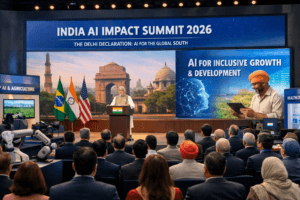
The Delhi Declaration: Can India Forge a New Path for AI at the Crossroads of the Global South?
The winter smog that often blankets New Delhi in February has, for the next five days, a different kind of haze hanging over it—a fog of ambition, anxiety, and anticipation. The Indian capital is playing host to the 2026 India AI Impact Summit, a gathering that, on paper, brings together 20 heads of state, the C-suite elite of Silicon Valley, and thousands of delegates. But beneath the surface of bilateral meetings and keynote speeches lies a more profound question: Can the Global South claim its seat at the table where the future is being built?
This isn’t just another tech conference. It’s a pivotal moment in the rapidly evolving story of artificial intelligence, a story that has so far been written primarily in the boardrooms of San Francisco, the research labs of London, and the regulatory halls of Brussels and Beijing. The summit’s move to New Delhi—following previous editions in France, the UK, and South Korea—signals a deliberate and significant geographic and philosophical shift.
From Safety Warnings to a Jamboree of Possibility
To understand why this summit matters, one must first understand how far these gatherings have come. The inaugural global AI summit, held at Bletchley Park in the UK in late 2023, was a somber affair. Held on the hallowed ground where Alan Turing cracked the Enigma code, the atmosphere was one of existential dread. The focus was narrow and profound: the “frontier” risks of highly advanced AI—the kind that could, theoretically, be used to design bioweapons or escape human control. It was a meeting of cautious scientists and wary politicians, a necessary conversation about the doomsday scenarios.
Fast forward to 2026, and the tone has shifted dramatically. While safety remains a critical undercurrent, the summit has evolved into what the original AP report accurately describes as an “all-purpose jamboree trade fair.” The conversation has broadened from “How do we stop AI from destroying us?” to “How do we build it, deploy it, pay for it, and ensure it doesn’t leave most of the world behind?”
This evolution is a testament to the technology’s relentless, breathtaking pace. ChatGPT, launched just over three years ago, is no longer a novelty but a utility. Generative AI is now embedded in our search engines, our office software, our creative tools, and, increasingly, the critical infrastructure of nations. The summit’s transformation reflects a global realization: AI is not a future shock to be prepared for, but a present reality to be managed and leveraged.
India’s High-Stakes Pitch: The “Digital Public Infrastructure” Model
For India, the summit is a coming-out party of sorts. The nation of 1.4 billion people has long been the back office of the world—a hub for outsourcing and IT services. But Prime Minister Narendra Modi’s government is aggressively pushing a new narrative: India as a front-office leader in the digital economy.
The central plank of India’s pitch is its world-leading experiment with Digital Public Infrastructure (DPI) . Over the last decade, India has built and scaled a trio of interconnected platforms: Aadhaar (a biometric digital identity), UPI (Unified Payments Interface, a real-time payment system), and DigiLocker (a platform for digital documents). Together, they have created a foundational layer that allows any Indian citizen, even those in remote villages with a basic smartphone, to participate in the formal economy.
India’s argument to the world, and especially to the Global South, is that AI can be deployed in a similar fashion. “The goal is clear: AI should be used for shaping humanity, inclusive growth and a sustainable future,” India’s IT Minister Ashwini Vaishnaw stated, encapsulating this vision.
The logic is compelling. Instead of AI being a tool that only large corporations can afford to build and deploy, India envisions a future where the government provides “AI as a service” for the public good. Imagine an AI-powered assistant, integrated with Aadhaar and UPI, that can help a farmer in Maharashtra check soil health via a phone camera, apply for a loan, and get real-time weather forecasts in Marathi. Imagine an AI that can help a nurse in a rural clinic in Bihar diagnose early signs of diabetic retinopathy from a retinal scan. Imagine a system that can personalize education for millions of children in their mother tongue, grading homework and identifying learning gaps in real-time.
This is the “India Stack” model applied to AI. It’s a vision that is both ambitious and deeply pragmatic, aiming to leapfrog development stages by using AI to massively scale the delivery of public services at a fraction of the traditional cost.
The Titans and the Tension: Regulation vs. Innovation
The presence of tech royalty—Google’s Sundar Pichai, OpenAI’s Sam Altman, Microsoft’s Brad Smith, and Qualcomm’s Cristiano Amon—is a testament to the market’s importance. They are not in New Delhi just for the cultural experience; they are there to navigate one of the world’s largest and fastest-growing digital markets.
But their presence also introduces a central tension that will define the summit’s outcome. Last year’s Paris summit was dominated by a speech from U.S. Vice President JD Vance, who issued a stark warning to Europe against what he called “excessive regulation” that could cripple the industry. This transatlantic philosophical divide—the U.S.’s pro-innovation, “move fast and break things” ethos versus Europe’s precautionary, rights-based regulatory approach—now has a third, powerful voice: the Global South, represented by India and attended by leaders like Brazil’s Lula da Silva.
India, for its part, is trying to walk a middle path. It wants to attract the investment and innovation of the tech giants while also safeguarding its own strategic interests and ensuring the technology serves its developmental goals. The presence of executives from companies like ReNew, a clean energy firm, highlights another dimension. For Indian industry, AI isn’t just about chatbots; it’s about optimizing energy grids, making manufacturing more efficient, and solving hard infrastructure problems.
This balancing act will be on full display during the closed-door sessions. Can India bridge the gap between the U.S.’s laissez-faire attitude and Europe’s desire for hard regulation? Or will it forge a third way, one that prioritizes societal-scale applications over both corporate profits and individual rights?
The “Godfathers” and the Ghost at the Feast
While the trade show floor buzzes with demos of the latest AI tools, a more sober conversation is happening on the sidelines. A panel of experts, led by Yoshua Bengio—one of the famed “Godfathers of AI”—has just released its second annual report on AI safety. Bengio’s presence is a crucial reminder of the “ghost at the feast.”
“The whole point of this report is to build an international consensus on the state of the science regarding the emerging risks of AI,” Bengio told the AP. His warning is a necessary counterweight to the summit’s boosterism. He speaks of “systemic risks”—the potential for AI models to be misused, to malfunction in unpredictable ways, or to create feedback loops that destabilize financial markets or spread misinformation faster than ever before.
This scientific perspective is vital for the Global South. The harms of a malfunctioning AI system are not distributed equally. A biased algorithm used for loan applications in a developed economy might mean a denied credit card; in a developing economy, it could mean the difference between a farmer getting a life-saving loan or being pushed into destitution. A deepfake video targeting a politician in the West is a scandal; in a fragile democracy, it could incite communal violence. For India and its fellow Global South nations, the safety conversation isn’t just about existential future risks; it’s about present-day, real-world harms that could derail development and deepen inequality.
The Human Element: Anxious Students and an Evolving Workforce
Beyond the rarefied air of summit venues and five-star hotels, the impact of AI is being felt in more quotidian ways. For 22-year-old Anirudh Singh, a social work student at Delhi University, AI is a pragmatic tool. “I think AI is just reducing the tedious work that students generally had to do,” he said, speaking to the AP. For him, AI is a research assistant that helps him prepare internship projects faster, freeing him up to focus on the human interactions that are the core of his field.
But for every student like Anirudh, there are millions of young Indians looking at the rapid advancements with a mix of fascination and fear. India produces a massive number of STEM graduates every year, and the country’s massive outsourcing and IT services industry has been built on a foundation of specific, codifiable skills. AI threatens to automate many of those very tasks—code debugging, basic content creation, data processing.
Sangeeta Gupta of Nasscom, the industry body, acknowledges the “genuine concern.” The emphasis, she argues, must be on massive, agile “re-skilling programs.” This is the human-scale challenge that the summit’s lofty declarations must ultimately address. It’s not just about building world-class AI models; it’s about building a world-class workforce that can work with those models. The new job roles she mentions—AI auditors, prompt engineers, AI ethics compliance officers—are not yet common in India. Building the educational infrastructure to create them is a task as monumental as building the digital infrastructure itself.
The New Delhi Declaration: A Blueprint or a Wish List?
As the five-day summit draws to a close, the attendees are expected to adopt the “New Delhi Declaration.” Like its predecessors, this will likely be a non-binding pledge, a statement of shared principles rather than a legally enforceable treaty. The art of these summits is in finding consensus language that satisfies the U.S.’s desire for unfettered growth, Europe’s push for safeguards, and the Global South’s demand for access, equity, and development.
The true test of the India AI Impact Summit will not be the document it produces, but the direction it sets. Will it succeed in shifting the center of gravity of the AI revolution? Can it translate the idea of AI for the Global South from a philanthropic talking point into a viable economic and social model?
For the leaders and CEOs flying out of New Delhi, the summit will be one of many meetings. But for the 1.4 billion people of India, and the billions more in the Global South watching closely, the hope is that this gathering marks the moment their needs, their challenges, and their potential finally became a central part of the world’s most important conversation. The infrastructure is being built, the talent is there, and the ambition is clear. Now, the world is watching to see if the promise of the Delhi Declaration can be transformed into a reality as profound and impactful as the technology itself.
You must be logged in to post a comment.