
The Death of a Thousand Paper Cuts: How Israel’s New Land Laws Are Redrawing the West Bank
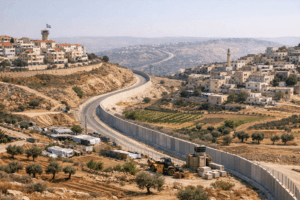
The Death of a Thousand Paper Cuts: How Israel’s New Land Laws Are Redrawing the West Bank
For decades, the battle for the West Bank was fought with tanks, tear gas, and stones. Today, it is increasingly being fought with zoning permits, land registries, and property deeds.
Hebron, Occupied West Bank – Just south of the Ibrahimi Mosque, where the limestone walls bear the scars of bullets and time, a new kind of weapon is being quietly unholstered. It isn’t made of steel or gunpowder. It is made of ink and legal jargon.
Last week, Israeli Finance Minister Bezalel Smotrich stood before cameras and announced a series of administrative adjustments to how land is bought, sold, and governed in the occupied West Bank. To the casual observer, the changes sounded technical—boring, even. They involved declassifying land registry records, cancelling transaction permits, and shifting oversight committees.
But to the Palestinian shopkeeper shuttering his stall in the Old City of Hebron, and to the Israeli settler praying at the Tomb of the Patriarchs just metres away, these “technical adjustments” represent a paradigm shift. They are, as Palestinian President Mahmoud Abbas stated, an “open Israeli attempt to legalise settlement expansion.”
This is not the thunderclap of a formal declaration of sovereignty. It is the slow drip of a faucet left running, wearing away the stone of international law until nothing is left but a puddle of broken promises.
The Bureaucratic Architecture of Annexation
To understand why the world is reacting with such alarm—why the UK, Egypt, Saudi Arabia, and even the White House have felt compelled to issue statements—one must look past the headlines and into the fine print of the security cabinet’s decisions.
The most seismic shift is the cancellation of the decades-old prohibition on the direct sale of West Bank land to private Jewish individuals. For nearly 50 years, a military order has effectively barred Israelis from walking into a Palestinian town and buying a plot of land directly. Instead, settlers acquired housing through state-controlled companies or via the Civil Administration. This new rule tears up that playbook.
Smotrich’s framing is messianic; he described the move as facilitating “land redemption.” The Israeli foreign ministry, adopting a more secular tone, called it a correction of a “racist distortion” that discriminated against non-Arab buyers.
Yet, on the Palestinian side, the fear is visceral. In a society where land is not merely an economic asset but the repository of identity—where the deed to a great-grandfather’s olive grove is more valuable than gold—the spectre of aggressive purchasing agents backed by the full weight of the state is terrifying.
Simultaneously, the cabinet has scrapped the requirement for transaction permits. Initially designed to prevent fraud and money laundering in a volatile real estate market, this oversight mechanism acted as a speed bump. Removing it clears the highway for rapid acquisitions, often facilitated by middlemen who operate in the grey economy of forgery and coercion.
“Historically, we have seen that when you remove oversight, you don’t remove fraud; you legitimize it,” said a legal analyst from the Israeli anti-occupation group Peace Now. “This is not transparency; this is carpetbagging.”
Hebron: The Epicentre of the New Strategy
Nowhere are these changes more combustible than in Hebron. The city is a ghost-zoned labyrinth of empty Palestinian markets and reinforced settler compounds. Here, 500 metres from the Cave of the Patriarchs, the new measures transfer sole building licensing authority to Israeli bodies.
Previously, there existed a fragile, dysfunctional administrative patchwork. Now, Smotrich and Defence Minister Israel Katz have ensured that any nail hammered, any stone laid, and any security camera mounted in sensitive zones around this holy site will be approved exclusively by pro-settler authorities.
This effectively allows Israel to reshape the demographic and physical landscape of one of the world’s most contested religious heritage sites. The move goes beyond settlement expansion; it is an assertion of sovereign custodianship over a site sacred to 2.4 billion Christians and Muslims and 15 million Jews.
The Human Ledger: Who Pays the Price?
Behind the geopolitics are human ledgers—balance sheets of loss that will never be recorded in a cabinet protocol.
In the village of Shuqba, near the new outpost visible from the main road, a 67-year-old farmer named Imad recently discovered that a parcel of his land, untitled for generations, had been “claimed” through a network of third-party brokers. Under the old system, Imad would have had time; the transaction permit process often flagged such predatory claims. Under the new system, the sale can be finalized in weeks.
“I don’t have a paper from the Ottoman Empire or the British Mandate that they recognize,” Imad said, referring to the archaic land registry system that Israel is now declassifying. “They have money and lawyers. I have olive trees my father planted. Who do you think the court will believe?”
Conversely, for a young settler family in Kiryat Arba, the changes represent the normalization of their existence. “We don’t see ourselves as living across the Green Line,” said a resident who wished to remain anonymous. “We are living in Judea. Why should it be harder for me to buy a house here than it is for someone in Tel Aviv?”
This dichotomy—one man’s redemption is another man’s dispossession—is the static hum that never leaves the West Bank frequency.
The Geopolitical Chessboard: Timing and Reactions
The announcement was timed with precision. It came exactly 72 hours before Prime Minister Benjamin Netanyahu was scheduled to meet with US President Donald Trump in Washington.
The Trump administration, while far more sympathetic to Israeli settlement than its predecessors, has drawn a red line at formal annexation. A White House official reiterated this, stating, “A stable West Bank keeps Israel secure.”
However, the distinction between de jure annexation (passing a law saying “this is Israel”) and de facto annexation (applying Israeli civil law, planning, and enforcement to the territory) is a vanishingly thin line. By the time the Netanyahu-Trump meeting occurred, the “facts on the ground” had already been altered.
The reaction from the Arab world was unusually swift and unified. A joint statement from Egypt, Jordan, the UAE, Indonesia, Pakistan, Turkey, Saudi Arabia, and Qatar described the measures as “accelerating attempts at illegal annexation.” This consensus is notable, given that several of these nations (UAE, Bahrain) normalized ties with Israel via the Abraham Accords under the premise that annexation was off the table.
The Oslo Accords: A Dismantling, Not a Revision
To truly grasp the gravity of these steps, one must revisit the summer of 1993. The Oslo Accords were never meant to be permanent. They were a five-year interim arrangement, a framework of trust. In that framework, the West Bank was divided into three administrative jellybeans: Area A (Palestinian cities), Area B (Palestinian villages with shared security), and Area C (full Israeli control).
Smotrich’s latest measures do not merely nibble at the edges of Area C. By inserting Israeli enforcement powers for environmental and archaeological matters into Areas A and B, they hollow out the core of Palestinian administrative autonomy.
This is the revival of a specific committee designed for “proactive” state land purchasing. It is a mechanism that assumes the State of Israel has a sovereign right to acquire “state land” in a territory where it is not the sovereign. It is the application of domestic property law to an occupied territory, which is the very definition of annexation under the Fourth Geneva Convention.
The Market of Treason
There is another layer to this story, one steeped in blood and taboo. In Palestinian society, selling land to Jews is considered high treason, punishable by death. The Palestinian Authority maintains the death penalty for such crimes, though it rarely carries out executions, preferring lengthy prison sentences.
Yet, the market exists. It exists in hushed conversations in Ramallah coffee shops and encrypted WhatsApp messages. Desperate economic conditions, family feuds, or sheer greed sometimes compel a Palestinian landowner to sell.
The PA’s ability to police these sales has always been limited by the fact that the ultimate registry of title lies with the Israeli Civil Administration. By declassifying these records and removing transaction permits, Israel is essentially inviting a flood of attempted purchases. It creates a moral hazard: if a Palestinian sells, he is a traitor; if he refuses, his land may be declared “state land” via absentee status or lack of formal title.
The E1 Shadow and the Future of Two States
Lurking in the background of this policy shift is the dormant giant of the E1 plan. This is a proposed settlement bloc that would run east of Jerusalem, slicing deep into the West Bank. If fully built, E1 would physically sever the northern West Bank (Nablus, Jenin) from the southern West Bank (Hebron, Bethlehem), making a contiguous Palestinian state geographically impossible.
Smotrich has explicitly vowed to double the settler population. The UN reports that 2025 saw record displacement of Palestinians (over 37,000) and record settler violence. These are not coincidental statistics; they are correlated variables in an equation of expansion.
Conclusion: The Quiet Catastrophe
Wars produce photographs. The 1967 war gave us images of paratroopers at the Western Wall. The Intifadas gave us masked gunmen and burning tyres. But annexation by paperwork produces no dramatic photography. It produces grey-haired judges stamping forms. It produces surveyors with theodolites. It produces clerks filing carbon copies.
This is the tragedy of the current moment. Because there was no dramatic speech from the Knesset podium declaring sovereignty over the entire West Bank, the world’s outrage is muted, diffused, and procedural.
Yet, the result is the same. The Palestinian dream of statehood is not being killed by a single bullet; it is being starved to death by a thousand paper cuts. Each new land registry file, each revoked permit, and each “proactive purchase” is a nail in the coffin of the two-state solution.
As the sun sets over the hills of Hebron, casting long shadows over the Ibrahimi Mosque, the merchants pack up their counterfeit goods and the settlers walk home under armed guard. The land remains. But the rules of who owns it, who lives on it, and who prays on it have shifted yet again—this time, with the full weight of the Israeli civil code behind them.
You must be logged in to post a comment.