
The Death of a Dream? At the UN, Palestine Declares Israel Chose Annexation Over Peace
In a powerful address to the UN Security Council, Palestine’s Permanent Observer Riyad Mansour declared that Israel has definitively chosen annexation over peace, systematically seizing Palestinian land through settlements, demolitions, and displacement while exploiting a fragile Gaza ceasefire as cover for accelerating West Bank expansion. Mansour warned that Israel’s far-right government, citing racist ideology from its ministers, is rapidly creating irreversible facts on the ground to eliminate any possibility of a two-state solution, confining Palestinians to smaller areas while facing a demographic reality of 7.5 million Palestinians between the river and the sea. Despite condemnation from over 100 countries and all Security Council members, Israel continues its actions unabated, undermining the Gaza truce and attacking the Palestinian Authority, leaving the international community with a stark choice between upholding international law or allowing the two-state solution to become a permanent illusion.
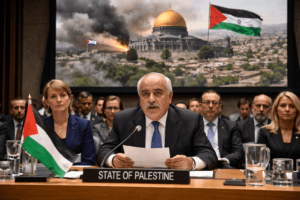
The Death of a Dream? At the UN, Palestine Declares Israel Chose Annexation Over Peace
As the first crescent moon heralds the arrival of Ramadan, a month synonymous with peace, reflection, and community, the air in the occupied Palestinian territories is thick not with the spirit of the holy month, but with a suffocating sense of finality. This was the powerful and somber image painted at the United Nations Security Council on February 19, 2026, by Riyad Mansour, the Permanent Observer of the State of Palestine.
Speaking at a ministerial meeting chaired by British Foreign Secretary Yvette Cooper, Mansour delivered a statement that was less a plea and more a definitive pronouncement: after decades of conflict, negotiations, and failed peace processes, Israel has made its choice. It has chosen annexation over peace.
His words arrive at a precarious moment. A fragile ceasefire in Gaza, brokered with considerable effort by the United States and regional powers, is threatening to collapse under the weight of ongoing violence and political obstruction. Simultaneously, the Israeli government is accelerating its footprint in the West Bank at a pace that Mansour and dozens of other nations argue is a de-facto annexation, rendering the two-state solution a geographical and political impossibility.
A Ramadan of Restriction and a “Fundamentally Racist” Narrative
Mansour’s address was framed by the stark contrast of the season. Ramadan, he noted, should be a time when the spiritual and familial bonds of Palestinians are strengthened. Instead, for the first time this year, they are observing it while being “deprived of practicing their religious rites freely and peacefully.” This isn’t merely about access to holy sites like the Al-Aqsa Mosque, though that remains a perennial flashpoint. It is about the broader erosion of daily life under occupation—the checkpoints that turn a visit to a relative’s home into an odyssey, the settlers who view Palestinian worship as a provocation, and the creeping sense that one’s very existence in one’s homeland is temporary.
The core of Mansour’s argument was a dismantling of the Israeli government’s stated motivations. He rejected the narrative that its actions are defensive or security-driven, framing them instead as a long-standing, methodical project of displacement.
“Israel’s goal has long been to displace the Palestinian people in order to seize their land,” he stated. “The scale and pace have changed, but the tools and objectives remain the same, namely settlement construction, settler terrorism, land confiscation under various pretexts, house demolitions, and the seizure of land records.”
This is the slow, grinding machinery of annexation. It’s not always a dramatic, single declaration, though Mansour warned that recent decisions by the Israeli government have made the intent “blatantly obvious.” It is the daily reality for Palestinians in the West Bank: a village herder finds his ancestral grazing land declared a “firing zone”; a family in East Jerusalem wakes up to an eviction notice pinned to their door, citing ancient land claims; a community watches as a new outpost, illegal even under Israeli law, is connected to the grid and water supply, slowly becoming an immovable reality.
Mansour pointed to the ideology driving this machinery, quoting extremist Finance Minister Bezalel Smotrich, who has openly boasted of “strengthening our grip on the land and eliminating the idea of a Palestinian state in the heart of the country.” He also recalled the chilling words of Israeli Foreign Minister Israel Katz in 2023, who stated that Gaza “must be smaller by the end of the war,” framing territorial shrinkage as both a security necessity and “the price the Arabs understand.”
This language, Mansour argued, betrays a “fundamentally racist” underpinning to Israeli policy. It is a worldview that sees Palestinians not as a people with national rights, but as a demographic threat to be managed, contained, and ultimately displaced. It frames Israelis as the sole sovereign “civilizers” and Palestinians as strangers in their own narrative.
The World Speaks, Israel Acts
The Palestinian envoy pointed out a glaring paradox: Israel is accelerating its annexationist policies despite near-universal condemnation. Just a day before his speech, over 100 countries and organizations signed a statement at the UN condemning and rejecting these measures. All fifteen members of the Security Council, including the United States, have expressed their opposition, viewing it as a direct violation of the UN Charter and international law.
This international consensus, however, seems to have become a background hum, ignored by the Israeli government. Mansour questioned the timing and the intent.
“What is the significance of Israel intensifying its annexation efforts… just days before the Peace Council meeting in Washington, and at a time when the US administration and regional and international actors are striving to solidify the fragile ceasefire in Gaza?”
The implication is clear: the far-right elements within the Israeli government view the diplomatic focus on Gaza as a smokescreen. While the world’s attention is fixed on the humanitarian catastrophe and the complex negotiations for hostage releases and a lasting truce, they are quietly but aggressively redrawing the map of the West Bank.
This strategy is coupled with the active sabotage of the Gaza ceasefire itself. Mansour accused Israel of undermining the agreement by continuing military operations that kill Palestinians, severely restricting the flow of humanitarian aid, and keeping the Rafah crossing closed. Furthermore, he highlighted Israel’s opposition to the Palestinian Authority assuming its rightful role in governing Gaza, a key component of any post-war plan that envisions a unified Palestinian territory.
Between a Ceasefire and a State: The Trump Plan’s Unraveling
In a striking section of his address, Mansour referenced the ceasefire plan associated with former President Donald Trump, a plan initially viewed with deep suspicion by many Palestinians. He explained that for Palestinians, the value of that plan was not in its long-term political vision, but in its immediate, life-saving potential: a ceasefire to end the famine in Gaza and a promise to halt annexation and forced displacement.
“We hoped it would be a first step towards the Palestinian people exercising their right to self-determination,” he said.
Instead, the reality on the ground has been the opposite. Israel, he argued, does not truly want a ceasefire. Its objectives remain unchanged: occupation, annexation, and the forced displacement of Palestinians, not just in Gaza—which he noted is now physically divided in two—but throughout the West Bank and East Jerusalem.
This is the central, tragic choice Mansour laid before the Security Council. Israel was presented with a fork in the road: one path led toward a freeze on settlement activity, a genuine ceasefire, and a potential re-engagement with the peace process. The other led to the unilateral seizure of land, the entrenchment of a one-state reality of domination, and the death of any negotiated two-state solution.
“Israel chose between annexation and peace,” Mansour declared, “and chose annexation.”
The Demographic Question and the “Two-State Illusion”
The Palestinian Observer posed a critical question to the international body: “How will we stop Israel?”
He warned that the Israeli government is moving with speed, hoping to create irreversible facts on the ground before a firm international response can be mobilized. It may offer tactical concessions to placate Washington, but its strategic direction is unyielding.
He then painted a picture of the demographic reality that Israel will eventually have to confront. Palestinians, he noted, have been confined to smaller and smaller enclaves—bantustans, in the eyes of many critics. But they have not disappeared. Their numbers are growing. Today, between the Jordan River and the Mediterranean Sea, there are approximately 7.5 million Palestinians living alongside nearly 7 million Jewish Israelis.
This is the core of the one-state reality that annexation creates. If Israel proceeds with formal or de-facto annexation of the West Bank, it will be faced with an impossible choice: either grant these 7.5 million Palestinians full citizenship and equal rights, thereby ending the dream of a Jewish state with a decisive Jewish majority, or continue to rule over them without rights, cementing a system of apartheid.
“Will this grant them equal rights,” Mansour asked, “or will it make their lives impossible through death, destruction, and displacement?”
For the current Israeli government, the answer, based on the policies and quotes presented by Mansour, points overwhelmingly to the latter. By stoking settler violence, conducting nightly military incursions into Palestinian cities like Jenin and Nablus, demolishing entire communities in Area C, and deliberately weakening the Palestinian Authority, the government is making life not just difficult, but unlivable, with the goal of pushing people out.
A Call for Action Over Words
Mansour concluded his address with a stark warning. The two-state solution, long the bedrock of international consensus, is in imminent danger of becoming a “two-state illusion.” To prevent this, the world must move beyond statements of condemnation.
He demanded that the international community affirm, “in word and deed, that the Gaza Strip and the West Bank, including East Jerusalem, constitute the territorial unity of the State of Palestine.” The political and geographical separation of Gaza from the West Bank has been a long-standing Israeli goal, and its prolongation, he argued, must end.
The meeting at the UN Security Council was another chapter in a long, painful history of diplomacy. But the tone from the Palestinian representative was one of grim resolution. The message was that the time for equivocation is over. Israel has made its intentions clear, not through hints or leaked documents, but through the bulldozers on the hillsides, the settlers in the outposts, and the statements of its highest officials.
The question now hanging over the Security Council chamber, the halls of Washington, and the capitals of Europe is whether they have the will to enforce the very international law they profess to uphold. As Palestinians begin their first fast of Ramadan, they do so under the shadow of a choice made for them—a choice for land over peace, for conflict over coexistence. And the world is being forced to choose which side it is on.
You must be logged in to post a comment.