
The Death of a Controversial Figure: What Abu Shabab’s Demise Reveals About Gaza’s Future
Yasser Abu Shabab, a controversial Bedouin militia leader in his 30s who was backed by Israel as part of its strategy to build armed anti-Hamas factions in Gaza, was killed in a clash in Rafah. His death marks a significant setback for Israel’s controversial proxy project, as Abu Shabab—a former convicted drug trafficker who led the “Popular Forces”—was widely viewed by Palestinians as a collaborator and was infamous for allegations of looting humanitarian aid despite portraying himself as its protector.
His elimination exposes the fundamental failure of attempting to engineer an alternative governing authority through militias that lacked popular legitimacy and operated in a devastating landscape of war and displacement, leaving a power vacuum and deepening uncertainty over Gaza’s future.
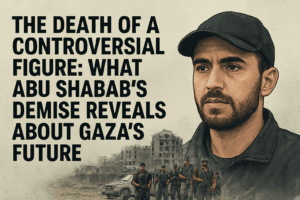
The Death of a Controversial Figure: What Abu Shabab’s Demise Reveals About Gaza’s Future
The killing of Yasser Abu Shabab, a militia leader whose rise and fall were orchestrated by Israel, represents far more than the death of a single man. It marks the dramatic collapse of a controversial Israeli strategy to cultivate armed Palestinian factions as a counterweight to Hamas. His story—from convicted drug trafficker to commander of the “Popular Forces”—reveals the complex, often contradictory, forces vying for power in Gaza’s devastated landscape.
Abu Shabab’s end in Rafah on December 4, 2025, was as murky as his life. Conflicting reports claimed he was killed by Hamas, died in an “internal” family dispute, or was ambushed by “resistance factions”. This confusion underscores the perilous reality for those attempting to navigate Gaza’s fractured loyalties amid war, occupation, and a desperate humanitarian crisis.
The Making of a Militia Leader: From Prison Cell to Israeli Proxy
Yasser Abu Shabab was, by most accounts, an unlikely candidate to lead a political alternative. A Bedouin from the Tarabin tribe in his early 30s, he had dropped out of school early and built a reputation not as a nationalist leader, but as a criminal. Prior to the war, he was serving a 25-year sentence in a Hamas-run prison on drug trafficking charges, having been involved in smuggling operations across the Sinai-Gaza border.
His path changed dramatically in October 2023. During the outbreak of war, he escaped from prison as it was bombed by Israeli forces. Seizing the chaos, he assembled a gang of roughly 100 followers, many reportedly former officers of the Palestinian Authority’s security forces. By mid-2024, this group had morphed into the “Popular Forces” (initially called the “Anti-Terror Service”), operating in Israeli-controlled areas of Gaza with a stated mission to fight Hamas.
Israel’s backing was his crucial advantage. In June 2025, Prime Minister Benjamin Netanyahu confirmed Israel was arming Palestinian clans opposed to Hamas, a clear reference to Abu Shabab’s forces. While Abu Shabab publicly denied receiving Israeli weapons, the support was an open secret. Netanyahu defended the policy, arguing, “What’s bad about it?… It saves soldiers’ lives”.
Table: The Contradictory Identities of Yasser Abu Shabab
| Identity | As Portrayed by Himself/Israel | As Viewed by Many Palestinians |
| Military Role | Leader of “Popular Forces”; protector of aid | Israeli collaborator and proxy |
| Political Goal | Building a “new future” as alternative to Hamas | Undermining Palestinian unity for Israeli interests |
| Humanitarian Role | Securing and distributing aid convoys | Primary figure behind systematic looting of aid |
| Personal Background | Local opposition figure | Convicted drug trafficker and criminal |
The Flawed Strategy: Israel’s Gamble on “Alternative” Forces
Abu Shabab was not an isolated case but the most prominent face of a broader Israeli experiment. Across Gaza, a patchwork of armed groups emerged in areas under Israeli control, built around family clans, criminal networks, and new militias. These groups, including the “Counter-Terrorism Strike Force” near Khan Younis led by Hossam al-Astal, received varying degrees of Israeli support and began jockeying for a role in Gaza’s future.
The strategic logic for Israel was straightforward: create local forces that could secure territory, weaken Hamas, and perhaps form the nucleus of a future governing structure that would not threaten Israel. However, this strategy was fraught with historical irony and immediate practical flaws.
Michael Milshtein, a former head of Palestinian affairs for Israeli military intelligence, warned that Israel was repeating America’s mistake in Afghanistan—arming groups that might eventually turn their weapons on their benefactors. “There will be a moment when they will turn their rifles – the rifles they got from Israel – against the IDF,” he cautioned.
More immediately, these militias lacked popular legitimacy. For most Gazans, including those disillusioned with Hamas, cooperation with Israel during a devastating war was disqualifying. Abu Shabab’s own Tarabin tribe disowned him, stating his killing marked “the end of a dark chapter”. Palestinian voices in Gaza expressed deep contempt for these groups. “These groups that co-operate with the occupation are the worst thing that the war has produced,” said Zaher Doulah from Gaza City. “Joining them is not only dangerous, it is a great betrayal”.
The Aid Paradox: Protector or Predator?
Perhaps the most damaging contradiction in Abu Shabab’s operations centered on humanitarian aid. He portrayed his Popular Forces as protectors of aid convoys, claiming to secure deliveries from looting and corruption. His group distributed images of fighters handing out supplies, and he told CNN he led “citizens… who have volunteered to protect humanitarian aid”.
In reality, according to internal United Nations assessments and Palestinian security sources, Abu Shabab was “the main… stakeholder behind systematic and massive looting”. Jonathan Whittall of the UN Office for the Coordination of Humanitarian Affairs stated that gangs like Abu Shabab’s were responsible for “The real theft of aid since the beginning of the war,” and that this was happening “under the watch of Israeli forces”.
This dual role—as both distributor and thief of aid—epitomized the moral compromise of the militia strategy. In a territory where famine conditions have prevailed, controlling aid became a source of power and profit, further alienating the population the groups claimed to serve.
The Violent Backdrop: Demolition and Displacement
The militia experiment unfolded against a backdrop of ongoing widespread destruction. Even after a ceasefire began on October 10, 2025, Israel continued massive demolition campaigns in areas it controlled. Satellite analysis by BBC Verify found that over 1,500 buildings were destroyed in these zones in less than a month following the ceasefire.
This destruction appeared methodical. Entire neighborhoods of houses, gardens, and orchards that showed no prior damage were leveled, apparently through controlled demolitions rather than combat. While Israel stated it was dismantling “terror infrastructure” in accordance with ceasefire terms, analysts like Professor Adil Haque argued that such large-scale destruction of civilian property during a ceasefire likely violated the laws of war.
Furthermore, reports indicated Israel had plans for a forced large-scale transfer of Gaza’s population. Defence Minister Israel Katz spoke of relocating 600,000 people to a “humanitarian city” in Rafah, with eventual plans to move Gaza’s entire population south. Philippe Lazzarini, head of UNRWA, warned this would create “massive concentration camps”. This context made any group cooperating with Israel appear complicit in what many feared was a plan for permanent displacement.
The Uncertain Future: Power Vacuums and Competing Visions
Abu Shabab’s death leaves a power vacuum in the areas he controlled and raises urgent questions about what comes next for Gaza’s governance. His militia represented one contentious vision among several for Gaza’s future, none of which currently commands broad support.
- The U.S. “Peace Plan”: The Trump administration’s plan calls for an International Stabilization Force and a newly-trained Palestinian police force. Some militia leaders, like Hossam al-Astal, claimed U.S. representatives had confirmed their groups would have a role in this future police force. However, a U.S. official stated they had “nothing to announce,” and a senior Palestinian Authority security official rejected blanket integration of these Israeli-backed militias.
- The Palestinian Authority: The PA, Hamas’s political rival based in the West Bank, seeks to return to governance in Gaza but requires significant reform according to the U.S. plan. It views the Israeli-backed militias with deep suspicion, seeing them as tools for continued Israeli influence.
- Hamas: Despite being militarily weakened, Hamas retains significant guerrilla capacity and continues to govern the parts of Gaza beyond Israeli control. It has vowed to eliminate collaborators and opposes any settlement that excludes it.
Netanyahu has insisted that Gaza will be run by neither Hamas nor the unreformed PA. This leaves a dangerous governance limbo. As Hugh Lovatt of the European Council on Foreign Relations noted, the longer Israel stays in Gaza, “the sense that Israel is stalling its withdrawal… will become an increasingly greater threat to the maintenance of the ceasefire”.
Conclusion: The Inevitability of a “Dark Chapter”
The life and death of Yasser Abu Shabab expose the profound difficulties of engineering political change through military proxies. His story is one of opportunism, contradiction, and ultimate rejection. He attempted to brand himself as a nationalist alternative while being armed by an occupying power, and as a humanitarian while being accused of stealing lifesaving aid.
For Israel, his killing is a stark setback in a risky strategy that critics warned was doomed from the start. It highlights the failure to find local partners with both the power and the legitimacy to challenge Hamas.
For Palestinians in Gaza, his demise reinforces a bitter truth: in the midst of overwhelming destruction and humanitarian catastrophe, solutions imposed from outside, or built on collaboration with the occupying force, are unlikely to find a foothold. As his own tribe declared, his death closes what they called a “dark chapter”—one that few in Gaza mourned, but whose end leaves the future as uncertain and perilous as ever.
The fundamental challenges remain: achieving a sustainable ceasefire, rebuilding a shattered territory, and establishing a legitimate governance structure that can provide for Palestinians while addressing Israeli security concerns. Abu Shabab’s failed project suggests that militias built on contradiction are not the answer.
You must be logged in to post a comment.