
The Day the Classroom Fell: Unpacking the Minab School Massacre and the Quest for Justice
A devastating precision airstrike on the Shajareh Tayyebeh Primary School in southern Iran on February 28, 2026, reportedly killed 168 civilians, including at least 48 children and their teachers, in what Human Rights Watch has called a potential war crime requiring immediate investigation. Evidence shows the school was a distinct civilian structure, walled off from an adjacent IRGC naval base with its own street entrance, yet it was directly struck by highly accurate munitions during school hours, suggesting deliberate targeting rather than an errant strike. While neither the US nor Israel has claimed responsibility, both possess the advanced intelligence capabilities that should have identified the facility as a school, raising serious questions about whether the attack violated international laws of war prohibiting direct attacks on civilians and requiring proportional force. Human Rights Watch is demanding a thorough, independent investigation, public accountability for those responsible, and compensation for victims’ families, amid concerns that recent US policy changes weakening civilian protection protocols may have contributed to this catastrophic failure to distinguish between military targets and classrooms full of children.
The Day the Classroom Fell: Unpacking the Minab School Massacre and the Quest for Justice
The morning of Saturday, February 28, 2026, began like any other school day in the coastal town of Minab, in Iran’s Hormozgan province. At the Shajareh Tayyebeh Primary School, children filed into their classrooms, the air filled with the familiar shuffle of backpacks and the murmur of young voices. The school, with its brightly painted walls and a courtyard marked for a soccer pitch, was a place of learning and childhood, a stark contrast to the arid landscape and the nearby military installation it bordered.
By 10:45 a.m., that sanctuary had become a tomb.
A precision strike, one of hundreds unleashed by US and Israeli forces across Iran that morning, tore through the school’s roof. In an instant, lessons in math and literature were replaced by a curriculum of shock, shrapnel, and fire. The final death toll, now at 168 according to Iranian state media, includes at least 48 children, their teachers, and the school’s principal. A new, devastating chapter was written in the long and tragic history of civilians caught in the crossfires of the Middle East.
A Target Painted Innocence
The central question emerging from the rubble is a simple, haunting one: why was a primary school, full of children, struck with such lethal precision? The available evidence, meticulously compiled and analyzed by Human Rights Watch (HRW), points not to a tragic accident, but to a potential war crime.
The Shajareh Tayyebeh school was undeniably close to an Islamic Revolutionary Guard Corps (IRGC) Naval Forces compound. But proximity to a military objective does not make a civilian object a legitimate target. High-resolution satellite imagery and photographic evidence show the school was a distinct entity, walled off from the military installation with its own separate, unguarded entrance to the public street. Watchtowers that once stood nearby were removed in 2016, further reinforcing the school’s non-military character. It was, by every observable metric, a place for children.
The nature of the attack itself adds another layer of gravity to the incident. HRW’s analysis of impact sites and munition entry points suggests the use of highly accurate, guided munitions. This was not an errant rocket or a misfired shell. It was a deliberate act of targeting a specific structure. At least eight, and possibly ten, separate buildings across the compound were directly struck, including a medical clinic inaugurated just over a year prior. This pattern of precision suggests the attackers had a detailed picture of their targets. If that is the case, how could they have missed—or ignored—the presence of a school?
The laws of war, or international humanitarian law, are unequivocal. They enshrine the principle of distinction: parties to a conflict must at all times distinguish between civilians and combatants and between civilian objects and military objectives. Attacks must only be directed at military objectives. A school full of children is the very definition of a protected civilian object. It loses that protection only if it is being used for military purposes at the time of the attack—a scenario for which HRW has found no evidence.
Furthermore, even if a legitimate military target existed in the vicinity, the principle of proportionality prohibits an attack if the expected harm to civilians and civilian objects would be excessive in relation to the anticipated direct military advantage. Striking a building adjacent to a school with such force that the school itself is hit could be a violation. But directly striking the school itself, at a time when it was known to be occupied, appears to be a direct and flagrant violation of the principle of distinction.
A Community’s Grief, A Nation’s Blackout
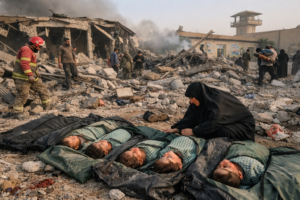
The human cost of this strike is not merely a statistic. It is etched in the frantic screams of a video verified by HRW, showing people gathered around the collapsed school. It is visible in the photographs of small bodies, faces covered in dust, still clad in their green-checkered school uniforms, lying in body bags. It is written in the names of children, identified by their birth dates on a list released by local officials—names like 8-year-old girls and 10-year-old boys whose futures were incinerated in a flash.
The Coordinating Council of Iranian Teachers’ Trade Associations described a scene of utter chaos. The school administration, perhaps alerted to the wider attacks, called parents to come and pick up their children. But the window between that call and the explosion was tragically short. Many parents were still en route when the bombs hit, arriving not to embrace their children, but to search for them in the debris.
In the days that followed, Iran imposed a near-total internet blackout, with traffic dropping by 98 percent. While the government has a history of such shutdowns during crises, this digital blackout served a dual, sinister purpose. It prevented the world from seeing the full scope of the horror in real-time and hindered the ability of families to communicate, find information, and organize. It created a vacuum of information that was slowly, painstakingly filled by HRW researchers analyzing satellite imagery of freshly dug graves at the Minab Hermud Cemetery.
Those images are a silent testament to the scale of the tragedy. By March 4, rows of new graves—at least 100 of them—could be seen carved into the earth. Funerals on March 3 showed crowds of mourners and rows of small caskets. The cemetery, once a final resting place for a community’s elders, now holds a generation of its children.
The Unanswered Questions and the Demand for Accountability
Neither the United States nor Israel has officially claimed responsibility for the Minab strike. An Israeli military spokesperson told HRW they were “not aware of any [Israeli military] strikes in the area.” US Defense Secretary Pete Hegseth stated, “We, of course, never target civilian targets, but we’re taking a look and investigating that.”
These statements, however, stand in stark contrast to the operational picture painted by US officials themselves. Gen. Dan Caine, Chairman of the Joint Chiefs of Staff, described the overall campaign as the “culmination of months, and in some cases, years of deliberate planning and refinement.” The Israeli military also asserted the attacks were based on “precise intelligence.”
This is the crux of the matter. How can years of planning and “precise intelligence” fail to identify a primary school? How can a military with advanced multi-domain intelligence capabilities not know that a building is a school, that it is walled off from a military base, and that it would be filled with children on a Saturday morning, the first day of the school week in Iran?
If the intelligence was faulty, that represents a catastrophic failure that resulted in mass civilian casualties. If the school was knowingly targeted, it constitutes a war crime. If it was a case of “collateral damage” deemed “proportionate,” then it signals a terrifyingly low threshold for the value of civilian life in the targeting process.
This last point is particularly alarming given recent policy shifts within the US Department of Defense under the second Trump administration. The reported termination of senior military lawyers, the loosening of targeting protocols, and the elimination of “civilian environment teams” suggest a deliberate dismantling of the very safeguards designed to prevent tragedies like Minab. Defense Secretary Hegseth’s public dismissal of “stupid rules of engagement” raises a chilling question: were the rules designed to protect civilians considered an impediment to “winning”?
Human Rights Watch has rightly called for an immediate, thorough, and independent investigation. But an investigation by the very parties who carried out the strikes is not enough. The findings must be made public. The international community—allies of both the US and Israel—must insist on transparency.
The families of the 48 children killed in Minab deserve more than a vague statement of regret. They deserve to know the truth. They deserve to know whose finger was on the trigger and whose analysis placed a crosshair on their children’s classroom. They deserve accountability, including prosecution for those responsible, and compensation for their immeasurable loss.
The rubble of the Shajareh Tayyebeh Primary School is more than just a scene of devastation. It is a monument to a catastrophic failure of humanity and a stark test for the laws of war. How the world—and specifically the US and Israel—responds to this test will define not only the legacy of this conflict but also the future protections for countless other children in war zones around the world. The lessons in Minab were written in blood; the world must now prove it is ready to learn them.
You must be logged in to post a comment.