
The Data Center Gold Rush: Can India’s Digital Dreams Withstand an Environmental Reckoning?
India’s rapid emergence as a global hyperscale data center hub, fueled by AI demand, data localization laws, and massive digital consumption, presents a critical paradox: while promising economic and technological supremacy, the unprecedented scale of expansion—with capacity projected to surge to 9-10 GW by 2030—is colliding with severe environmental constraints. This growth imposes immense strain on the nation’s already stressed electricity grid, risks exacerbating water scarcity in major metros like Bengaluru and Chennai due to the vast volumes needed for cooling AI servers, and complicates India’s carbon reduction goals given the sector’s reliance on a coal-heavy grid and diesel backups. Despite Big Tech’s ambitious global sustainability pledges, experts warn that without immediate, location-specific policy guardrails—such as mandatory water and grid impact assessments, transparency in resource usage, and strategic decentralization—this foundational digital infrastructure could undermine its own social license to operate and intensify resource conflicts, making the integration of sustainable design from the outset not just an ecological imperative but a strategic necessity for India’s long-term resilience.
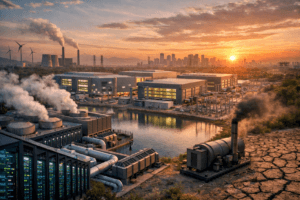
The Data Center Gold Rush: Can India’s Digital Dreams Withstand an Environmental Reckoning?
In the sprawling tech corridors from Hyderabad to Visakhapatnam, a silent, power-hungry revolution is underway. Towering campuses of servers and cooling systems are rising from the ground, representing billions in investment from the world’s most powerful tech companies. India, with its vast population and explosive digital adoption, is not just a market anymore; it’s becoming the central nervous system for global AI and cloud computing.
This hyperscale data center boom promises to catapult India into digital supremacy, creating jobs, fostering innovation, and solidifying its geopolitical tech stature. Yet, beneath the gleaming facades lies a pressing dilemma: this infrastructure of the future is being built on resources that are already straining under the weight of the present. The race for digital dominance is on a collision course with water scarcity, an overloaded power grid, and carbon commitments, forcing a critical national conversation about the true cost of growth.
The Unstoppable Surge: Why India is the New Global Data Hub
The drivers of this expansion are multifaceted and powerful. The Indian government’s data localisation policies require certain types of data to be stored within the country, creating a non-negotiable demand for local server capacity. Simultaneously, the AI explosion has generated insatiable demand for processing power. Generative AI models don’t run on laptops; they require warehouse-sized complexes of specialized chips (GPUs) that consume electricity at an unprecedented scale.
Couple this with the world’s fastest-growing major digital economy—where streaming, fintech, e-commerce, and digital public infrastructure (like UPI) are becoming ubiquitous—and the business case is undeniable. From global giants like Google, Microsoft, Amazon, and Meta to domestic conglomerates like Adani and L&T, the players are all placing massive bets. Current estimates suggest India’s data center capacity could leap from about 1.5 GW today to nearly 10 GW by 2030, potentially making it the second-largest market in Asia-Pacific.
This isn’t merely industrial growth; it’s an order-of-magnitude transformation. As S. Anjani Kumar of Deloitte India warns, if sustainability isn’t baked into the blueprint from day one, “environmental risks will scale faster than mitigation efforts.”
The Triple Resource Squeeze: Power, Water, and Carbon
The environmental footprint of a data center is a story of three interconnected crises.
- The Power Hunger:Data centers are the ultimate “always-on” entities. A single hyperscale campus can demand power equivalent to a medium-sized city. By 2030, they are projected to consume over 57 TWh annually—nearly 2.6% of India’s total projected electricity demand. The strain is exacerbated by AI, which is causing rack power densities to skyrocket. These facilities need not just vast amounts of power, but ultra-reliable, high-quality supply. This places immense pressure on urban grids in Mumbai, Chennai, and Hyderabad, which are already prone to congestion and outages.
The carbon math is sobering. With over 70% of India’s grid still coal-fed, every megawatt consumed has a significant emissions footprint. While tech companies are major buyers of renewable energy, the reality is that at night or on calm days, their servers are often still running on fossil fuels. Furthermore, the ubiquitous diesel generators used for backup power are a significant, yet frequently under-reported, source of local air pollution and CO2.
- The Thirst That’s Hard to Quench:If power is a national challenge, water is a hyper-local crisis waiting to happen. The overlooked secret of the cloud is that it’s kept aloft by immense quantities of water used for cooling. A typical mid-sized facility can use over 400 million liters annually. New AI-driven campuses are even more voracious, with estimates suggesting some can draw up to19 million liters per day.
The crux of the issue is location. Major data center hubs—Bengaluru, Chennai, Mumbai—are already categorically water-stressed. When a single campus’s daily water use rivals that of a small town, and multiple such campuses cluster around the same depleted reservoirs or groundwater sources, it creates a “concentration risk.” This isn’t just an environmental issue; it’s a social and operational one. Public backlash, regulatory curbs, or simply running dry could bring a billion-dollar digital fortress to a grinding halt.
- The Carbon Headroom Conflict:India has committed to achieving net-zero emissions by 2070 and building 500 GW of non-fossil capacity by 2030. The data center boom directly tests these ambitions. The sector’s colossal energy demand could lock in decades of additional coal-based generation, making the clean energy transition steeper and more expensive. True sustainability requires moving beyond carbon offsets and renewable energy certificates (RECs) to actually enabling 24/7 clean power on the grid—a monumental infrastructure challenge in itself.
Beyond the Green Pledge: The Gap Between Global Goals and Local Ground Reality
Big Tech’s sustainability commitments are headline-grabbing and necessary: Microsoft aims to be water positive, Google targets 24/7 carbon-free energy, and Amazon is the world’s largest corporate renewable buyer. These global frameworks are pushing the industry forward.
However, as Rishi Agrawal of TeamLease RegTech points out, a global net-zero pledge “doesn’t automatically solve water stress in Bengaluru.” A data center can be “carbon neutral” on paper through remote offsets while exacerbating a local water crisis. This disconnect reveals a critical governance gap. Voluntary corporate action, while positive, is insufficient for a sector becoming critical national infrastructure.
Building a Responsible Digital Future: The Policy Imperative
To avoid a crisis of resources and legitimacy, India needs to move swiftly from ad-hoc approvals to strategic governance. Several key interventions are crucial:
- Mandatory Transparency: Requiring public, site-level disclosure of Power Usage Effectiveness (PUE) and, critically, Water Usage Effectiveness (WUE) would shine a light on performance, drive competition on efficiency, and inform communities.
- Pre-Approval Impact Assessments: New projects should be contingent on rigorous water stewardship and grid impact studies, not just environmental clearances. This would incentivize companies to choose sites wisely and invest in advanced cooling (like air-assisted or waterless systems) from the start.
- Rethinking Urban Planning: Classifying data centers as ordinary commercial real estate is a mistake. The National Building Code should recognize them as unique infrastructure, allowing for vertical densification and excluding essential utility plants from Floor Space Index (FSI) calculations to prevent inefficient urban sprawl.
- Decentralization and Zones: Promoting edge data centers in Tier-2/3 cities can ease pressure on metro utilities and improve latency. The concept of Data Centre Economic Zones (DCEZs) in resource-rich, non-metro areas—with single-window clearances and incentives—could attract sustainable builds from the outset.
- Accounting for the Full Footprint: Regulation must look beyond operational electricity to include Scope 3 emissions (from construction materials like concrete and steel) and mandate a clear path to phasing out diesel generators, perhaps by supporting grid-scale battery storage or green hydrogen pilot projects.
Turning Constraint into Leadership: India’s Unique Opportunity
The challenge is monumental, but so is the opportunity. India is building its digital backbone later than many Western nations, giving it a “clean slate” advantage. It can leapfrog past the inefficiencies of legacy infrastructure.
Imagine data centers powered by round-the-clock renewable microgrids, cooled by India’s long coastline using deep seawater (cutting cooling energy by up to 79%), and built with low-carbon materials. This wouldn’t just mitigate harm; it could make India a global exporter of sustainable hyperscale engineering and a benchmark for the Global South.
Technological innovation, from energy-efficient AI chips to novel cooling chemistries, will be part of the solution. But technology alone is not a panacea. It must be driven by thoughtful policy, corporate accountability, and public transparency.
The Narrow Window
The data centers being built today will define India’s digital and environmental landscape for decades. They are the engines of economic growth, AI innovation, and national security. But their social license to operate depends on how they coexist with their communities and environment.
The message for policymakers, tech giants, and developers is unequivocal: In the age of climate crisis, how you build is as important as what you build. India has the chance to demonstrate that digital progress and ecological responsibility are not a zero-sum game. By embedding sustainability into the very foundation of its digital leap, India can secure not just technological sovereignty, but also a legacy of responsible growth. The future doesn’t belong merely to those who scale fastest, but to those, as the article concludes, who “scale with conscience.” The time to act is now, before the concrete sets and the servers hum to life on an unsustainable path.
You must be logged in to post a comment.