
The Dangerous Doctrine: Why America’s War on Iran Exposes the Hollowing of Global Norms
The Dangerous Doctrine: Why America’s War on Iran Exposes the Hollowing of Global Norms
When the World’s Policeman Abandons the Rulebook
On February 28, 2026, the United States and Israel launched a full-scale military offensive against Iran. Within hours, American warplanes were streaking toward Tehran, precision munitions were obliterating facilities described vaguely as “nuclear threats,” and Ayatollah Ali Khamenei—according to subsequently confirmed reports—had been killed in an operation that combined CIA intelligence, Mossad infiltration, and the kind of real-time surveillance that makes traditional warfare look like a relic of a gentler age.
By March 8, when former Union Minister P. Chidambaram published his scathing analysis in The Indian Express, the region was already ablaze. Iran had retaliated against US military bases across half a dozen Arab countries. Shipping lanes near Sri Lanka were suddenly war zones. And India—home to nearly one crore citizens scattered across the Middle East—found itself watching from the sidelines, its voice reduced to a whisper, its moral authority evaporated like morning dew in a desert sun.
This is not merely another chapter in the Middle East’s long, blood-soaked history. This is something more dangerous: the formal abandonment of the last pretenses of international law, the triumph of the Monroe Doctrine expanded to planetary scale, and a demonstration that when the world’s sole superpower decides to act, the United Nations Charter becomes what cynical diplomats have long suspected—a collection of noble sentiments printed on paper that burns as readily as any other.
The Architecture of Illegality
Let us be precise about what just happened, because precision matters when nations die and people burn.
The US Constitution is clear: the President cannot declare war without Congressional authorization. Donald Trump did exactly that. The UN Charter is equally unambiguous: Article 2(4) prohibits “the threat or use of force against the territorial integrity or political independence of any state.” The US and Israel violated this provision with the kind of casual indifference that characterizes those who write rules for others while exempting themselves.
The justification offered—that Iran possessed, or was about to possess, nuclear weapons capable of threatening the United States—unravels under even cursory examination. The Wall Street Journal, citing US officials with access to classified intelligence, flatly reported that these alleged threats were unsubstantiated. Oman, which had been mediating between Tehran and Washington, had publicly stated that Iran agreed to “zero stockpiling of enriched uranium.” Russian Foreign Minister Sergey Lavrov asked the question that should have been asked a thousand times: “Where is the evidence?”
There was none. There rarely is.
We have seen this film before. In 2003, Colin Powell stood before the UN Security Council, holding a vial of what he claimed could be anthrax, and made the case for war against Iraq. The weapons of mass destruction never materialized. In 2011, the Obama administration invoked humanitarian concerns to justify intervention in Libya—a country that subsequently collapsed into factional warfare and slave markets. The pattern is so familiar it barely registers as news anymore: identify a target, manufacture a threat, assemble a coalition of the willing (or at least the compliant), and bomb until regime change is achieved or public attention wanders elsewhere.
The Human Calculus Behind the Headlines
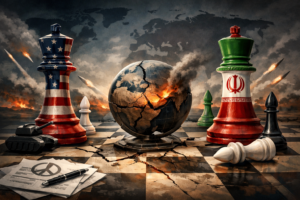
It is easy, from the safe distance of newspaper columns and Twitter arguments, to treat war as a geopolitical chess game. Pieces move. Kings fall. Analysts debate whether the elimination of Ayatollah Khamenei represents a strategic victory or a tactical overreach.
But there are no pieces. There are only people.
The 70,000 Palestinians killed in Gaza since October 7, 2023, were people. The 1,219 Israelis killed in Hamas’s attack were people. The Iranian civilians now dying under American bombs are people. The Indian workers in Kuwait, Bahrain, Qatar, Saudi Arabia, and the UAE—waking each morning to check whether their host countries have been drawn into the expanding conflict—are people. They did not vote for this war. They did not authorize this war. They will, however, pay for it with everything they have.
Chidambaram notes that India condoled the deaths “only after six days.” That delay speaks volumes. It suggests paralysis, uncertainty, a government unsure whether to mourn the dead or calculate the geopolitical implications of mourning. When you wait nearly a week to acknowledge that human beings have died, you have already made your choice: you have chosen the calculus over the corpses.
India’s Impossible Position
This brings us to the uncomfortable question of India’s role—or rather, its absence.
On February 25, 2026, just three days before the war began, Prime Minister Narendra Modi addressed the Knesset in Jerusalem. His words were carefully chosen, but their meaning was unmistakable: “India stands with Israel, firmly, with full conviction, in this moment, and beyond.”
He offered condolences for Israeli families whose worlds were shattered on October 7. He did not mention Gaza. He did not mention the 70,000 dead. He did not mention that international humanitarian law imposes obligations on all parties to conflict, including allies.
Now, with American bases under Iranian attack across the Middle East, with the Chabahar Port investment of USD 370 million hanging in the balance, with nearly ten million Indian citizens scattered across a region suddenly consumed by war, India has no leverage, no mediating role, no seat at any table that matters.
This is what strategic alignment without strategic autonomy looks like. It looks like paralysis. It looks like irrelevance. It looks like a country that once championed decolonization and non-alignment reduced to issuing carefully worded statements that no one reads and fewer care about.
The contrast with earlier decades is instructive. During the Cold War, India maintained relationships with both superpowers while preserving the capacity to act independently. That capacity required something that now seems in short supply: the willingness to displease friends when principles demanded it. Today, the imperative appears reversed: please friends at all costs, and let principles fend for themselves.
The Monroe Doctrine Goes Global
Chidambaram’s reference to the Monroe Doctrine deserves attention. Originally articulated in 1823, the doctrine declared the Western Hemisphere off-limits to European colonization—a assertion of American hegemony dressed in the language of anti-imperialism. Over two centuries, it evolved into justification for repeated US interventions in Latin America: regime changes, proxy wars, support for dictators, overthrow of democracies. All in the name of stability. All in the name of American interests.
What we are witnessing now is the Monroe Doctrine globalized. Venezuela in 2026. Iran in 2026. The pattern is consistent: identify a government the United States finds inconvenient, declare it illegitimate, and remove it by force. The fact that these governments were elected, or at least emerged from their countries’ internal political processes, becomes irrelevant. The fact that regime change violates every international treaty the United States has signed becomes a technicality.
And here is the cruel irony: many of the regimes the United States leaves undisturbed are far worse than the ones it targets. Dictators who cooperate with American interests receive military aid, diplomatic support, and photo opportunities at the White House. Dictators who defy American interests receive bombs.
This is not a foreign policy. It is a protection racket with aircraft carriers.
The Machinery of Modern War
There is another dimension to this conflict that deserves attention, one that Israeli correspondent Alon Mizrahi has highlighted: this is a war without soldiers, at least in the traditional sense. Machines are fighting machines. Drones engage drones. Cyberattacks precede airstrikes. Surveillance systems track targets in real-time, feeding data to command centers thousands of miles away, where young men and women watch screens and press buttons that end lives they will never see.
The machines that are most lethal and in endless supply will win. That much is certain.
But what does victory mean in such a conflict? If you destroy Iran’s nuclear facilities but create a generation of Iranians radicalized by the deaths of their families, have you won? If you eliminate the country’s leadership but fragment the state into warring factions, have you achieved stability? If you demonstrate American military supremacy but reveal American diplomatic isolation, have you strengthened your position or weakened it?
These questions are not merely academic. They will determine whether the Middle East experiences a generation of relative peace or a generation of unending conflict. And they will determine whether the United States emerges from this moment as a respected leader or a feared bully—a distinction that matters more than military planners typically acknowledge.
The Untruth at the Heart of the Matter
Let us return to the foundational lie, because lies that launch wars deserve special attention.
In June 2025, the United States and Israel conducted “Midnight Hammer,” a campaign that allegedly obliterated Iran’s key nuclear enrichment facilities. If that claim was true, Iran could not possibly have stockpiled nuclear weapons or enriched uranium in the months that followed. If that claim was false, then the intelligence community was either incompetent or dishonest. Neither possibility reflects well on those who now insist that war was necessary.
Chidambaram quotes Lavrov’s question—”Where is the evidence?”—and leaves it hanging because no answer exists. The evidence was not produced because the evidence did not exist. The threat was not imminent because the threat was manufactured.
This matters. It matters because when the world’s most powerful nation goes to war on false pretenses, it damages something beyond the countries it attacks. It damages the very idea that international relations can be governed by law rather than force. It tells every other nation that might is right, that the strong do what they can and the weak suffer what they must. It returns us to a world before the UN Charter, before the Geneva Conventions, before the fragile architecture of global governance that was supposed to prevent exactly this kind of war.
What Comes Next
The war, Trump says, may continue for four to five weeks or more. That estimate, like the intelligence about Iranian nuclear weapons, should be treated with skepticism. Wars rarely adhere to schedules. They expand, mutate, and consume in ways their architects never anticipated.
If the conflict spreads to involve Hezbollah in Lebanon, Shia militias in Iraq, Houthi forces in Yemen, or any of the other armed groups that populate the region, four to five weeks becomes four to five years. If Iran succeeds in closing the Strait of Hormuz, global oil prices will spike, economies will shudder, and countries far from the fighting will feel its effects. If the United States becomes bogged down in another Middle Eastern quagmire, the strategic implications for China, Russia, and every other power will be profound.
And India? India will watch. It will issue statements. It will evacuate citizens if it can. It will hope that its investments survive and its relationships endure. But it will not shape events, because it has surrendered the capacity to shape events. That capacity was surrendered incrementally, decision by decision, speech by speech, until one day—perhaps this day—India woke to discover that it had become what it once despised: a country that follows rather than leads, that adapts rather than shapes, that endures rather than influences.
The Moral Question
Underlying all of this is a question that diplomats prefer to avoid: what gives one country the right to change the regime of another?
Chidambaram’s answer is unequivocal: nothing. “However bad a regime may be in a country, it is the sole right of the people of that country to change the regime.”
This is the heart of the matter. The Iranian people may despise their government. They may yearn for freedom, democracy, and human rights. They may welcome foreign intervention as liberation. But those are their choices to make, their revolution to fight, their future to determine. When outsiders make those choices for them—when outsiders bomb their cities, kill their leaders, and install new governments—they are not liberating anyone. They are colonizing. They are imposing their will on people who have not consented and will not forget.
The United States has done this repeatedly. Iran (1953), Guatemala (1954), Chile (1973), Afghanistan (2001), Iraq (2003), Libya (2011), Venezuela (2026), and now Iran again. The names change, the justifications change, but the pattern remains constant. And each time, the United States discovers that removing a regime is easier than building a stable replacement, that military victory is simpler than political success, that destroying an enemy is faster than winning a population.
The Spectator’s Lament
For India, the tragedy is not merely that war has broken out. Wars will always break out. The tragedy is that India has positioned itself where it can do nothing useful—neither prevent the war nor influence its conduct nor shape its aftermath.
The one crore Indians in the region will survive or not, depending on factors entirely beyond their government’s control. The Chabahar Port investment will succeed or fail, depending on decisions made in Washington and Tehran. The broader relationship with the Middle East will evolve or deteriorate, depending on forces India can no longer influence.
This is not strength. This is not strategic autonomy. This is not the foreign policy of a country that aspires to global leadership. It is the foreign policy of a country that has chosen sides so definitively that it has lost the capacity to mediate between them.
And when the war ends—as all wars eventually end—India will discover that it has spent whatever moral capital it possessed. It will discover that the countries it might have helped, the relationships it might have cultivated, the influence it might have wielded have all been sacrificed on the altar of alignment. It will discover that in bending to the world’s policeman, it has forgotten how to stand on its own.
You must be logged in to post a comment.