
The Crumbling Homes of Palestine: Behind Israel’s Demolition Policy in the West Bank
The Crumbling Homes of Palestine: Behind Israel’s Demolition Policy in the West Bank
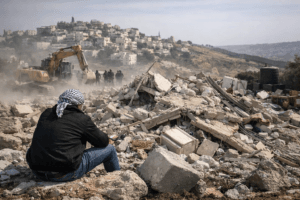
On a Tuesday morning in December 2025, the sound of bulldozers echoed through Qalandia village, northwest of Jerusalem. Samer Hamdiyya watched as the two-story home where he raised his family was reduced to a pile of rubble. Israeli forces had surrounded the property, unleashing tear gas canisters before the demolition began. For Hamdiyya, the demolition order cited a familiar, unforgiving reason: his home stood in Area C, a zone comprising over 60% of the occupied West Bank where Israel exercises full control.
Hamdiyya’s story is not an isolated tragedy but part of a disturbing pattern transforming the West Bank’s landscape. In a single month prior, November 2025, Israeli authorities conducted 46 separate demolition operations, destroying 76 structures that included family homes, agricultural buildings, and sources of livelihood. What unfolds at the individual level as a personal catastrophe is, in aggregate, a systematic policy with profound implications for the future of Palestine.
Understanding Area C: The Legal Framework of Dispossession
To comprehend why demolitions like Hamdiyya’s occur, one must understand the unique and contentious status of Area C. Created by the 1995 Oslo II Accords as a temporary administrative division, it was intended to be gradually transferred to Palestinian jurisdiction. Nearly three decades later, this “temporary” arrangement remains, with Israel retaining exclusive control over security, planning, and construction.
This control is exercised through a restrictive planning regime. For Palestinians, obtaining a building permit in Area C is described as “virtually impossible”. Data shows that between 2009 and 2012, only 2.3% of Palestinian permit applications were approved. Consequently, families like Hamdiyya’s, needing to build or expand homes for growing families, are forced to construct without permits. These structures are then retroactively deemed “illegal” and face demolition orders that can come years later.
The demographics of Area C highlight the inequality embedded in this system. It is home to approximately 354,000 Palestinians and 491,548 Israeli settlers. Despite the near-parity in population, the allocation of land and resources is starkly disproportionate. Israeli settlements are systematically expanded, often with state support, while Palestinian communities face severe restrictions on development and access to basic services.
The Humanitarian Impact: Beyond the Rubble
The consequences of this policy extend far beyond the loss of a roof. For Palestinian communities in Area C, life is marked by profound deprivation:
- Education and Healthcare: One-third of communities lack a primary school, forcing children to undertake long, often dangerous journeys. Nearly half report hampered access to emergency healthcare due to distance or military checkpoints.
- Water Scarcity: Over 70% of communities are not connected to a water network. They rely on expensive tankered water, with 95,000 people receiving less than half the World Health Organization’s recommended daily minimum.
This creates what human rights groups call a “coercive environment”—a set of conditions so harsh that residents are pressured to abandon their homes and land, achieving displacement without a formal expulsion order.
A Systematic Campaign: Demolitions in Context
The demolition of Hamdiyya’s home is a single data point in a much larger campaign. Recent months have seen an escalation in both the scale and strategic focus of these operations, particularly targeting refugee camps in the northern West Bank.
The table below summarizes key recent demolition operations, illustrating their systematic nature and devastating scope:
| Date/Location | Scale of Order | Reported Impact | Official Justification |
| Nov 2025 (Various) | 46 operations, 76 structures | 20 inhabited homes destroyed; 30 agricultural structures | Lack of building permits (Area C regulations) |
| Dec 2025, Nur Shams Camp | 25 residential buildings | Affects ~100 family homes, hundreds of people | “Clear and necessary operational need” for military control |
| Dec 2025, East Jerusalem & Ramallah | 2 buildings (a hall and a home) | Families forcibly displaced | Lack of construction permits |
The case of the Nur Shams refugee camp is particularly alarming. In mid-December 2025, orders were issued for the demolition of 25 residential buildings, a move the Director of UNRWA Affairs for the West Bank called “more devastating news”. Satellite imagery revealed that nearly half (48%) of all buildings in the camp had already been damaged or destroyed prior to this latest order.
These camp demolitions are linked to “Operation Iron Wall,” a large-scale Israeli military campaign launched in January 2025. The operation has reportedly displaced over 32,000 Palestinians from northern West Bank camps and damaged or destroyed approximately 1,500 homes in a single year. UN officials argue that the goal is to “permanently alter the topography” of the camps to enable long-term Israeli military control.
Justifications, Law, and Lasting Consequences
The Israeli state provides two primary justifications for these actions, both heavily contested under international law.
- Administrative Demolitions (Lack of Permits): This is the reason given for demolitions like Hamdiyya’s in Area C. Critics condemn this as a catch-22, where permits are systematically denied before structures are declared illegal. Israeli officials often cite adherence to old Jordanian or British Mandate planning laws, while ignoring provisions within those same legal frameworks that should allow for Palestinian development.
- Military Necessity: For operations in camps like Nur Shams, Israel cites a “clear operational need” to combat militant networks operating from civilian areas. However, international law, specifically Article 53 of the Fourth Geneva Convention, prohibits the destruction of property by an occupying power unless rendered absolutely necessary by military operations. UN and human rights organizations argue that the scale and permanence of the destruction, which renders entire neighborhoods uninhabitable, far exceed this narrow exception and amount to collective punishment.
The International Court of Justice (ICJ), in a landmark advisory opinion in July 2024, declared Israel’s occupation of Palestinian territory illegal and called for the evacuation of all settlements. UN officials continue to urge Israel to abide by this ruling and its obligations under international law.
The ultimate consequence is what historian Omer Bartov describes as a state of “social death.” He draws a parallel to 1930s Germany, noting that the policy “dehumanises the population because you treat it as a population that has to be controlled, and it dehumanises the people doing it because they have to think of that population as being lesser than human”. This process severs contact and empathy, making the occupied invisible to the occupier.
Echoes in Gaza and the Erosion of Hope
A parallel, devastating dynamic is unfolding in Gaza. Despite a ceasefire in October 2025, satellite analysis shows Israel has destroyed over 1,500 buildings in areas it continues to control, with many showing no prior damage. Experts warn this mirrors the creation of “facts on the ground” long practiced in the West Bank, potentially jeopardizing peace plans and any viable future for Palestinian statehood.
For Palestinians like Samer Hamdiyya or the residents of Nur Shams, each demolished home is more than a material loss. It is the destruction of memory, stability, and the hope of return. As one UN official stated, residents who have waited months to go home find that “with each blow of the bulldozers, this hope becomes ever more distant”. When homes, schools, and olive groves are erased, the very fabric of a community—its past and its future—is torn apart.
The rubble in Qalandia and Nur Shams is a testament to a policy of displacement that operates one home at a time. It is a slow-moving crisis that rarely makes global headlines but is steadily reshaping the map and extinguishing the possibility of a just and lasting peace. The international community’s challenge is to see these not as isolated administrative acts, but as interconnected strokes in a broader campaign to determine, irrevocably, who controls the land and who is allowed to call it home.
You must be logged in to post a comment.