
The Crossroads of Faith and Education: Jerusalem’s Christian Schools Face an Existential Threat
The Israeli Ministry of Education has ordered that from September, Christian schools in Jerusalem may only hire teachers who reside in the city and hold Israeli-issued qualifications, effectively banning more than 200 Christian Palestinian teachers who live in the West Bank and hold Palestinian degrees—a move that threatens not only the livelihoods of educators who have served for decades but the very survival of the historic Christian schools themselves. Founded in the late 19th century to preserve the Christian presence in the Holy Land, these fifteen institutions now face severe staffing shortages, potential loss of their Christian character, and the risk of forcing Christian families to emigrate, prompting the General Secretariat of Christian Schools to launch urgent appeals with Israeli authorities, the Holy See, and the international community while preparing for financial hardship and praying for a reversal of a policy that could irrevocably diminish one of the world’s most ancient Christian communities.
The Crossroads of Faith and Education: Jerusalem’s Christian Schools Face an Existential Threat
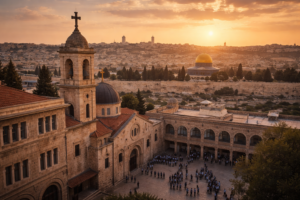
In the narrow, ancient streets of East Jerusalem, where the weight of history presses against every stone, a quiet crisis is unfolding—one that threatens not only the livelihoods of hundreds of educators but the very future of a Christian presence that has endured in this city for two millennia.
The Israeli Ministry of Education’s recent directive, delivered to school principals across Jerusalem in late March, carries consequences far beyond administrative policy. When the new school year begins in September, more than 200 Christian Palestinian teachers will find themselves barred from the classrooms where many have taught for decades. Their offense? Residing in the West Bank rather than Jerusalem itself, and holding academic qualifications earned under the Palestinian educational system rather than Israeli-issued credentials.
For the General Secretariat of Christian Schools (GSCS), which oversees a network of institutions that have educated generations of Jerusalem’s children since the late nineteenth century, this is not merely a labor dispute. It is an existential reckoning.
The Heart of the Matter
To understand why this decision has sent shockwaves through the Christian community of the Holy Land, one must first grasp what these schools represent. They are not simply places of learning. They are anchors—institutions founded during the Ottoman era by Catholic, Orthodox, and Protestant religious orders with a dual mission: to provide quality education and to sustain the Christian presence in a city that holds the very origins of their faith.
Fifteen Christian schools in Jerusalem now face the prospect of losing nearly 230 teachers. Spread across these institutions, that translates to roughly fifteen educators per school—a loss so significant that academic continuity itself hangs in the balance.
The decision formalizes a trajectory that began last July, when the Knesset’s Education Committee approved legislation questioning the academic standards of degrees obtained in the West Bank. When the current school year opened in September, 171 teachers from the West Bank were denied authorization to work, prompting a week-long strike across all Christian schools in Jerusalem—a rare display of collective action that temporarily forced a reversal.
That reprieve, it now appears, was temporary.
The Human Toll Behind the Policy
Behind the bureaucratic language of “work permits” and “academic standards” lie real lives—teachers who have built their careers within these institutions, who have watched students grow from first-graders clutching pencil cases to young adults crossing stages at graduation ceremonies.
The GSCS representative who spoke with Aid to the Church in Need described teachers who have dedicated years, sometimes decades, to their schools. They receive fair wages, enjoy professional stability, and serve as pillars of their communities. Many hold green cards—administrative documents that have long allowed certain Palestinians from the West Bank to work and travel within Israeli-controlled areas. Under the new directive, these permits will no longer suffice.
The termination of their employment, the representative warned, will lead to severe financial hardship. For some, the only path forward will be emigration—joining the slow but steady stream of Christians leaving the Holy Land in search of stability elsewhere. Each departure chips away at a community whose numbers have already dwindled precipitously over the past century.
More Than a Labor Issue
What makes this moment particularly fraught is the question of what comes next. The Israeli Ministry of Education has stipulated that replacement teachers must reside in Jerusalem and hold Israeli-issued qualifications. But here lies the practical impossibility at the heart of the policy: there simply are not enough Christian teachers in Jerusalem to fill the gap.
The Christian population of Jerusalem—once a substantial portion of the city’s residents—has shrunk dramatically over generations. Economic pressures, political uncertainty, and the sheer difficulty of daily life have driven countless families to seek opportunities elsewhere. Those who remain are fewer, and among them, the pool of qualified educators with Israeli teaching credentials is limited.
The GSCS representative put it bluntly: “In the long term, these restrictions risk permanently affecting the Christian character of our institutions and weakening the Christian faith and presence in the city.”
For institutions founded explicitly to preserve that presence, the irony is devastating. Schools established to keep the Christian faith alive in the land of its birth now face the prospect of becoming, in practice if not in name, something other than what they were meant to be.
The Broader Context
This policy does not exist in a vacuum. It emerges from a complex landscape of competing national narratives, administrative jurisdictions, and demographic pressures. East Jerusalem, annexed by Israel after the 1967 war in a move not recognized internationally, occupies a peculiar legal and political space. Palestinian residents hold permanent residency status—a designation that can be revoked if they live outside the city for extended periods—while the Israeli government asserts administrative control over education, zoning, and other civic functions.
The question of who may teach in Jerusalem’s schools thus becomes entangled with larger questions about sovereignty, identity, and the future of the city itself. The Christian schools, historically able to navigate these tensions with a degree of autonomy, now find themselves caught in the crosscurrents of policies that leave little room for the flexibility their unique circumstances require.
A History of Education Amid Turmoil
The Christian schools of Jerusalem have weathered many storms. Founded in an era when the Ottoman Empire still ruled the region, they expanded under the British Mandate, endured the division of the city in 1948, and navigated the transformations following 1967. Through wars, intifadas, and shifting political orders, they remained constant—places where Christian and Muslim students studied together, where generations learned not only mathematics and literature but also the difficult art of coexistence.
Many of these institutions educated the very leaders who would shape Palestinian society. They became synonymous with academic excellence, attracting families from across the socioeconomic spectrum who sought the rigorous education these schools provided. For many Christian families, sending children to these schools was itself an act of cultural preservation—a way of ensuring that their children would remain connected to their heritage and their community.
That legacy is now at risk of being severed.
The Response
The GSCS is not taking the decision quietly. The representative told ACN that the organization is pursuing every possible avenue of appeal—engaging with legal organizations, seeking dialogue with Israeli government officials (however difficult such engagement has become), and coordinating with local Church leadership.
The Holy See has been apprised of the situation, and influential international partners are being mobilized to urge the Israeli government to reconsider. It is, in many ways, the classic diplomatic approach: quiet pressure, legal challenges, and appeals to reason and precedent.
But there is also an awareness that such efforts may not succeed. And so the schools are preparing for a worst-case scenario—one in which families lose their incomes, students lose their teachers, and institutions lose the very character that has defined them for more than a century.
The Role of the International Community
For those watching from outside the region, the question naturally arises: what can be done?
The GSCS representative offered three avenues. First, and most urgently, the problem must be highlighted on a global scale. Making the truth known—the human consequences behind the policy language—is essential. This is not, fundamentally, a story about bureaucratic procedures. It is a story about teachers who may lose their careers, students whose education may be disrupted, and a Christian community whose presence in Jerusalem may be irrevocably diminished.
Second, if the decision is enforced, financial aid will be necessary. Families deprived of their income will need support, and schools facing sudden staffing crises will require resources to adapt. The international Christian community, which has long supported the churches of the Holy Land, may be called upon to provide that assistance.
Third, and perhaps most profoundly, the representative emphasized the importance of prayer. “Prayer remains the key to the heart of Almighty God,” he said, “in the land he has blessed and sanctified.” It is a reminder that for the Christian communities of the Holy Land, faith is not merely a cultural identity but a lived reality—a source of resilience in the face of challenges that might otherwise seem insurmountable.
Looking Ahead
As September approaches, the clock is ticking. The schools face a daunting summer of uncertainty, with administrators scrambling to prepare for outcomes that remain unclear. Will the government reverse course, as it did after last year’s strike? Will legal challenges succeed in staying the policy? Or will the schools be forced to implement a transition that their own leadership acknowledges may be impossible to execute without fundamentally altering their mission?
What makes this moment particularly poignant is the sense of déjà vu. Time and again, the Christian communities of the Holy Land have found themselves navigating between political pressures and their commitment to remaining in the land of their heritage. Each crisis brings new challenges, new departures, new losses. And yet, somehow, the community endures—smaller than it once was, perhaps, but still present, still bearing witness.
Whether it will continue to do so in the classrooms of Jerusalem’s Christian schools may depend on what happens in the months ahead. The teachers who face unemployment are not merely employees; they are carriers of a tradition, embodiments of a presence that has survived empires, crusades, and conflicts. To lose them is to lose something that cannot easily be replaced.
The GSCS representative’s words carry a weight that transcends the immediate crisis: “The Church will not abandon them in these difficult circumstances.” It is a promise, and perhaps also a prayer—that the institutions founded to preserve Christian presence in the Holy City will themselves be preserved, and that the teachers who have given so much to those institutions will not be left to face their uncertain futures alone.
In a land where every stone tells a story, the story of Jerusalem’s Christian schools is still being written. What comes next will depend on political decisions, legal battles, and the resilience of a community that has known how to endure. But it will also depend on whether the wider world—the global Christian community, the international human rights community, all those who believe in the value of pluralism and the importance of preserving ancient Christian presence in the Middle East—chooses to pay attention, to speak out, and to act.
The teachers are waiting. The schools are waiting. And in the ancient city where Christians have worshipped for two thousand years, the future hangs in the balance.
You must be logged in to post a comment.