
The Creamy Layer Debate: A Former Chief Justice Confronts His Community Over SC Reservations
Former Chief Justice of India B.R. Gavai has revealed facing significant criticism from within his own Scheduled Caste community for his judicial opinion that the “creamy layer” principle—which excludes economically advanced members from reservation benefits—should be applied to SCs, arguing that the constitutional vision of substantive equality requires affirmative action to be a temporary equalizer, like Dr. Ambedkar’s analogy of a bicycle given to help someone catch up, not a permanent entitlement, and questioning whether treating the son of a chief justice and the son of a marginalized laborer identically truly serves social justice when vast intra-community disparities exist, thus highlighting a fundamental tension between preventing the perpetual elite capture of benefits and addressing the persistent social discrimination that affects all community members regardless of economic status.
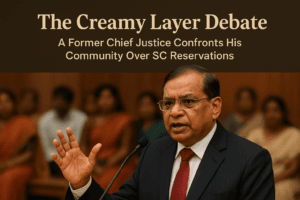
The Creamy Layer Debate: A Former Chief Justice Confronts His Community Over SC Reservations
A judge’s commitment to constitutional equality collides with community expectations, revealing deep fissures in India’s 75-year-old affirmative action experiment
The air at Mumbai University carried more than academic discourse on a recent Saturday when former Chief Justice of India B.R. Gavai delivered a lecture on affirmative action. What emerged was a rare, personal confession from one of India’s most distinguished jurists: he had been “widely criticised” by members of his own Scheduled Caste community for his judicial opinion that the “creamy layer” principle should apply to SC reservations.
This confrontation represents more than a personal predicament—it embodies a fundamental tension at the heart of India’s social justice policies. Should affirmative action benefits continue indefinitely across generations within historically disadvantaged communities? Or should mechanisms exist to redirect these benefits toward those who remain genuinely disadvantaged, even within these protected categories?
The Personal Confrontation: A Judge Faces His Community
Justice Gavai’s disclosure reveals the emotional and social cost of judicial independence. As only the second Dalit to serve as Chief Justice of India, his position carried particular weight within his community. Yet when he advocated applying the creamy layer principle to Scheduled Castes—a doctrine previously reserved mainly for Other Backward Classes—he faced accusations of hypocrisy.
“I was accused of taking benefit of the reservation myself to become a Supreme Court judge and then advocating the exclusion of those who fell in the creamy layer,” Gavai revealed during his lecture titled “Role of Affirmative Action in Promoting Equal Opportunity“. His response highlighted a common misunderstanding about India’s judiciary: “But these people did not even know that there is no reservation for the constitutional office of High Court or Supreme Court judge“.
Gavai’s personal journey mirrors the success story of affirmative action—rising from humble beginnings to India’s highest judicial office—yet his judicial reasoning now questions whether such success should lead to continued benefits for one’s descendants. This tension between personal identity and constitutional principles forms the core of this unfolding debate.
What Exactly Is the “Creamy Layer” Principle?
The creamy layer doctrine represents one of the most significant refinements to India’s reservation policy since its inception. Conceptually, it refers to economically and socially advanced members within backward classes who are excluded from reservation benefits to ensure those benefits reach the genuinely disadvantaged.
The doctrine originated in the landmark 1992 Indra Sawhney v. Union of India case (commonly known as the Mandal Commission case), where the Supreme Court upheld 27% reservations for Other Backward Classes but mandated exclusion of the “creamy layer”. The rationale was straightforward: reservation should not become a mechanism for perpetuating privilege within backward communities.
Table: Evolution of Income Threshold for Creamy Layer Exclusion
| Year | Income Threshold | Key Development |
| 1971 | ₹1,00,000 | Sattanathan Commission introduces concept |
| 1993 | ₹1,00,000 | Formal implementation post-Indra Sawhney |
| 2004 | ₹2.5 lakh | First revision |
| 2008 | ₹4.5 lakh | Second revision |
| 2013 | ₹6 lakh | Third revision |
| 2017 | ₹8 lakh | Current threshold (as of 2025) |
| *Sources: * |
The criteria extend beyond simple income thresholds. The framework also excludes children of constitutional functionaries (President, Supreme Court and High Court judges), high-ranking bureaucrats, military officers above colonel rank, and professionals like doctors, lawyers, and engineers earning above specified limits. Importantly, income from salaries and agricultural land is typically excluded from these calculations, focusing instead on “non-exempt” income that indicates accumulated wealth.
The Constitutional Question: Ambedkar’s Bicycle Analogy
At the heart of Justice Gavai’s argument lies a reinterpretation of B.R. Ambedkar’s original vision for affirmative action. Speaking on Ambedkar’s death anniversary, Gavai invoked what he called Ambedkar’s “bicycle analogy”:
“Babasaheb, in so far affirmative action is concerned, was of the view that it is like providing a cycle to those who are lagging behind…suppose somebody is at tenth km and somebody at zero, he (the latter) should be provided a cycle, so that he reaches faster till the tenth km. From there, he joins the person who is already there and walks along with him“.
Gavai then posed the critical question: “Did he (Ambedkar) think that the person should not leave the cycle and carry forward and thereby ask the people who are at zero km to continue to be there?“. His answer was emphatic: “In my view, that was not the vision of social and economic justice as contemplated by Babasaheb Ambedkar. He wanted to bring social and economic justice in the real sense and not in a formal sense“.
This interpretation frames affirmative action as a temporary equalizer rather than a permanent entitlement—a tool for overcoming initial disadvantage that should eventually be relinquished once a reasonable level of parity is achieved.
The Judicial Journey: From OBCs to SCs/STs
For nearly three decades following the Indra Sawhney judgment, the creamy layer principle applied primarily to Other Backward Classes. The Supreme Court explicitly stated in that judgment that the principle had “no relevance in the case of SCs and STs“. This distinction rested on the recognition that SC/ST backwardness stemmed from untouchability and extreme social segregation—factors presumed to affect all members regardless of economic status.
The judicial landscape began shifting with cases like M. Nagaraj v. Union of India (2006), where the Court upheld reservations in promotions for SCs/STs but introduced the concept of “quantifiable data” to demonstrate backwardness and inadequate representation. However, it was in Jarnail Singh v. Lachhmi Narain Gupta (2018) that the Court explicitly extended the creamy layer principle to SC/ST reservations in promotions.
Justice Gavai’s own contribution came in August 2024, when he was part of a Supreme Court bench that called for excluding the creamy layer within SCs and STs from reservation benefits. In a 281-page judgment, he analyzed stark disparities within these communities, particularly between urban and rural populations, concluding that treating all SCs/STs equally “would obliterate the equality principle enshrined in the Constitution“.
The Stark Reality: Why Gavai Questions Uniform Treatment
Justice Gavai’s judicial reasoning stems from observable socioeconomic realities within India’s marginalized communities. As he noted during his lecture, “I have travelled across the country, travelled across the world, I have seen many people belonging to the Scheduled Caste becoming chief secretary or director general of police or ambassadors and high commissioners“.
This progress—while celebrating the success of affirmative action—simultaneously reveals growing internal disparities. Gavai posed a poignant question that captures the essence of the debate:
“Can applying the same yardstick to the son of a chief justice of India or chief secretary and the son of a labourer who has studied in a gram panchayat school satisfy the test of equality as enshrined in the Constitution?“.
This question underscores a fundamental tension: when the child of an SC Chief Justice and the child of an SC manual laborer compete for the same reserved seat, does treating them identically advance substantive equality or undermine it?
The Implementation Challenge: More Complex Than Theory
The practical implementation of creamy layer exclusion for SCs/STs presents formidable challenges that extend beyond the already complex OBC framework:
Defining relevant criteria: While income thresholds provide a starting point, critics argue that economic measures alone cannot capture the persistent social discrimination faced by SCs/STs, even among affluent members. The social stigma of caste often persists despite economic mobility.
Administrative complexities: The 2024 Supreme Court ruling acknowledged “non-uniformity in the way different states and institutions have applied the doctrine,” resulting in “varied interpretations and confusion“. Creating a standardized, nationwide framework for SC/ST creamy layer identification would require substantial administrative machinery.
Data collection challenges: Unlike OBCs, who have been the subject of numerous socioeconomic surveys, comprehensive intra-community data on SC/ST stratification remains limited. As noted in legal analyses, “empirical evidence of benefit concentration” exists but systematic data collection is inadequate.
Political dimensions: The Union Government has expressed opposition to applying creamy layer principles to SCs/STs, arguing that “as per Babasaheb Dr B. R. Ambedkar’s Constitution there cannot be any creamy layer in SC and ST Reservation“. This creates potential friction between judicial directives and executive implementation.
Diverse Perspectives: Beyond Gavai’s Position
The debate extends far beyond Justice Gavai’s courtroom and lecture hall, encompassing diverse viewpoints:
The Uniform Backwardness Argument: Many scholars and activists maintain that caste-based discrimination affects all SCs/STs regardless of economic status. They argue that an affluent Dalit still faces social exclusion and stigma in ways that an affluent OBC might not. From this perspective, economic criteria alone cannot remedy caste-based oppression.
The Intersectionality Perspective: Some advocates suggest more nuanced approaches that consider multiple dimensions of disadvantage. The National Commission for Backward Classes has previously recommended sub-classifying OBCs into “backward,” “more backward,” and “extremely backward” categories. Similar approaches could theoretically apply to SCs/STs.
The “Sunset Clause” Debate: Broader questions concern whether reservation policies should have inherent time limits. While Gavai’s bicycle analogy suggests affirmative action should eventually be relinquished, others counter that structural inequalities persist and require ongoing remedial measures.
Table: Contrasting Positions on Creamy Layer for SCs/STs
| Position | Key Argument | Representative View |
| For Application | Promotes intra-community equity; prevents elite capture | Justice Gavai: Benefits should reach “genuinely disadvantaged” |
| Against Application | Caste discrimination persists regardless of economic status | Union Government: Discrimination “does not happen on economic basis” |
| Modified Application | Need nuanced criteria beyond income alone | NCBC: Recommended sub-classification within OBCs |
Looking Forward: The Future of Social Justice Policy
Justice Gavai’s personal confrontation with community criticism illuminates a pivotal moment in India’s social justice evolution. The debate transcends legal technicalities to touch fundamental questions about equality, representation, and the ultimate goals of affirmative action.
Several developments will likely shape this ongoing conversation:
Judicial consistency: The Supreme Court has acknowledged “judicial inconsistency” in applying the creamy layer doctrine, leading to “confusion and multiple interpretations“. Future rulings may seek to establish more coherent principles.
Data-driven policymaking: There’s growing emphasis on “quantifiable data” to guide reservation policies. Comprehensive surveys of intra-community disparities could inform more targeted approaches.
Legislative action: Parliament could potentially address these questions through constitutional amendments or new legislation, though such moves would inevitably generate intense political debate.
Social transformation: Ultimately, the most meaningful progress may come from broader social changes that reduce caste-based discrimination, potentially diminishing the need for remedial policies altogether—though this remains a distant prospect.
Justice Gavai concluded his lecture by acknowledging affirmative action’s positive role over 75 years. His personal journey from humble beginnings to Chief Justice of India stands as testament to that progress. Yet his willingness to question whether the same mechanisms that enabled his ascent should continue unchanged for future generations represents a courageous engagement with the next chapter of India’s equality project—one where the bicycle of affirmative action may need to be passed to those still at the starting line.
You must be logged in to post a comment.