
The Creamy Layer Conundrum: CJI Gavai’s Push for an Equity-Centric Revamp of SC Reservations
In a significant address days before his retirement, Chief Justice of India B.R. Gavai forcefully reiterated his stance that the ‘creamy layer’ exclusion should be applied to Scheduled Caste (SC) reservations, arguing that the child of a senior IAS officer and the child of a poor agricultural labourer, though both SC, cannot be equated, as treating them equally in reservations denies real equality of opportunity to the truly disadvantaged.
Citing a recent Supreme Court judgment that allowed sub-classification within SCs, Gavai emphasized that the goal of the Constitution is substantive, not just paper, equality, and that allowing a privileged section within the community to continually monopolize benefits undermines the policy’s core purpose of uplifting the most marginalized, even though this view remains contentious and has been widely criticized by those who believe it dilutes protections against the unique, perpetual stigma of untouchability.
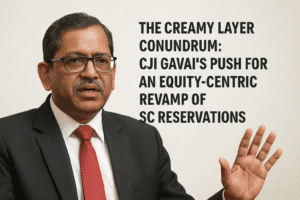
The Creamy Layer Conundrum: CJI Gavai’s Push for an Equity-Centric Revamp of SC Reservations
Meta Description: As his tenure concludes, Chief Justice of India B.R. Gavai reignites a critical debate: should the ‘creamy layer’ concept apply to Scheduled Caste reservations? We delve into the arguments for equitable distribution, the legal battle, and the quest for substantive equality.
Introduction: A Judge’s Parting Reflection on Substantive Justice
In the twilight of his tenure, Chief Justice of India B.R. Gavai chose not to reflect on the power of his office, but on a principle that lies at the heart of the Indian Constitution: substantive equality. Speaking in Amaravati just days before his retirement, CJI Gavai reaffirmed his contentious, yet profoundly compelling, stance—that the “creamy layer” exclusion must be applied to reservations for Scheduled Castes (SCs). This isn’t merely a legal opinion; it is a clarion call to re-evaluate whether a seven-decade-old policy is truly serving its purpose of uplifting the most marginalized, or if it has been co-opted by an entrenched elite within the community.
The Chief Justice’s analogy was stark and impossible to ignore: “Can the child of an IAS officer, who becomes chief secretary, and his son who gets the best of education in a city like Hyderabad or Bangalore, be equated with the child of a poor agricultural labourer studying in a village?” His answer, and the rationale behind it, cuts to the core of a national conversation about social justice, merit, and the evolving nature of discrimination.
The Legal Crucible: From Indra Sawhney to Sub-Classification
To understand the weight of CJI Gavai’s comments, one must look at the landmark 2024 judgment by a seven-judge bench of the Supreme Court, which he referenced. The central issue was the sub-classification of Scheduled Castes—does a state government have the right to create sub-groups within the SC list to ensure that benefits trickle down to the most backward among them?
The verdict was overwhelmingly clear: six of the seven judges held that sub-classification is permissible. If a state finds that reservation benefits are being monopolized by a few dominant castes within the SC category, leaving others behind, it has the constitutional authority to correct this imbalance. This was a monumental shift, acknowledging the complex, multi-layered reality of deprivation within the legally monolithic SC group.
However, CJI Gavai, in his concurring opinion, went a step further. He argued that the logic of the **”creamy layer”**—a principle established in the seminal 1992 Indra Sawhney case (the Mandal Commission case) for Other Backward Classes (OBCs)—should be extended to SCs. The Indra Sawhney judgment held that to ensure reservations reach the “truly backward,” more affluent and advanced members of OBCs (the creamy layer) should be excluded. CJI Gavai’s view is that the same principle of internal exclusion is necessary to achieve “real equality” among SCs.
The Philosophical Core: Paper Equality vs. Real Equality
The crux of the opposition to the creamy layer for SCs has historically been that unlike OBCs, whose backwardness is primarily social and educational, the stigma of untouchability attached to SCs is perpetual and unchangeable. A wealthy Dalit, it is argued, still faces the social disability of caste-based discrimination, which reservations are designed to mitigate.
CJI Gavai’s reasoning challenges this by focusing on the objective of equality of opportunity. He invokes the trinity of the Constitution—Liberty, Equality, and Fraternity—as envisioned by Dr. B.R. Ambedkar. His argument posits that “paper equality,” where two individuals from vastly different socioeconomic strata within the same caste are treated identically, can itself be a form of injustice.
“Equality should not be only a paper equality but a real equality,” he asserted.
In this framework, providing reservation to the well-off, third-generation beneficiary from a family of senior bureaucrats does not serve the objective of uplifting the community from the depths of generational poverty and oppression. In fact, it actively denies that opportunity to the poorest Dalit family in a remote village, for whom the reservation policy was originally conceived. It creates a new, privileged class within a disadvantaged community, thereby perpetuating internal inequality.
The Human Dimension: The IAS Officer’s Son vs. The Labourer’s Child
Let’s flesh out the Chief Justice’s analogy. The son of the Dalit IAS officer has access to elite private schools, high-quality coaching institutes, a home environment rich in social and cultural capital, and the security of a life free from material want. The concept of “stigma”, while potentially present in social interactions, does not translate into a lack of opportunity in the same visceral way.
Contrast this with the daughter of the Dalit agricultural labourer. Her life is likely defined by economic precariousness, under-resourced government schools, the social tyranny of caste in a village setting, and the constant pressure to contribute to family survival. For her, the hurdle is not just the potential discrimination at the end of the ladder, but the inability to even find the first rung.
To treat these two individuals as equally entitled to a reserved seat in a medical college or a government job is, as CJI Gavai suggests, to misunderstand the very meaning of equity. It confuses the means (caste-based reservation) with the ends (socio-economic upliftment of the most backward).
The Road Ahead: A Fractured Verdict and a National Dialogue
While CJI Gavai’s view is powerful, it is important to note that it did not command a majority. In the seven-judge bench, only three other judges concurred with his specific opinion on applying the creamy layer to SCs. This indicates that the legal battle is far from over. The judgment opened the door for sub-classification, but the specific tool of the creamy layer remains a point of vigorous judicial and political debate.
The criticism he acknowledges is real and passionate. Many Dalit intellectuals and activists fear that introducing the creamy layer is the first step towards dismantling the fundamental protection that reservations provide against the unique and enduring evil of untouchability. They argue it is a slippery slope that could be exploited by those who wish to dilute reservation policies altogether.
Yet, CJI Gavai’s parting reflections force a necessary introspection. As India evolves, so must its tools for justice. The data from various states increasingly shows a concentration of reservation benefits among a handful of dominant SC castes. The question is no longer if there is an internal hierarchy, but how the system should respond to it.
Conclusion: An Unfinished Project of Justice
CJI Gavai’s journey from a municipal school in a semi-slum area of Amravati to the highest judicial office in the land is a testament to the transformative power of the Constitution he now interprets. His personal narrative lends a unique moral authority to his call for a more nuanced application of reservation policy.
His stance is not an attack on reservations, but a plea to refine them. It is a call to ensure that the ladder of social mobility is not held by those who have already climbed it, but is extended downward to those still trapped in the well of historical injustice. By championing the exclusion of the creamy layer, he is arguing for a reset—a return to the foundational purpose of reservations: to create a truly level playing field where the son of a labourer can, against all odds, dare to dream of becoming a Chief Justice himself.
The debate he has reignited will undoubtedly continue in courtrooms, parliament, and public forums. But by framing it around the poignant contrast between two children of the same caste, separated by a chasm of opportunity, he has ensured that the human face of this constitutional dilemma remains at the forefront. The quest for “real equality” continues.
You must be logged in to post a comment.