
The “Core 5” Concept: Analyzing Trump’s Reported Plan for a New Global Power Bloc
The reported “Core 5” concept, allegedly drawn from a draft Trump National Security Strategy, envisions a radical shift in U.S. foreign policy away from values-based alliances like the G7 toward a hard-power bloc comprising the United States, China, Russia, India, and Japan.
Defined by population size, military capability, and geopolitical influence rather than democratic norms, the proposed forum would prioritize direct great-power bargaining, acceptance of spheres of influence, and transactional diplomacy, with early focus areas such as Middle East security.
Its most disruptive implication is the sidelining of Europe, signaling a potential downgrading of the transatlantic alliance and a reordering of global power structures. For India, inclusion would acknowledge its rising status but also pose strategic dilemmas by placing it alongside key partners and adversaries in a single framework. Whether or not the Core 5 ever materializes, the debate itself reflects a growing recognition in Washington of a multipolar world and a willingness to reconsider the foundations of the post–Cold War international order.
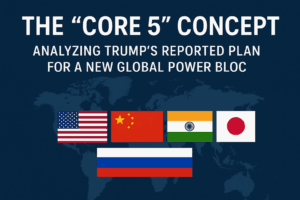
The “Core 5” Concept: Analyzing Trump’s Reported Plan for a New Global Power Bloc
Reports from Washington suggest a radical shift in U.S. foreign policy may be in the works. The concept of a “Core 5” (C5) bloc, uniting the United States, China, Russia, India, and Japan, has emerged from leaks of an alleged unpublished draft of the Trump administration’s National Security Strategy (NSS). While the White House firmly denies any “alternative, private, or secret version” of the strategy exists, the idea has ignited intense debate among policymakers and analysts about the future of American alliances and the structure of global power.
This reported plan would represent more than a simple diplomatic reshuffle. It signals a potential fundamental reorientation—away from traditional, values-based alliances like the G7 and toward a pragmatic, power-centric forum that intentionally sidelines Europe and elevates strategic competitors.
The Reported “Core 5” Blueprint
According to detailed reports from publications like Defense One and Politico, the alleged C5 framework is designed as a high-level platform for the world’s most populous and influential states. Each proposed member nation has a population exceeding 100 million, representing a combined total of about 3.5 billion people.
The group’s proposed operation mirrors that of the G7, with plans for regular summits built around specific thematic issues. A primary agenda item identified in the reports is security in the Middle East, with a focus on advancing diplomatic normalization between Israel and Saudi Arabia.
The selection criteria mark a decisive break from the post-Cold War order. Unlike the G7, which is defined by member wealth and democratic governance, the C5 would be defined by **”hard power”**—sheer population size, military capability, and global influence. This shift away from ideological alignment to pure power calculus is a hallmark of the reported strategy.
The following table outlines how the proposed “Core 5” contrasts with the existing G7 framework:
| Feature | Reported “Core 5” (C5) Bloc | Existing G7 Grouping |
| Proposed Members | US, China, Russia, India, Japan | US, Canada, Japan, Germany, France, UK, Italy (EU participates) |
| Core Selection Criteria | Population (>100M), Military/Economic “Hard Power,” Global Influence | Wealth, Advanced Economy, Democratic Governance |
| Geopolitical Focus | Direct great-power negotiation; Spheres of influence; Transactional deals | Coordination among Western liberal democracies; Shared values |
| Reported First Agenda | Middle East security (Israel-Saudi normalization) | Varied (global economy, security, climate, etc.) |
| Stated/Implied Goal | Manage a multipolar world through direct engagement with major rivals | Uphold and promote a rules-based international order |
A Radical Shift in U.S. Strategic Worldview
The C5 concept does not exist in a vacuum. It is presented as a key component of a broader, and starkly different, U.S. national security philosophy captured in the alleged unpublished NSS draft. This worldview represents a clean break from the foreign policy of both Democratic and Republican administrations since the end of the Cold War.
The reported draft explicitly rejects the goal of American global dominance, stating: “Hegemony is the wrong thing to want and it wasn’t achievable”. It criticizes post-Cold War foreign policy elites for believing “permanent American domination of the entire world was in the best interests of our country,” arguing instead that U.S. concern should be limited to activities that “directly threaten our interests”.
This translates into two major policy thrusts:
- A “Hemisphere-First” Focus: The strategy reportedly calls for the U.S. to concentrate its commitments on issues directly affecting American interests, prioritizing its own hemisphere—Latin America and the Caribbean. Brookings scholars note this reorientation essentially asserts a “Trump Corollary” to the Monroe Doctrine, aiming to counter Chinese influence and control migration and drug flows, potentially through military means.
- A Redefinition of Competition: The public NSS notably abandons the explicit language of “great power competition” that framed the approach to China and Russia during both the first Trump administration and the Biden era. Instead, it frames challenges as “managing European relations with Russia” and “rebalancing America’s economic relationship with China,” implying a move toward accepting spheres of influence and transactional diplomacy over ideological confrontation.
The Calculated Snub: Europe’s Exclusion and Destabilization
The most immediate and explosive implication of the C5 proposal is the deliberate exclusion of Europe. No European Union country or traditional ally like the UK is included, sending a seismic signal that the Atlantic alliance is no longer the central pillar of U.S. global strategy.
Analysts like Torrey Taussig, a former NSC official, argue this would lead European capitals to a stark conclusion: the U.S. now views Russia as the dominant power capable of exercising its sphere of influence in Europe. This is compounded by the reported draft’s startling assessment of Europe as facing “civilizational erasure” due to immigration and societal changes.
Beyond exclusion, the alleged strategy takes an activist approach to undermining European unity. It reportedly encourages Washington to “work more with” right-leaning governments in Austria, Hungary, Italy, and Poland “with the goal of pulling them away from the [European Union]”, as part of an effort to “Make Europe Great Again”. The document also advocates supporting political parties and cultural figures in Europe who champion national sovereignty and traditional social frameworks.
India’s Pivotal and Precarious Position
For India, inclusion in the theoretical C5 is a double-edged sword, reflecting both its meteoric rise and the complexities of modern geopolitics.
On one hand, it is a recognition of prime geopolitical stature. India’s inclusion alongside the other giants is an acknowledgment of its demographic and economic weight, its critical geographic position connecting the Indo-Pacific to West Asia, and its status as a major power not formally tied to any bloc. This aligns with the NSS’s public praise for the Quad (US, India, Japan, Australia) and encouragement for India to play a larger security role in the Indo-Pacific.
On the other hand, it places New Delhi in an immensely challenging position. India would be asked to sit as a peer in a forum containing both its most important strategic partner (the US) and its most formidable military adversary (China), with which it shares a tense, disputed border. Furthermore, it would have to navigate this alongside Russia, a longstanding defense partner now deeply alienated from the West.
This proposed structure could potentially marginalize the Quad, a grouping India has invested in deeply, by creating a new, more powerful inner circle that includes China and Russia but excludes other democratic partners like Australia. India has not officially commented on the C5 reports, and its silence likely reflects a careful calculation of these profound risks and opportunities.
From Theory to Reality: Significant Obstacles Ahead
Despite the compelling logic to analysts who see it as a “very Trumpian idea,” the path from a leaked concept to a functioning international body is fraught with obstacles.
- Official Denials and Authenticity: The White House’s firm denial of any alternate NSS draft is a significant barrier. Without official acknowledgment, the idea remains in the realm of speculation and unattributed reporting.
- Inherent Member Conflicts: The proposal assumes that deep, existential conflicts between member states can be managed within a single club. The intense US-China rivalry across trade, technology, and military domains, the hot war between US-ally Japan and a Russia-China aligned North Korea, and the ongoing India-China border tensions present a web of hostilities that would complicate, if not paralyze, collaborative decision-making.
- Execution vs. Vision: As Brookings scholar Daniel Hamilton notes, documents like the NSS are often “barometers of countervailing pressures” within an administration rather than operational blueprints. The gap between articulating a vision of burden-sharing with “regional champions” and the messy reality of implementing it is vast.
Conclusion: A Signal of a Transforming World Order
Whether the “Core 5” evolves into a formal institution or remains a rhetorical artifact of a controversial draft, its eruption into public discourse is profoundly significant. It crystallizes a foreign policy philosophy that is transactional, non-ideological, and premised on a stark recognition of multipolarity.
The very fact that such a concept is being debated seriously in Washington forces a global reassessment. It signals to Europe that its post-war reliance on American leadership can no longer be assumed, to China and Russia that raw power can secure a seat at the top table, and to rising powers like India that the architecture of global governance may be ripe for disruptive change. In this sense, the “Core 5” is more than a proposal—it is a potent symbol of a world where the old rules are being rewritten, and the new ones are yet to be determined.
You must be logged in to post a comment.