
The Constitution of Silence: What the Palestinian Draft Charter Reveals About the Future of Peace
The draft constitution for a proposed “State of Palestine” is deeply flawed not by what it includes—democratic language and institutional frameworks—but by what it omits: any mention of Israel, any recognition of Jewish historical ties to the land, any defined borders signaling finality of claims, and any repudiation of violence. Most troubling, it constitutionally enshrines state responsibility for “martyrs” and “prisoners”—terms that in Palestinian political vocabulary refer to individuals who carried out terrorist attacks against Israeli civilians—thereby elevating a pay-to-slay infrastructure to foundational legal status. A constitution that cannot name its neighbor, define its borders, or disentangle national identity from honoring those who killed civilians does not represent a blueprint for peaceful coexistence, but rather preserves the mechanisms and narratives of perpetual conflict.
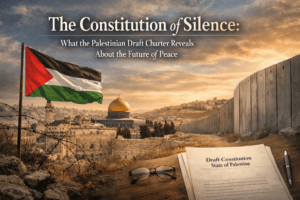
The Constitution of Silence: What the Palestinian Draft Charter Reveals About the Future of Peace
On paper, it reads like the founding document of a nation ready to take its place among the community of states. The newly released draft constitution of the “State of Palestine” contains all the expected hallmarks of modern governance—democratic institutions, separation of powers, rights protections, and nods to international law. It is polished, professional, and presented with the gravity that such foundational documents deserve.
But there is something haunting about what remains unwritten.
For those who have lived through the decades of conflict, who have buried children killed in terrorist attacks, who have watched peace processes rise and collapse under the weight of unspoken truths, this document tells a story far more powerful than its carefully crafted articles reveal. It is a story told through silence.
The Name That Cannot Be Uttered
The most striking absence in the draft constitution is anything resembling recognition of the State of Israel. Not merely diplomatic recognition—that could presumably come through separate instruments—but any acknowledgment whatsoever that the Jewish people exist as a nation with legitimate ties to this land.
Nowhere in the document does the word “Israel” appear. Nowhere does it reference the Jewish people’s three-thousand-year history in the region. Nowhere does it suggest that the proposed Palestinian state envisions itself living alongside another sovereign entity with its own legitimate claims and aspirations.
This is not a minor omission. Constitutions are the moments when national movements define themselves for posterity. They answer fundamental questions: Who are we? What do we believe? How do we intend to relate to others? When a proposed state cannot bring itself to name its neighbor in its founding charter, it signals something profound about the nature of the peace it envisions.
Consider what this means for future generations of Palestinian schoolchildren. Their constitution—the supreme law of their land—will not require them to learn about the Jewish state next door. Their textbooks will not be measured against a constitutional mandate for peaceful coexistence. Their leaders will take oaths to a document that treats Israel as an unmentionable void.
The peace process has always struggled with the gap between interim agreements and final status expectations. But a constitution is supposed to be final. It is supposed to resolve ambiguities, not preserve them. By maintaining this silence, the draft ensures that the question of Israel’s legitimacy—indeed, its very existence—remains constitutionally unsettled.
Borders Drawn in Sand, Claims Without End
The draft constitution declares Jerusalem the capital and speaks expansively of homeland and land. But it notably fails to define the territorial borders of the proposed state. This is not an accidental oversight.
Constitutions typically establish jurisdiction with precision. They define where the state’s sovereignty begins and ends. They draw lines. Here, the lines remain deliberately blurred, and that ambiguity serves a purpose that peace advocates should examine carefully.
A state without defined borders is a state that has not resolved its claims. It is a state that preserves the ability to assert rights over territory beyond whatever negotiated settlement might emerge. It is a state whose constitutional DNA contains the seeds of future conflict.
The international community has long insisted that the path to peace requires two states for two peoples, with mutually agreed borders that end all claims. Yet this constitutional draft does not reflect that vision. Instead, it creates a framework in which borders remain perpetually negotiable—not in the diplomatic sense, but in the existential sense of national purpose.
When combined with the preservation of the Palestine Liberation Organization as the “sole legitimate representative” even after statehood, the document suggests a dual-track approach that has haunted peace efforts for decades: statehood as a phase, not a resolution.
Martyrs, Prisoners, and the Constitution of Violence
Then there is the most troubling feature—the constitutional elevation of what Palestinians call “martyrs” and “prisoners” to objects of state responsibility and honor.
Article after article mandates comprehensive care for these categories and their families. The state assumes responsibility for their welfare, their medical needs, their social integration. On its face, this might sound like a compassionate social welfare provision. But in the Palestinian political lexicon, these terms carry specific and violent meanings.
“Martyrs” are not civilians who died in crossfire or victims of war. They are individuals who died while carrying out attacks against Israelis—including suicide bombings, shootings, and stabbings of civilians. “Prisoners” are not ordinary criminals. They are men and women convicted in Israeli courts of terrorism offenses, many involving the murder of innocent people.
The Palestinian Authority’s system of payments to these individuals and their families—what critics have long called “pay-to-slay”—has been a flashpoint in international diplomacy for years. The United States and other nations have passed laws conditioning aid on the cessation of these payments. Israel has documented in painstaking detail how financial rewards for terror create perverse incentives for violence.
Palestinian officials have insisted that reforms were implemented, that payments were folded into broader social welfare mechanisms, that the system no longer encourages terrorism. A constitution presented to the world as evidence of state-building maturity offered the perfect opportunity to make that case definitively.
Instead, the draft entrenches the system at the highest legal level.
This is not reform. This is constitutionalization. It takes a controversial infrastructure associated with incentivizing violence and elevates it to a permanent feature of the state’s relationship with its citizens. Future Palestinian governments would require constitutional amendments to change this structure—assuming any government would dare challenge such deeply embedded national narratives.
What Peace Requires
As the father of Alisa Flatow, a twenty-year-old American student murdered in a Palestinian terrorist attack in 1995, I read this document with eyes that have seen too much. I have spent decades fighting for justice against Iranian-sponsored terror, watching the families of my daughter’s murderers receive financial rewards and public honors. I know what these words mean in practice, not just on paper.
Constitutions teach the next generation what is sacred. They are the foundational texts that shape national identity and values. When a proposed state embeds support for “martyrs” in its constitution, it tells every Palestinian child that killing civilians is not merely tolerated but honored. It tells the families of victims like my Alisa that their loved ones’ murders are considered worthy of state celebration.
Peace requires more than institutional architecture. It requires intellectual honesty. It requires defining borders and ending open-ended claims. It requires teaching children that killing civilians is not martyrdom but murder. It requires acknowledging the other people who claim rights to the same land and recognizing the legitimacy of their state alongside one’s own.
This draft constitution does none of these things.
The document speaks the language of rights and democracy because that language is expected by the international community. But beneath the modern vocabulary lies an older vocabulary—one of unending conflict, of national identity built on sacrifice for the cause, of a neighbor whose existence cannot even be acknowledged in writing.
The Test of Seriousness
There will be those who argue that constitutions are living documents, subject to amendment and interpretation. That the draft represents a starting point, not a final word. That Palestinian statehood will create responsibilities and moderate political culture over time.
Perhaps. But the test of seriousness is whether a national movement uses its foundational moment to close doors or leave them open. Does it lock in conflict or lock in peace? Does it entrench narratives of victimhood and violence or commit to coexistence and reconciliation?
The international community should read this draft carefully before applauding it as evidence of Palestinian readiness for statehood. The polished language and democratic rhetoric should not distract from the core questions: Can a state make peace when its constitution cannot name its neighbor? Can it build coexistence when its foundational document honors those who killed civilians? Can it achieve finality when its borders remain deliberately undefined?
A constitution that cannot bring itself to mention Israel is not yet a blueprint for peace. It is a blueprint for continued conflict, dressed in the language of modernity and presented to a world too eager to see progress where none exists.
The door to peace remains open only when both sides walk through it together. This draft leaves that door wide open—but to continued claims, continued ambiguity, continued honoring of violence. That is not a door to peace. It is a door to more of the same.
And for those of us who have buried children killed in this conflict, more of the same is simply unacceptable.
You must be logged in to post a comment.