
The Concert Economy: How India’s Youth Are Powering a Billion-Dollar Experience Revolution
India’s live entertainment sector is undergoing a seismic shift, powered by its young, affluent demographic whose disposable income is increasingly spent on experiences rather than goods. This surge is fueled by digitally native fandom that transcends city tiers, drawing global artists to multiple Indian hubs and generating a powerful “concert economy” with significant spillover effects into tourism, hospitality, and local retail. While landmark events like Coldplay’s Ahmedabad concerts have proven the scale of demand and economic impact—generating billions in revenue—the industry faces a critical infrastructure gap, with a shortage of large-scale venues threatening to constrain future growth. As the government aims to position India among the world’s top live entertainment destinations, this youth-driven movement marks a profound cultural and economic renaissance, transforming collective passion into a formidable economic force.
The Concert Economy: How India’s Youth Are Powering a Billion-Dollar Experience Revolution
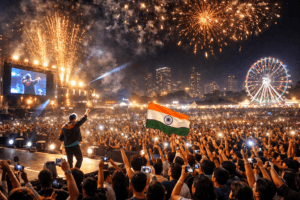
If you want to understand the changing pulse of India, don’t just look at stock indices or tech hubs. Look at the crowds—the seas of people chanting lyrics in unison, the smartphone lights swaying in stadium darkness, the vibrant, eager faces waiting for hours to witness their favorite artists. From the bustling streets of Mumbai to the growing urban centers of Guwahati and Nashik, a profound shift is underway. India’s youth are not just attending concerts; they are architecting a vibrant, multi-billion rupee “experience economy,” and the world is finally taking note.
This isn’t merely about entertainment. It’s a socio-economic metamorphosis driven by demography, disposable income, and a deep-seated desire for collective moments in an increasingly digital world. The live event, once a rarity for international A-list acts, has become a staple of Indian urban life, creating powerful ripple effects that are reshaping cities, consumer behavior, and the nation’s cultural footprint.
The Demographic Engine: Affluence Meets Aspiration
The foundation of this boom is incontrovertible: India’s formidable youth demographic. With over 100 million more people expected to join the working-age population by 2030, the country boasts not just numbers, but a generation with growing economic power. Per capita income is rising fastest among major emerging markets, creating a substantial cohort of young, affluent professionals.
For this generation, spending is increasingly tied to value defined by experience and identity, not just ownership. As Raghav Anand of EY Parthenon notes, “Once you are affluent, it is about new experiences.” A premium concert ticket or a festival pass is a badge of participation, a source of social currency, and an investment in personal joy. It’s the antidote to the isolation of screens—a chance for what fan Tanvi Shirgaonkar calls “collective effervescence.” This shift from buying things to buying moments is the core of the revolution.
The Fandom Revolution: Beyond Metros, Beyond Borders
A critical evolution has been the democratization of fandom. Digital platforms—Spotify, YouTube, social media—have dissolved geographic and linguistic barriers. A fan in Shillong can discover Japanese artist Fujii Kaze as easily as someone in South Mumbai. This has fundamentally altered the touring map for global artists.
Gone are the days when a tour meant a single stop in Mumbai or Delhi. Now, artists like Travis Scott and Coldplay are playing in Ahmedabad, and festivals like Lollapalooza have planted their flags firmly in Indian soil. The staggering growth in live event footfalls in cities like Shillong (213%) and Guwahati (188%) isn’t a anomaly; it’s a testament to powerful, untapped demand. Naman Pugalia of BookMyShow hits the nail on the head: “Fandom is such a powerful force that it knows really no definitions of tiers or metros.”
This decentralization is forcing the industry to evolve, pushing infrastructure and investment beyond traditional hubs and validating India as a multi-city touring destination.
The Economic Ripple: More Than Just a Ticket
The true magnitude of this trend is seen in its spillover effects. A single concert is now a significant economic event. The Coldplay concerts in Ahmedabad, for instance, weren’t just a musical success; they were an economic catalyst, generating an estimated ₹6.41 billion ($70.5 million) in value.
This “concert economy” energizes a whole ecosystem:
- Hospitality & Tourism: Hotels, homestays, and flights see a surge. Fans often turn a concert into a weekend getaway.
- Local Retail & Services: Restaurants, cafes, transportation, and retail shops around venues experience a massive boom in footfall.
- Job Creation: From event security and stagehands to vendor staff and promotional crews, live events generate extensive temporary and permanent employment.
- City Branding: Cities like Ahmedabad have been repositioned on the global cultural map, attracting future events and tourism.
The government’s vision to place India among the world’s top five live entertainment destinations by 2030 recognizes this potent combination of cultural soft power and hard economic benefits.
The Infrastructure Gap: The Challenge Within the Boom
Yet, this breakneck growth is straining a still-nascent infrastructure. The euphoria is sometimes met with logistical headaches. As Anand points out, “The expectation has gone up.” Audiences now demand global-standard experiences: seamless entry and exit, high-quality acoustics, clean facilities, and sophisticated production.
The stark reality is a shortage of large-scale, purpose-built venues. With fewer than ten such venues capable of hosting over 10,000 people in major cities, and a glaring absence in smaller ones, the physical space to host this demand is limited. This gap presents both a challenge and a colossal opportunity for investors and city planners. The next phase of growth will depend heavily on bridging this infrastructure deficit to ensure safety, comfort, and sustainability.
The Turning Point and the Road Ahead
Many industry experts point to Coldplay’s 2025 Ahmedabad tour as a watershed moment. It proved that India could not only sell out massive shows but could execute them at a scale that impressed global standards. It showcased the organized spending power of the Indian fan and gave other international artists the confidence to plan elaborate Indian legs.
As we look to 2026 and beyond, the concert economy is approaching an inflection point. The trend is set to mature from a boom into a robust, structured pillar of the consumer economy. We can expect to see:
- More Genre Diversity: Beyond pop and rock, growth in hip-hop, indie, regional language tours, and electronic music.
- Experience Innovation: An expansion in premium offerings—from VIP packages to integrated festival camping experiences.
- Strategic Investments: Increased investment in venue development, crowd management technology, and artist discovery platforms focused on regional talent.
In the end, the roar of the crowd in an Indian stadium is more than just sound. It’s the echo of a demographic dividend in full swing, the signature of a generation asserting its cultural identity, and the heartbeat of a new economic reality. India’s youth are writing a new script—one where passion fuels the economy, and the main events are live, loud, and here to stay. The world isn’t just watching; it’s now tuning in to perform.
You must be logged in to post a comment.