
The Cold Reality: Winter Storms Compound Gaza’s Postwar Misery
The Cold Reality: Winter Storms Compound Gaza’s Postwar Misery
In the war-ravaged Gaza Strip, the onset of winter has become a lethal emergency. A two-week-old baby, Mohammed Abu al-Khair, succumbed to severe hypothermia in a hospital in Khan Younis, becoming a tragic symbol of a crisis that extends far beyond the battlefield. His death underscores a chilling truth: for over a million displaced Palestinians, a ceasefire has not meant safety, but a desperate struggle for survival against the cold, the rain, and a collapsed infrastructure.
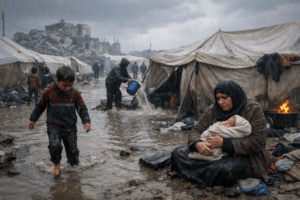
The recent heavy rains and winds have flooded makeshift shelters, destroyed precarious belongings, and exposed families to a brutal combination of wet and cold. This natural disaster, unfolding atop a man-made catastrophe, reveals the profound fragility of life in Gaza more than two months after the guns fell silent and the immense challenges that lie ahead for any meaningful recovery.
A Landscape of Rain, Rubble, and Ruined Shelter
For the estimated one million Gazans living in tents and other makeshift shelters, the past week of storms has been catastrophic. “Last night was really horrendous for the families,” reported Jonathan Crickx, Chief of Communications for UNICEF in the State of Palestine. From his office, he observed up to 15 centimeters of standing water, with families resorting to buckets in a futile attempt to bail out their homes.
The shelters themselves offer little protection. Most are fashioned from nothing more than tarpaulins or plastic sheeting nailed to fragile wooden frames, unable to withstand strong winds or pooling water. The UN reports that over 40 designated emergency shelters were severely flooded, forcing already displaced people to relocate yet again. In one camp in Deir al-Balah, CNN footage showed dozens of dilapidated tents standing in muddy water, with children hopping barefoot over massive puddles.
The consequences are dire for health and safety. Beyond the immediate threat of hypothermia, flooded areas mix rainwater with sewage and garbage, creating a toxic environment ripe for disease outbreaks. “We are very, very concerned… to see children getting sick,” Crickx warned, describing the damp clothes and soaked mattresses of the children he met.
The Hidden Killer: War-Damaged Infrastructure Collapsing in the Storm
The rains have activated a second, silent threat lurking in Gaza’s urban landscape: critically damaged buildings. Two years of bombardment have left structural weaknesses invisible until stress tests like heavy rain and wind. The result has been deadly collapses.
Gaza’s Civil Defence agency reported that 17 residential buildings collapsed completely and another 90 partially collapsed due to the storm. The human cost is significant. While Gaza’s Health Ministry confirmed at least 11 storm-related deaths from building collapses, the Civil Defence put the toll higher at 17, including four children. Video footage from the Shati refugee camp showed first responders recovering a man’s body from the rubble of a suddenly collapsed roof, a grim scene repeated across the territory.
These collapses starkly illustrate that the storm’s impact is not merely a weather event but a direct continuation of the war’s destruction. As Dr. Muneer al-Bursh of Gaza’s Health Ministry stated, the storm represents a “fourth tragedy” for residents, compounding killing, displacement, and exile.
The Scale of the Response and the Gap in Need
International aid agencies have mobilized a significant winter response, but it is a race against time and a tide of overwhelming need.
Aid Delivered vs. Immense Need: A Snapshot
| Aid Item | Quantity Distributed or in Pipeline | Scale of the Need |
| Winter Clothing Kits | Over 384,000 kits (distributed & planned) | For 1 million children in Gaza |
| Blankets | Over 913,000 (distributed & planned) | For families in flooded, unheated tents |
| Tents & Tarpaulins | Thousands of tents, hundreds of thousands of tarps | Shelters for 1.5 million people lacking adequate shelter |
UNICEF has described this as one of its largest-ever winter stockpiles for Gaza, with kits containing jackets, hats, gloves, and even shoes for children walking barefoot across rubble. The UN and partners are also clearing storm drains, reinforcing areas with sandbags, and distributing food parcels to hundreds of thousands.
Yet, the consensus from the ground is unambiguous: it is not enough. “We are working relentlessly… but the scale of the needs is so immense,” Crickx stated, noting that the flimsy shelters “are not made to withstand a storm”. Haytham Herzallah of Medical Aid for Palestinians pointed out that even the tents that have arrived are “designed for desert conditions” and do not protect from rain or cold.
Aid access remains a point of tension. While the Israeli military body Cogat states that 600-800 trucks of humanitarian supplies enter Gaza daily, UN agencies report ongoing restrictions and obstructions. The UN notes that critical items, including education materials, remain blocked from entry.
Beyond Immediate Relief: The Daunting Road to Reconstruction
The current crisis is a stark preview of the monumental challenges facing Gaza’s long-term recovery. Even as humanitarians battle the floods, broader questions about governance, security, and reconstruction loom, unanswered.
- A Vacuum of Power and a Struggle for Control: The ceasefire, based on a U.S.-brokered plan, is fragile. While the agreement envisions a committee of Palestinian technocrats to run Gaza, no such body is yet in place. On the streets, Hamas police have returned to routine duties like traffic control, but the group has also engaged in deadly clashes with other Palestinian factions and carried out public, summary executions. This reality underscores the profound security and governance vacuum. As a CNAS policy report warns, removing Hamas’s governance leaves a significant power vacuum, and the question of “Who will be in charge?” is central to any chance of recovery.
- The $70 Billion Reconstruction Puzzle: The United Nations estimates the cost of rebuilding Gaza at a staggering $70 billion. However, the path to that reconstruction is fraught. Israel, which controls half of Gaza’s territory and all its crossings, has said it will forbid reconstruction in Hamas-held areas until the group disarms and has historically restricted materials like concrete over security concerns. Furthermore, the planning process itself has become politicized and competitive. The Guardian reports that U.S. contractors with political connections are already jockeying for a piece of the anticipated reconstruction effort, with one planning document envisioning a “Master Contractor” system that could gross $1.7 billion a year on trucking fees alone.
The Human Face of an Enduring Crisis
Behind the statistics on tents and tonnage are countless stories of resilience and exhaustion. Umm Mohammed Assaliya, a displaced mother in Gaza City, told Al Jazeera, “We try to dry the children’s clothes over the fire… The tent we were given cannot withstand winter conditions. We need blankets”.
In a PBS interview, Jonathan Crickx of UNICEF recounted meeting a three-year-old girl named Bisan. “She was very, very cute. But at the same time she was extremely cold and her sweatpants were extremely dirty and wet… she should just have a proper shelter. She should be able to go to a kindergarten, play with toys and not be in a situation like she is today”.
These individual portraits highlight that the crisis in Gaza has evolved but not ended. The ceasefire halted the bombs and bullets, but it did not halt the suffering. It merely changed the primary agents of threat—from explosives to exposure, from airstrikes to illness. The winter storms have made it brutally clear that for Gaza’s displaced millions, peace, in any meaningful sense of the word, remains a distant prospect. Their immediate future hinges not only on the arrival of more robust tents and warmer blankets but on the swift establishment of functional governance, sustained humanitarian access, and a credible, inclusive plan to rebuild a territory that has been pushed to the very brink.
You must be logged in to post a comment.