
The Classroom Battlefield: How School Textbooks Shape the Next Generation of Conflict
School textbooks in several Middle Eastern education systems, including those used by the Palestinian Authority and in Tunisia, have been found to contain content that glorifies violence, promotes antisemitic stereotypes, and erases or distorts historical facts, according to research by monitoring organizations like IMPACT-se. These materials, which range from poems praising child martyrs in Gaza to literature textbooks presenting Adolf Hitler in a positive light while omitting the Holocaust, serve to entrench conflict narratives and dehumanize perceived enemies for the next generation. Critics argue such assessments can reflect political agendas, yet the persistent pattern across different subjects and grade levels raises significant concerns about how systemic educational indoctrination perpetuates cycles of conflict by shaping young minds to view violence as heroic and compromise as betrayal, thereby undermining the foundations for future peace despite some countries demonstrating that more balanced and tolerant curricula are possible.
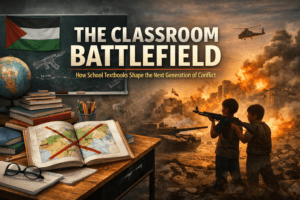
The Classroom Battlefield: How School Textbooks Shape the Next Generation of Conflict
The lessons children learn today become the convictions they fight for tomorrow.
In Grade 12 classrooms across the Palestinian territories, students study a poem that venerates children in Gaza who fight and die as martyrs to liberate Palestine. In neighboring Tunisia, eleventh-grade literature books describe Adolf Hitler as one of the “most important figures” of the 20th century, crediting him with building Germany into a great power while largely omitting the Holocaust. These are not isolated incidents but part of a deeply entrenched pattern across several national education systems, where textbooks become instruments for shaping ideology, entrenching conflict, and defining the enemy.
A comprehensive analysis by the Institute for Monitoring Peace and Cultural Tolerance in School Education (IMPACT-se) reveals a troubling educational landscape in parts of the Middle East and North Africa. Their research, spanning hundreds of textbooks from multiple countries, uncovers how curriculum materials often glorify violence, promote antisemitic stereotypes, and erase historical facts to serve political narratives. This is more than an academic concern—it represents a strategic battlefield where the minds of future generations are shaped, with profound implications for the possibility of lasting peace in one of the world’s most volatile regions.
The Palestinian Curriculum: A Case Study in Systemic Incitement
The Palestinian Authority’s curriculum, used in West Bank, Gaza, and East Jerusalem schools (including those operated by UNRWA), presents perhaps the most comprehensive example of how education can be weaponized. Despite international pressure and promises of reform, the 2025-2026 curriculum remains substantively unchanged from previous editions, systematically promoting themes across all subjects, including math and science.
Key findings from the Palestinian curriculum analysis reveal:
- Glorification of Violence and Martyrdom: Textbooks frequently promote jihad and present armed struggle as a noble pursuit. Historical figures who carried out deadly attacks against civilians are held up as role models. A particularly disturbing element is the reported teaching of a poem that praises children in Gaza for fighting and dying as martyrs.
- Systematic Antisemitism: Jewish people are routinely portrayed through damaging stereotypes, with materials blaming Jews for regional misfortunes and suggesting inherent negative characteristics.
- Erasing Israel and Rejecting Peace: Maps consistently label all of Israel as “Palestine,” physically erasing the Jewish state from geographical awareness. The curriculum rejects the two-state solution and presents peacemaking as undesirable.
Perhaps most alarmingly, this curriculum is taught in UNRWA schools despite the agency’s mandate to uphold United Nations values of peace and neutrality. IMPACT-se’s research indicates that UNRWA-produced materials themselves contain content encouraging jihad, violence, and martyrdom, directly contradicting the organization’s stated zero-tolerance policy for incitement.
A Regional Pattern: Textbook Content Across the Middle East
The Palestinian case, while particularly comprehensive, is not unique. IMPACT-se’s regional research reveals similar patterns in several Middle Eastern education systems, though with significant variation in approach and emphasis.
| Country | Key Findings in Textbooks | Notable Examples/Context |
| Tunisia | Glorification of Hitler while minimizing Holocaust; antisemitic stereotypes; hostility toward Israel. | Grade 11 Literature textbook describes Hitler as important figure without mentioning Holocaust; Grade 12 poem praises child martyrs in Gaza. |
| Jordan | Extreme antisemitic tropes; justification of violence against Israel; negative portrayal of peace treaty; legitimization of Hamas attacks; Holocaust absent. | New content downplays October 7 attacks; maps erase Israel; Zionism framed as racist colonial conspiracy. |
| Pakistan | Hostility toward Jews and India; jihad framed as armed struggle; religious content integrated into non-religious subjects. | Textbooks frequently sideline non-Muslims; fail to meet UNESCO standards for promoting peace. |
| Iraq | Valorization of violent jihad and martyrdom; antisemitic stereotypes; paternalistic gender content. | Patterns raise concerns about compliance with international tolerance standards. |
| Indonesia | Shift toward inclusivity and tolerance; more balanced portrayal of Jews; elimination of problematic content. | Merdeka Curriculum highlights minority religions as essential to national identity. |
| Uzbekistan/Kazakhstan | Respectful introduction of Judaism; acknowledgment of antisemitism and Nazi genocide; varied but generally balanced portrayal of Israel. | Efforts to promote interfaith harmony while distinguishing religious conservatism from extremism. |
This comparative view reveals a striking divergence between countries. While Tunisia, Jordan, and Pakistan maintain curricula with significant problematic content, Indonesia has made notable progress toward inclusivity, and Central Asian nations like Uzbekistan and Kazakhstan present more balanced approaches. This variation suggests that political will, rather than cultural or religious inevitability, drives these educational choices.
Two Sides of the Narrative: Critiques and Counter-Critiques
The conversation about textbook bias is not one-sided. Arab scholars and media outlets offer pointed critiques of IMPACT-se’s methodology and motivations. An analysis from Noon Post argues that IMPACT-se functions as “a tool that Israel relies on in this path, hiding behind the slogan of ‘comprehensive peace,'” suggesting the institute promotes normalization with Israel under the guise of educational reform.
These critiques highlight several important tensions:
- Political Agendas in Educational Assessment: Critics argue that organizations evaluating textbooks inevitably bring their own political perspectives, potentially pathologizing legitimate national narratives about resistance and self-determination.
- Asymmetrical Scrutiny: Some Arab commentators note that while Palestinian and Arab textbooks face intense international examination, Israeli educational materials receive less systematic review for content that might dehumanize Palestinians or justify occupation.
- The “Normalization” Debate: From this perspective, efforts to remove “problematic” content from Arab textbooks represent a soft power strategy to manufacture generational acceptance of Israel’s presence without addressing underlying political grievances.
These counter-narratives complicate any simplistic reading of the textbook debate, reminding us that education never exists in a political vacuum. What one side views as “incitement,” another may regard as “patriotic education” or “preservation of national narrative.”
The Stakes: Education as a Determinant of Future Peace
The content of school textbooks matters profoundly because education shapes foundational worldviews during the most formative years of cognitive and moral development. Children taught through materials that glorify martyrdom, dehumanize “the other,” and erase competing historical narratives internalize these perspectives as fundamental truths.
Several concerning implications emerge from the current educational landscape:
- Perpetuation of Conflict Cycles: When children learn that violence against civilians is heroic and that compromise with “the enemy” is betrayal, they become adults psychologically prepared for endless conflict rather than negotiated peace.
- Intergenerational Transmission of Trauma and Hatred: Educational systems that emphasize victimization without acknowledging the humanity of opposing groups ensure that historical grievances continue to fuel present-day animosities.
- Undermining of Diplomatic Efforts: Peace processes consistently falter when populations have been educated to view the other side as fundamentally illegitimate or subhuman. No diplomatic agreement can survive long-term without corresponding educational transformation.
- Radicalization Pathways: While not every student exposed to problematic content becomes radicalized, such materials create an ecosystem where extremist narratives appear reasonable and mainstream.
Toward Solutions: Principles for Educational Transformation
Addressing problematic content in textbooks requires nuanced approaches that respect national sovereignty while promoting values conducive to peace. Several principles emerge from successful examples like Indonesia’s curriculum reform:
- Comprehensive Review Processes: Independent, multidisciplinary committees including historians, child psychologists, peace educators, and representatives of different community perspectives should regularly review educational materials.
- Historical Accuracy Without Erasure: Textbooks should present historical events factually, including difficult histories of victimization and conflict, without glorifying violence or dehumanizing any group.
- Humanization of “The Other”: Even while teaching about political conflicts, curricula should include materials that acknowledge the humanity, culture, and legitimate aspirations of all parties involved.
- Promotion of Critical Thinking: Rather than presenting a single, authoritative narrative, educational materials should help students develop tools to analyze multiple perspectives and conflicting claims.
- Alignment with International Standards: UNESCO’s guidelines for peace and tolerance education provide valuable benchmarks for developing balanced curricular materials.
The Classroom as Peace Laboratory
The battle over textbooks represents a fundamental struggle over narrative, memory, and identity. As the IMPACT-se reports document, this struggle has concrete consequences in classrooms from Tunis to Gaza, where poems praise child martyrs and history books whitewash genocide. These educational choices don’t merely reflect existing conflicts—they actively shape future ones, determining whether the next generation inherits tools for peace or weapons for perpetual war.
The divergent paths taken by different countries—from Jordan’s regression to Indonesia’s progress—prove that change is possible when educational reform becomes a political priority. This reform must be balanced, addressing problematic content wherever it appears, whether in Arab textbooks that dehumanize Jews or in Israeli materials that might marginalize Palestinians.
In the end, the question is not merely what facts children memorize, but what values they internalize. Will they learn that their identity depends on the dehumanization of others? Or will they discover that true strength lies in the courage to acknowledge complex truths, to see humanity in the enemy, and to imagine futures beyond the cycles of retaliation? The answers being written into today’s textbooks will determine the possibilities available to tomorrow’s peacemakers.
You must be logged in to post a comment.