
The Chulha vs. The Conflict: Inside India’s Emergency LPG Plan as the Iran War Threatens the Kitchen
Amidst the escalating Iran war and the subsequent blockade of the Strait of Hormuz that threatens India’s energy supplies, the government has issued an emergency directive ordering all domestic refiners to maximize LPG production and sell it exclusively to state-run oil marketing companies—Indian Oil, HPCL, and BPCL—for the sole purpose of supplying domestic households, while simultaneously banning the diversion of propane and butane for petrochemical use. This move, designed to shield millions of vulnerable households from the immediate impact of the global gas squeeze, effectively centralizes the country’s LPG supply chain to prioritize kitchen fuel over commercial needs, though it risks straining the commercial sector and comes alongside a precarious 30-day US waiver allowing India to import stranded Russian crude as a temporary stopgap.
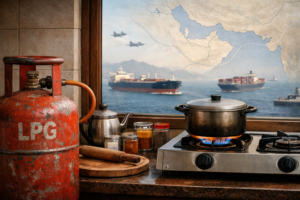
The Chulha vs. The Conflict: Inside India’s Emergency LPG Plan as the Iran War Threatens the Kitchen
On a normal day, the hiss of gas escaping a burner is the most mundane of sounds—the herald of a morning cup of chai or a family dinner. In India, that sound emanates from over 330 million kitchens, the vast majority of which are powered by Liquefied Petroleum Gas (LPG). It is the fuel of the nation’s domestic life, the silent partner in the daily ritual of cooking.
But in the first week of March 2026, that hiss took on a geopolitical weight. As global headlines screamed of drone attacks on Qatar’s Ras Laffan and Iranian blockades in the Strait of Hormuz, the Indian government issued a quiet but seismic directive to its oil refiners: stop thinking like global traders and start thinking like quartermasters for the nation’s kitchens.
The order, released on March 6, 2026, is a masterstroke of crisis management and a stark admission of vulnerability. It tells onshore refiners to maximize LPG production and sell it exclusively to three state-run behemoths—Indian Oil Corporation (IOC), Hindustan Petroleum Corporation Limited (HPCL), and Bharat Petroleum Corporation Limited (BPCL). This LPG is then strictly earmarked for domestic consumers only.
This is not just a supply chain adjustment; it is the story of how a war 2,000 kilometers away is forcing the world’s most populous nation to ration its most essential household fuel, turning every cylinder into a strategic asset.
The Anatomy of a Crisis: When the Global Gas Grid Fractures
To understand the gravity of the March 6 order, one must first understand India’s energy architecture. India is a hydrocarbon-hungry giant, importing roughly 85% of its crude oil and natural gas needs. While crude oil is refined into petrol and diesel—the fuels of mobility and industry—LPG occupies a sacred space. It is the fuel of the aam aadmi (common man), the clean cooking energy that replaced the smoky, health-hazardous chulhas of the past.
Under the Pradhan Mantri Ujjwala Yojana, the government distributed millions of free connections to below-poverty-line households. To disrupt this supply is not just an economic problem; it is a political and humanitarian red line.
The current disruption stems from the escalating Iran-Israel conflict, which has now drawn in major Gulf powers. The crisis reached a critical mass when:
- Qatar’s Ras Laffan was attacked: The world’s largest LNG (Liquefied Natural Gas) terminal faced a drone attack attributed to Iran. While LPG and LNG are different, the attack signaled that no energy infrastructure in the region was safe. Qatar is also a major LPG supplier, and the fear of escalation froze spot markets.
- The Strait of Hormuz was choked: Tehran followed through on decades of threats by effectively blocking the Strait of Hormuz, a narrow passage through which nearly a fifth of the world’s oil and a quarter of its LPG passes. For India, the math is terrifying—nearly half of its oil and gas imports traverse these waters daily.
In the global energy game, when the tap is squeezed, prices skyrocket. But for India, the fear wasn’t just about price; it was about physical availability. Ships carrying propane and butane (the two components of LPG) were stuck, rerouted, or too expensive to insure. The just-in-time global energy supply chain was snapping.
The Government Order: From Petrochemicals to the Kitchen Stove
The March 6 directive is a fascinating case study in economic centralization during a crisis. It effectively severs the open market for domestically produced LPG and creates a closed loop between refiners and the public.
The directive has three key pillars:
- Maximization & Monopsony: Refiners are ordered to run their plants to squeeze out every possible molecule of LPG. But they cannot sell it to the highest bidder. The only buyers are IOC, HPCL, and BPCL. This turns the three state-owned companies into a monopsony (a single buyer group), allowing the government to control the aggregate stockpile.
- The Ban on Petrochemical Conversion: This is perhaps the most technically significant part of the order. Refiners have been asked to avoid using propane and butane for petrochemical production. In a normal market, a refiner might look at the price of plastics or synthetic rubber and decide it’s more profitable to crack those hydrocarbons into higher-value products. That is now forbidden. The LPG must remain LPG. A barrel of oil can yield many things; the government has just dictated that, for now, the priority is a cooking flame, not a plastic bottle.
- The Domestic Wall: The LPG sold to IOC, HPCL, and BPCL can be resold only to domestic customers. This is a move to starve the commercial sector to feed the household one. Restaurants, hotels, industrial canteens, and autogas (LPG used as vehicle fuel) will likely face severe shortages or exorbitant prices in the parallel market as supply is diverted to ration cards and subsidized connections.
Human Impact: The Invisible Shield and the Visible Strain
What does this look like on the ground? It looks like reassurance in some places and anxiety in others.
For a family in rural Bihar or urban Mumbai with a Ujjwala connection, the immediate impact might be invisible—for now. The government is using its massive public distribution machinery to ensure that subsidized cylinders continue to reach them. The order acts as an invisible shield, buffering the most vulnerable from the global storm.
However, the strain is already visible elsewhere. In the narrow bylanes of Old Delhi or the bustling restaurant districts of Bangalore, owners are watching the news with dread.
“We are already paying a premium for commercial cylinders,” says Rajiv Mehra, who runs a small dhaba in Punjabi Bagh, New Delhi. “If the supply is capped to save only household gas, where does that leave us? We either increase prices or shut down. The customer will pay either way—first at my restaurant, then at the grocery store when transport costs rise.”
This is the cascading effect of the policy. By protecting the domestic kitchen, the government is effectively squeezing the commercial sector. This will likely lead to:
- Inflationary Spiral: Restaurants will pass on increased fuel costs. Industries using LPG for cutting, brazing, or as a fuel source will face production halts, impacting employment and output.
- The Black Market Premium: The price differential between subsidized domestic gas and scarce commercial gas will widen, creating a lucrative incentive for diversion and pilferage. Enforcement agencies will have their work cut out trying to ensure that subsidized cylinders sold to households aren’t secretly powering a roadside eatery.
The Russian Pivot: A 30-Day Lifeline or a Geopolitical Trap?
The LPG directive does not exist in a vacuum. Simultaneously, India is playing an even more dangerous game on the crude oil front. The United States, recognizing the catastrophic potential of a full-blown energy crisis in the world’s fifth-largest economy, issued a temporary 30-day waiver, allowing India to import Russian oil that is already at sea.
Treasury Secretary Scott Bessent called it a “stopgap measure” to “enable oil to keep flowing.” In less than a day, Indian refiners snapped up nearly 20 million barrels of seaborne Russian Urals.
This is a breathtakingly swift pivot, but it is laced with conditions. As part of an interim India-US trade deal, New Delhi has agreed to eventually abstain from Russian oil imports, which Washington argues funds the war in Ukraine.
This puts India in a geopolitical crucible. The 30-day window allows it to stockpile crude, which can be refined to produce more petrol, diesel, and—critically—more LPG. But it’s a Band-Aid on a bullet wound. The crude arriving now will extend the runway by a few weeks, but if the Strait of Hormuz remains closed and the war continues, the Indian economy faces a hard landing by April.
The Strategic Stockpile and the Road Ahead
For decades, energy analysts have argued for India to build a strategic crude oil reserve, which it has. But the current crisis highlights a new vulnerability: the lack of a strategic product reserve. You can store crude, but you need a functioning refinery to turn it into LPG. If the refining system is disrupted or if the crude doesn’t arrive, the reserve is useless.
The government’s current strategy is therefore threefold:
- Maximize Domestic Capture: The March 6 order ensures that every drop of LPG produced in India stays in India for its citizens.
- Diversify Crude Sources: The US waiver for Russian oil allows for a last-minute shopping spree to build crude inventories.
- Diplomatic Firefighting: Behind the scenes, Indian diplomats are likely in overdrive, talking to other Gulf nations like Saudi Arabia and the UAE, as well as Central Asian states, to secure alternative overland or maritime routes, though infrastructure for massive LGP imports via land is limited.
Conclusion: The New Normal of Energy Insecurity
The image of the Indian housewife lighting her stove is a powerful political symbol. By issuing this order, the government has signaled that protecting that flame is its non-negotiable priority, even if it means upending market economics and straining relations with the commercial sector.
The March 6 directive is more than a news item; it is a snapshot of a world fracturing along energy lines. It shows that in the 21st century, war is no longer confined to battlefields. It is fought in the straits, the pipelines, and the refineries. And its first victims are often the most mundane yet most essential aspects of our daily lives—the simple act of cooking a meal.
As the smoke clears from the drones in the Gulf, the real challenge for India has just begun: navigating a protracted period of energy scarcity where every cylinder counts, and the sound of cooking is also the sound of a nation holding its breath.
You must be logged in to post a comment.