
The Choice Against Peace: At the UN, Palestine Warns Annexation Is No Longer a Whisper, But a War Cry
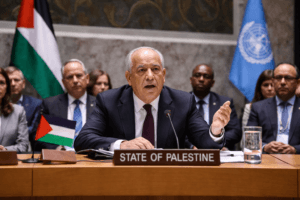
In a powerful address to the UN Security Council, Palestine’s Permanent Observer Riyad Mansour declared that Israel has definitively chosen annexation over peace, using systematic tactics like settlement expansion, land confiscation, and forced displacement to seize Palestinian land while stripping away the fundamental rights of its people. He argued that the Israeli government’s extremist ideology, voiced by ministers like Smotrich, seeks to eliminate the possibility of a Palestinian state entirely, viewing Palestinians as demographic obstacles rather than a nation with inherent rights. Despite condemnation from over 100 countries and all Security Council members, Israel is accelerating its land grab, even undermining fragile ceasefires in Gaza, betting that it can present the world with a fait accompli. Mansour warned that with 7.5 million Palestinians living under Israeli control from the river to the sea, the international community must decide whether this reality will lead to equal rights or perpetual oppression, urging immediate action to prevent the two-state solution from becoming a dangerous illusion.
The Choice Against Peace: At the UN, Palestine Warns Annexation Is No Longer a Whisper, But a War Cry
The first lights of Ramadan traditionally signify a time for reflection, community, and spiritual renewal. But for Palestinians in Jerusalem, the West Bank, and Gaza, the crescent moon ushers in a holy month marked not by peace, but by deprivation. As Minister Riyad Mansour, the Permanent Observer of the State of Palestine to the United Nations, stood before the Security Council on a winter day in New York, his words carried the weight of a people for whom the most fundamental rites of faith have become a battleground.
“The first day of the holy month of Ramadan arrives this year while Palestinians are deprived of practicing their religious rites freely and peacefully,” Mansour stated, setting a somber tone for a ministerial meeting convened to dissect a rapidly deteriorating reality in the Middle East.
But his address was far more than a lament. It was a stark, forensic indictment of a decades-long conflict reaching a precipice. The message was clear: Israel has made its choice. It has chosen land over peace, annexation over negotiation, and in doing so, has thrown the very concept of a two-state solution into an existential crisis.
From Creeping Occupation to Blatant Annexation
For years, the international community has watched the slow, systematic erosion of Palestinian territory with a mixture of condemnation and inertia. Settlements expanded, outposts were legalized, and the dream of a contiguous Palestinian state was slowly strangled by a network of checkpoints, bypass roads, and restricted areas. Mansour argued that this gradual process was merely the tool; the objective has always been the same.
“Israel’s goal has long been to displace the Palestinian people in order to seize their land,” he asserted. “The scale and pace have changed, but the tools and objectives remain the same.”
He painted a picture of a relentless machinery of dispossession: settlement construction that carves up the West Bank, settler terrorism that empties villages of their inhabitants, land confiscation justified by ancient religious texts or modern “security” needs, and the demolition of homes that leaves families homeless in the cold. These are not random acts of conflict; they are the deliberate dismantling of a nation’s infrastructure.
Mansour argued that this is no longer a creeping occupation. It has morphed into something more brazen. “Recent Israeli decisions signify the end of the road,” he warned. “Annexation is now blatantly obvious.” He framed this as a defining moment for the region and the world. To ignore it is to accept a future where might makes right, where international law is a suggestion, and where the map of the Middle East is redrawn not by peace agreements, but by force.
The Ideology of Denial
The Palestinian envoy delved into the ideological undercurrent driving these policies, pointing a finger directly at members of the current Israeli government. He quoted the extremist Finance Minister, Bezalel Smotrich, who boasted, “We are strengthening our grip on the land and eliminating the idea of a Palestinian state in the heart of the country.”
This, Mansour argued, is not fringe rhetoric; it is the operating principle of key ministers. It is an ideology that views Palestinians not as a people with inherent rights, but as demographic obstacles to be managed, contained, or removed. He cited a chilling statement from the Israeli Foreign Minister following the October 7th attacks, suggesting Gaza must be made “smaller” because that is “the price the Arabs understand.”
This narrative, Mansour contended, is “fundamentally racist.” It casts Israelis as defenders of civilization against a faceless enemy, dehumanizing Palestinians to justify their oppression. It is a worldview that denies the very existence of a Palestinian nation, treating the people of the West Bank and Gaza as strangers in their own ancestral homeland.
A Global Consensus, An Israeli Rejection
In a rare moment of unity, the world pushed back. Mansour revealed that over 100 countries and organizations, including all fifteen members of the Security Council, voiced their opposition to Israel’s annexation measures, declaring them a violation of the UN Charter and international law.
Yet, the international consensus seems to be met with a shrug in Jerusalem. Mansour posed a poignant question to the Council: Why is Israel accelerating its land grab at this precise moment? Why now, just days before a planned Peace Council meeting in Washington? Why at a time when the US administration and regional actors are struggling to solidify a fragile ceasefire in Gaza?
The answer, he suggested, is that Israel sees a window of opportunity. It is betting that the world’s attention is divided, that the US election cycle creates a political vacuum, and that it can present the international community with a fait accompli. It may offer “tactical concessions”—perhaps a temporary pause in settlement announcements—but “strategically it continues to seize land.”
He accused Israel of actively sabotaging the very ceasefire it ostensibly agreed to. By killing Palestinians, restricting humanitarian aid, keeping the Rafah crossing closed, and blocking the Palestinian Authority from assuming its rightful role in Gaza, Israel is ensuring the conflict remains a wound that cannot heal. The goal, Mansour implied, is to create a reality where Gaza is permanently severed from the West Bank, destroying the territorial contiguity required for a viable Palestinian state.
The Demographic Reality and the River-to-Sea Question
Perhaps the most powerful part of Mansour’s address was his reframing of the demographic debate. For decades, the focus has been on the Jewish majority in Israel. But Mansour flipped the script.
He noted that despite being confined to smaller and smaller enclaves, Palestinians have not disappeared. “In fact, their numbers in Gaza are increasing,” he stated, a quiet testament to a people’s resilience. He pointed to the growing Palestinian population in the West Bank.
Then he raised the specter of the Israeli right’s own slogan: “from the river to the sea.” He took this slogan, often used as a rallying cry by both sides, and placed it in the context of governance. “Israel is now talking about controlling the area from the river to the sea, a territory inhabited by 7.5 million Palestinians,” he said.
He posed the ultimate question that Israel must answer, not to the Palestinians, but to the world and itself: “Will this grant them equal rights? Or will it make their lives impossible through death, destruction, and displacement?”
This is the core of the matter. If Israel seeks to control all the land, it must decide the fate of the people on it. If it chooses a Jewish state over a democratic one, it must choose oppression. Mansour accused the government of seeking to “ignite an explosion in the West Bank” through military incursions and unchecked settler violence, deliberately destabilizing the Palestinian Authority, the very entity committed to the peaceful, two-state solution the international community claims to support.
The Two-State Illusion
As his address drew to a close, Mansour issued a final, urgent plea. He called on the world to affirm, “in word and deed,” that Gaza and the West Bank, including East Jerusalem, are one territorial unit—the State of Palestine. He warned against allowing the two-state solution to devolve into a “two-state illusion.”
His words served as a stark reminder that a solution is not a slogan. It requires tangible action to stop the machine of annexation. It requires holding violators of international law accountable. It requires recognizing that the Palestinian people are not a problem to be managed, but a nation with an inalienable right to self-determination.
The choice, as Mansour framed it, is brutally simple. Israel has chosen annexation. Now the Security Council, the United States, and all nations who claim to seek peace must answer a different question: Will they stand by and watch as that choice seals the fate of the region in blood and division, or will they finally find the will to enforce the laws and resolutions they have spent decades writing? The answer will determine not just the future of Palestine and Israel, but the very credibility of the international order.
You must be logged in to post a comment.