
The Chainsaw’s Echo: In the West Bank, the Uprooting of Olive Trees Is an Uprooting of History
This feature article expands on a news report about Israeli forces uprooting 500 olive trees near Ramallah, framing the act not merely as agricultural destruction but as a profound cultural and historical assault on Palestinian identity, where olive trees symbolize heritage, livelihood, and sumud (steadfastness). It explores the geopolitical context of the separation wall and nearby settlements, which enable such actions under the guise of security, while delving into the human cost—describing the psychological trauma of farmers who watch their ancestral groves, and their future, demolished by military bulldozers. Ultimately, the piece portrays this event as a microcosm of the broader conflict, where the systematic uprooting of trees represents a deliberate erasure of memory and a tool of displacement that resonates through generations.
The Chainsaw’s Echo: In the West Bank, the Uprooting of Olive Trees Is an Uprooting of History
The call came just before sunset on Friday. For the farmers in the villages of Deir Qadis and Kharbatha Bani Harith, west of Ramallah, the end of the work week was supposed to be a time of quiet rest. Instead, the rumble of heavy machinery shattered the evening calm, an all-too-familiar sound of dread echoing off the hills.
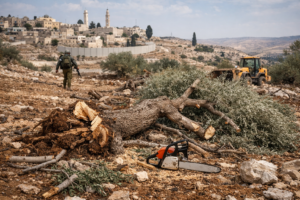
By nightfall, the landscape had been scarred. According to local sources speaking with the official Palestinian news agency WAFA, Israeli military bulldozers had leveled approximately 70 dunams (about 17 acres) of land. In their wake lay the splintered remains of an estimated 500 olive trees, some of them likely decades old, their gnarled trunks and silver-green canopies reduced to piles of kindling.
The official justification, as reported, was the proximity of the land to the Israeli separation wall and the adjacent Kiryat Sefer Modi’in settlement. The area was declared a closed military zone. But for the Palestinian families who have tended these groves for generations, the military order is not a legal document; it is a death sentence for their heritage.
This was not a spontaneous act of vandalism, but a calculated operation in a long-running, low-intensity conflict. To understand what happened on that hillside west of Ramallah is to understand the core of the Israeli-Palestinian struggle—a fight not just over land, but over memory, sustenance, and the very root of national identity.
More Than a Tree: The Olive as a Palestinian Symbol
In the West Bank, the olive tree is not merely a crop; it is a cornerstone of existence. It is a silent witness to history, a provider of life, and a potent symbol of sumud—the Arabic word for steadfastness, resilience, and attachment to the land.
These trees are family heirlooms. A farmer will often tell you that a particular tree was planted by his grandfather, or his great-grandfather. The ownership is not just recorded in Ottoman-era land deeds or Jordanian tax records; it is etched into the collective memory of the village. The annual harvest, a ritual that brings together extended families, is a celebration of continuity. It is a time when university students take leave from their studies and city dwellers return to their ancestral villages to beat the branches with long sticks, collect the fruit in burlap sacks, and carry it to the local press for the year’s supply of golden, peppery oil.
To uproot an olive tree, therefore, is to sever that connection. It is an act of ecological and cultural vandalism. When 500 trees are destroyed in a single evening, a community doesn’t just lose a season’s income; it loses a part of its story. The ancient trees, with their thick, twisting trunks, are living monuments. Their destruction sends a chilling message: your past is not safe, and your future here is uncertain.
The Geopolitics of a Bulldozer
The location of this particular uprooting is key. The villages of Deir Qadis and Kharbatha Bani Harith lie in the so-called “Seam Zone”—the area between the Green Line (Israel’s pre-1967 border) and the separation barrier. The wall, which Israel began constructing in the early 2000s, was officially justified as a security measure to prevent suicide bombings. However, in the West Bank, it deviates significantly from the Green Line to encompass major Israeli settlements on occupied land.
For Palestinians living near the wall, life is a bureaucratic nightmare. To access their own land on the other side of the barrier, farmers must obtain permits from the Israeli military authorities. These permits are notoriously difficult to acquire, often seasonal, and can be revoked without explanation. The area is frequently declared a “closed military zone,” as it was on Friday, preventing access for anything from a few hours to several days—or, in the case of these 70 dunams, indefinitely.
The proximity to the Kiryat Sefer Modi’in settlement (also known as the city of Modi’in Illit) adds another layer of complexity. International law, specifically the Fourth Geneva Convention, prohibits an occupying power from transferring its civilian population into the territory it occupies. Yet, these settlements continue to expand. The land taken for the wall, and the land cleared for “security reasons” near settlements, is often a precursor to further expansion. The destruction of agricultural land clears the way for the construction of more housing units, more roads for settlers only, and a deeper entrenchment of the occupation. The bulldozers that tore through the olive groves are, in this context, the advance guard of urbanization.
The Human Cost: Beyond the Headline
While the WAFA report gives us the crucial numbers—500 trees, 70 dunams—it cannot convey the personal devastation.
Imagine a farmer from Deir Qadis, let’s call him Abu Ahmed. For him, the olive grove was his second home. He knew each tree individually. One, with a split trunk, was where he sat as a boy and watched his own father work. Another, with a particularly high yield, produced the oil he reserved for his family’s own table for the entire year. The grove was his pension plan, his children’s university fund, and his connection to the soil that defines him.
On Friday evening, he heard the news. By the time he reached the outskirts of his land, the military jeeps had set up a cordon. He could only watch from a distance as the D9 bulldozer, an armored behemoth, pushed its blade through the trees. The sound of snapping wood, carried on the wind, was the sound of his life’s work being erased. The loss is not just economic; it is psychological. It is a deep, generational trauma that reinforces a sense of powerlessness.
For the women of the village, who often play a crucial role in the harvest, the loss is also social. The olive harvest is a time of communal work, of preparing large meals for the pickers, of storytelling and solidarity. The uprooting of the groves disrupts this social fabric, scattering families and severing the communal ties that have held these villages together for centuries.
A Policy of Protest and the Cycle of Response
The international community routinely condemns the destruction of Palestinian agricultural property. The United Nations Office for the Coordination of Humanitarian Affairs (OCHA) has documented thousands of trees uprooted by Israeli forces and settlers over the years. Human rights organizations like B’Tselem and Amnesty International have classified such actions as a form of collective punishment and a violation of international law.
Yet, the cycle continues. The official Israeli justification often revolves around security—trees providing cover for attackers, or land being required for military purposes. In other cases, trees are uprooted because they were planted without a permit in “Area C” (the 60% of the West Bank under full Israeli military control), where Palestinian development is severely restricted. But for the farmers of Deir Qadis, these are not abstract legal arguments. The trees were on land they have cultivated for generations, long before the wall, before the settlements, and before the military orders.
The response from the Palestinian Authority and various factions is predictable: official condemnations, statements to the press, and appeals to international bodies. But for the villagers, these words offer little solace. Their immediate concern is the practical reality of a destroyed livelihood. Some may try to replant, knowing that a new sapling will take years, perhaps a decade, to reach full productivity. Others, despairing, may give up, adding to the wave of migration from rural areas to cities or abroad, which is precisely the outcome such policies can engender.
The Sound of Silence
As night fell on Friday, the bulldozers eventually fell silent. The soldiers withdrew. In the morning, the residents of Deir Qadis and Kharbatha Bani Harith were left to survey the damage. The air, which once carried the scent of wild thyme and olive blossom, now smelled of churned earth and diesel.
The scene was one of desolation. The ancient trees, some with trunks thicker than a man’s torso, lay twisted and broken, their roots, once sunk deep into the terraced hillside, exposed to the sun. The 500 stumps that remained were like grave markers in a cemetery of memory.
This is the reality of life under occupation—a life where the most mundane, peaceful act of tending a tree can be interrupted by the roar of a military bulldozer. The story from west of Ramallah is not just a news item; it is a parable for the entire conflict. It is a story about the immense power of a modern army against the fragile, defiant steadfastness of a farmer and his olive grove. And as long as the chainsaw and the bulldozer are instruments of policy, the echo of that destruction will continue to reverberate through the hills of Palestine, a mournful sound that carries the weight of history and the fear for the future.
You must be logged in to post a comment.