
The Ceasefire Mirage: How Gaza Became Invisible While Suffering Continued
The October 2025 ceasefire in Gaza created a dangerous illusion of peace, shifting international attention away while the humanitarian crisis transformed rather than ended. Though large-scale bombing decreased, hundreds were still killed in ongoing attacks, while mass death continued through less visible means: winter storms flooded fragile tents, weakened buildings collapsed on families, and preventable diseases spread amid Israel’s systematic restriction of aid and medical evacuations. This “low-grade mass killing” and bureaucratic strangulation of humanitarian support, combined with the targeting of journalists and the global media’s quick shift to other news, rendered Gaza’s suffering invisible, allowing a normalized catastrophe to continue unseen by the world.
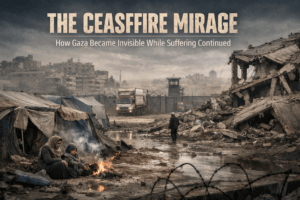
The Ceasefire Mirage: How Gaza Became Invisible While Suffering Continued
“The real goal of the ceasefire was not to stop the violence or death… The real goal was to stop the world from talking about Gaza.” – Eman Abu Zayed, Palestinian writer from Gaza.
When a fragile ceasefire took hold in Gaza in October 2025, a devastating new phase began. For those outside, the headlines faded and the sense of urgent crisis subsided. Inside the Strip, however, the suffering transformed rather than ceased, entering a period of what one writer has termed “low-grade mass killing”. This is the story of how a territory vanished from global consciousness while its people remained trapped between bombed-out ruins and flooded tents, facing death by exposure, starvation, and bureaucratic suffocation.
The Illusion of Calm: Violence in a New Form
The announcement of a ceasefire brought momentary relief and streets “erupted with ululations and cheers”. This hope proved tragically short-lived. While large-scale aerial campaigns may have paused, violence persisted in other, more sporadic forms.
According to the Gaza government media office, at least 418 Palestinians were killed and more than 1,110 injured in Israeli attacks in the period following the October ceasefire. Military actions continued across the territory, from artillery fire in the Bureij refugee camp to airstrikes in the Zeitoun neighborhood of Gaza City. These incidents represent not a clean break from war, but a shift in its tempo and character, one less likely to dominate international news cycles yet equally deadly for those in its path.
A Grim Choice: The Tents or the Ruins
With approximately 400,000 homes destroyed during the war, displaced Palestinians face an impossible decision each day: seek shelter in a flimsy tent exposed to winter storms or risk living in the skeletal remains of a building that could collapse at any moment.
The Peril of Makeshift Tents: An assessment by shelter specialists in Gaza revealed that thousands of tents supplied by various countries, including China, Egypt, and Saudi Arabia, are inadequate for winter conditions. Their fabric tears easily, is not waterproof, and their structures are weak. During recent storms, fierce winds blew down or damaged thousands of these tents, affecting at least 235,000 people. Linda Abu Halima, 30, described her family’s tent as “worn out and rainwater leaks inside,” a handmade structure of wood and tarpaulin they cannot afford to replace.
The Danger of Damaged Buildings: The alternative is arguably more terrifying. Two years of intense bombing have left countless structures critically unstable. Winter rains seep into cracks, saturating soil and further weakening foundations. The results are predictable and deadly. During one storm, 11 Palestinians were killed in less than 24 hours when homes collapsed. Civil Defence teams, lacking heavy machinery and fuel, struggle to rescue those trapped under the rubble. As one man in Khan Younis starkly put it, “Houses keep collapsing… Day after day a house falls, day after day people die”.
Table: The Visible War vs. The “Invisible” Suffering Phase
| Aspect | During Active War (Pre-Ceasefire) | During “Invisible” Phase (Post-Ceasefire) |
| Primary Cause of Death | Airstrikes, artillery, ground combat | Building collapses, hypothermia, starvation, preventable disease |
| Shelter Crisis | Active destruction of homes | Living in collapsing ruins or inadequate tents |
| Global Media Attention | High, constant headlines | Sharply diminished, sporadic coverage |
| Humanitarian Access | Severely restricted | Bureaucratically strangled by new regulations |
| Political Discourse | Focus on ceasefire negotiations | Focus shifted to other global “hot spots” |
The Bureaucratic Strangulation of Aid
If the military threat has become less visible, the bureaucratic warfare against survival has intensified. The ceasefire agreement included provisions for humanitarian aid, but on the ground, Israel has systematically restricted its flow.
Blocking Lifelines: The United Nations has warned that new Israeli restrictions on international NGOs risk “crippling humanitarian operations in Gaza at a moment of acute need”. These measures include complex new registration requirements that would significantly limit the ability of organizations to deliver life-saving assistance. UN Secretary-General António Guterres called for these measures to be reversed, stating they undermine fragile progress and contravene international humanitarian law.
The Closed Gate at Rafah: The Rafah crossing, Gaza’s vital connection to Egypt and the outside world, remains largely closed. While there is some indication of potential reopening due to U.S. pressure, it has been a point of severe contention. This closure has catastrophic consequences for the more than 16,000 people needing urgent medical evacuation. Over 1,000 have reportedly died waiting for permission to leave. Furthermore, Israel has failed to allow the negotiated number of aid trucks to enter, blocking essential supplies like medicine, shelter materials, and fuel.
The Silencing of Witnesses and the Shift of the Spotlight
A key component of making Gaza invisible has been the systematic undermining of those who bear witness.
Targeting Journalists: The Committee to Protect Journalists has documented that this conflict has been the deadliest for journalists in modern history. UN experts have expressed outrage, noting that at least 248 journalists have been killed in Gaza. They argue that Israel, while denying access to international media, “kills with impunity local journalists who are the world’s only professional lens into the agony”. This creates a vacuum of reliable information, making it easier for the narrative to be controlled and for the world’s attention to wander.
The Fickle Nature of Global Media: As the writer Eman Abu Zayed observed, engagement with stories from Gaza diminished sharply after the ceasefire announcement. The global media ecosystem, driven by the urgency of breaking news, quickly moved on to other “hot spots”. Social media algorithms, which often create “tunnel vision” by feeding users only one perspective, compound this issue, allowing publics to remain in informational bubbles that may no longer include Gaza. The intense, compassionate global focus that characterized the height of the bombing campaigns dissipated, leaving Palestinians to suffer in obscurity.
The Political Cost of Invisible Suffering
This invisible phase serves specific political purposes. For the Israeli government, it may represent a strategy of slow pressure, avoiding the diplomatic costs of dramatic bombing campaigns while continuing to make life in Gaza untenable. Some analysts suggest Israeli Prime Minister Benjamin Netanyahu may be “slow walking” ceasefire provisions to keep the option of resumed hostilities open.
For the international community, particularly the United States which brokered the ceasefire, the diminished visibility reduces political pressure. However, this does not mean the policy is cost-free. Within the U.S., support for unwavering aid to Israel has created fissures, even within President Trump’s MAGA base. Figures like Tucker Carlson and Steve Bannon have questioned the fiscal and strategic wisdom of this support, while Congresswoman Marjorie Taylor Greene broke ranks to call out the “genocide… happening in Gaza”. Polls show a notable generational shift, with younger Republicans increasingly skeptical of blanket support.
Conclusion: Normalization of Catastrophe
The tragedy of post-ceasefire Gaza is not that the war ended and rebuilding began. The tragedy is that the war transformed into a quieter, slower, yet equally lethal crisis. Mass death continues through collapsed buildings, hypothermia, starvation, and denied medical care—all direct consequences of the destruction and siege. The world, convinced the “genocide is over,” has turned its eyes away.
This invisibility is not an accident but an outcome. It results from restricted journalism, bureaucratic aid blockades, the closure of borders, and a global media culture that moves on once explosions become less frequent. As one displaced Gazan summarized, “The only thing that changed with the start of the ceasefire was the silence of the shelling and the end of the bloodshed; our daily lives remain almost the same, with the same suffering”.
Gaza now exists in a terrifying limbo, suffering a normalized humanitarian catastrophe that no longer commands the world’s conscience. Until this invisible suffering is recognized for what it is—a continued assault on life and dignity—the ceasefire will remain a mirage, offering peace only to those watching from afar.
You must be logged in to post a comment.