
The Carney-Modi Reset: Inside the $110 Billion Gambit Reshaping Canada-India Relations
During his first bilateral visit to India since taking office, Prime Minister Mark Carney met with Prime Minister Narendra Modi in New Delhi to orchestrate a major reset in Canada-India relations, resulting in over $5.5 billion in new commercial agreements and five Memorandums of Understanding. The visit, which marked the highest level of bilateral engagement in two decades, yielded a landmark $2.6 billion uranium supply deal with Cameco, a commitment to finalize a Comprehensive Economic Partnership Agreement by year’s end, and expanded cooperation across energy, critical minerals, technology, education, and defence. With total Canadian investment in India now surpassing $110 billion, the two leaders positioned their nations as complementary economic powers, launching initiatives ranging from university partnerships and student scholarships to space collaboration and maritime security cooperation, fundamentally reshaping a relationship long plagued by diplomatic tensions.
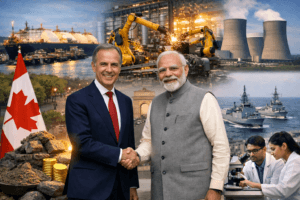
The Carney-Modi Reset: Inside the $110 Billion Gambit Reshaping Canada-India Relations
The photo op told only part of the story. When Mark Carney and Narendra Modi sat down together in New Delhi this week, the Canadian Prime Minister and his Indian counterpart weren’t just exchanging pleasantries and signing documents. They were attempting something far more ambitious: the wholesale reinvention of a relationship that had spent years in diplomatic deep freeze.
For Carney, making India his first bilateral visit since taking office wasn’t merely symbolic. It was strategic. And for Modi, hosting a Canadian leader for the first time since 2018 represented an opportunity to finally unlock partnership potential that both nations have long sensed but never fully captured.
What emerged from those meetings—five Memorandums of Understanding, a renewed commitment to a Comprehensive Economic Partnership Agreement by year’s end, and over $5.5 billion in new commercial agreements—tells us something important about how middle powers are navigating a fracturing world order. But the real story runs deeper than the press releases and talking points.
The Energy Equation Nobody’s Talking About
Let’s start with the Cameco deal. On the surface, it’s straightforward: $2.6 billion for 22 million pounds of Saskatchewan uranium headed to Indian reactors between 2027 and 2035. Clean energy partnership, mutual benefit, everyone wins.
But here’s what’s actually happening beneath the numbers.
India’s energy demand isn’t just growing—it’s transforming. When Carney’s office notes that Indian energy consumption equals that of China and Southeast Asia combined, they’re pointing to something fundamental about the coming decade. India is industrializing at a pace and scale that defies easy comparison. Every megawatt of that expansion will need to come from somewhere.
The uranium agreement matters because it represents something rare in international relations: perfect complementarity. Canada has the resource. India needs the fuel. There’s no competition, no zero-sum calculation—just straightforward mutual interest.
Yet the strategic energy partnership announced this week goes far beyond uranium. The liquefied natural gas discussions, the LPG arrangements, the solar and hydrogen cooperation—these aren’t just line items on a trade ledger. They’re the infrastructure of a relationship designed to outlast any single government or political cycle.
Consider what’s not being said aloud: for Canada, diversifying energy exports away from near-total dependence on the United States isn’t just good business—it’s existential. The India pivot represents the most significant attempt to reorient Canadian energy policy since the National Energy Program of the 1980s, except this time the motivation isn’t nationalism but necessity.
The Talent Pipeline Paradox
The numbers are staggering in their implications. Thirteen new university partnerships. Three hundred funded Indian researcher positions at Canadian institutions. Up to $100 million from the University of Toronto alone for Indian student scholarships. A Dalhousie innovation campus partnering with the Indian Institute of Technology Tirupati and the Indian Institute of Science Education and Research.
On paper, it’s education diplomacy at its finest. In practice, it’s far more complicated.
The 1.8 million Canadians of Indian origin represent one of the most successful diaspora communities anywhere in the world. They’re doctors, engineers, entrepreneurs, and political leaders. They’ve built bridges between two countries that share democratic values and institutional familiarity. But the student pipeline announced this week isn’t just about maintaining those bridges—it’s about fundamentally reshaping them.
Here’s the tension nobody wants to discuss publicly: India is rapidly building its own educational and research capacity. The Indian Institutes of Technology and Indian Institutes of Science Education and Research are world-class institutions that increasingly compete with, rather than feed into, Western universities. When the University of Toronto establishes a Centre of Excellence in India, it’s acknowledging that the old model—bright Indian students come West, receive training, and often stay—is giving way to something more reciprocal.
The scholarships and exchanges announced this week signal an uncomfortable truth for Canadian universities: the era of unilateral brain drain is ending. India no longer simply exports talent; it circulates it. Canadian institutions that understand this shift—that show up as partners rather than extractors—will thrive. Those that don’t will find themselves increasingly irrelevant to one of the world’s most dynamic educational ecosystems.
Security Cooperation and the Shadow of Discord
The most delicate paragraphs in the joint statement were also the most significant. “Advance bilateral cooperation on security and law enforcement.” “Issues of mutual concern.” “Illegal flow of drugs, particularly fentanyl precursors.” “Transnational organised criminal networks.”
This is the language of governments that have learned hard lessons about what happens when security cooperation breaks down.
The years between 2018 and 2025 weren’t kind to Canada-India relations. Diplomatic tensions, mutual recriminations, and a breakdown in intelligence-sharing created vulnerabilities that both countries are still working to address. The fact that National Security Advisor Ajit Doval has met with Canadian counterparts multiple times in recent months—including hosting the Deputy Clerk of the Privy Council in September and visiting Canada in February—signals a recognition at the highest levels that security cooperation cannot be held hostage to political disagreements.
For Carney, the challenge is managing domestic expectations while rebuilding operational trust. The Prime Minister’s public commitment to “continue to take measures to combat transnational repression” speaks to constituencies at home that remain deeply skeptical of Indian government actions. For Modi, the calculus is different: demonstrating that India can work productively with Western partners while maintaining its sovereign prerogatives.
The maritime security cooperation announced this week—increased naval activities, knowledge exchange, interoperability—represents the easiest part of this rebuilding. Ships and exercises are visible, measurable, and relatively uncontroversial. The harder work involves intelligence-sharing on criminal networks, counterterrorism cooperation, and the quiet collaboration that never makes it into press releases.
The Pension Fund Calculus
When Carney traveled with senior executives from nine major Canadian pension funds, he was making a statement about where the real money in Canada-India relations now sits. The Canada Pension Plan Investment Board, Ontario Teachers’ Pension Plan, and their counterparts collectively manage trillions in assets. Their interest in India isn’t diplomatic—it’s demographic.
Here’s what the pension funds understand that casual observers miss: India’s working-age population is enormous and growing at precisely the moment when Canada’s workforce is aging. The infrastructure investments, manufacturing partnerships, and technology collaborations announced this week aren’t just about immediate returns. They’re about positioning for a future in which Indian consumption, Indian production, and Indian innovation will shape global markets.
The $110 billion in direct and indirect Canadian investment in India didn’t materialize by accident. It represents decades of patient capital deployment by investors who understand that India’s growth story is real, even if it’s never linear. The new agreements—worth $5.5 billion in announced partnerships—extend that positioning.
But there’s something else happening here that deserves attention. Canadian pension funds are increasingly sophisticated about how they deploy capital internationally. They’re not just writing checks; they’re building operating capabilities, forming joint ventures, and taking active roles in the companies they invest in. This week’s announcements suggest that model is now being applied systematically to India, with implications that will play out over decades.
The Modi-Carney Chemistry
Political leaders matter in international relations, despite what structural determinists might argue. The relationship between Modi and Carney will shape how quickly and deeply the agreements announced this week actually materialize.
On paper, they’re an unlikely pair. Modi, the Hindu nationalist who rose from tea seller to prime minister, governing with absolute majority and transforming Indian politics. Carney, the global technocrat, former central banker, and political newcomer who speaks the language of markets as fluently as he does policy.
Yet the joint statement suggests genuine alignment on fundamentals. Both leaders are focused on economic transformation. Both understand that the old certainties of global trade are crumbling. Both see technology—particularly AI and advanced manufacturing—as central to their countries’ futures. And both have reason to want a functional relationship that insulates economic cooperation from political turbulence.
The invitation extended for Modi to visit Canada matters. It creates a deadline for progress and a visible marker of relationship health. Whether that visit happens this year or next, and what shape it takes, will tell us whether the reset announced this week has real momentum or merely rhetorical commitment.
What Actually Changes
The danger in covering any major diplomatic visit is mistaking announcements for outcomes. MOUs are not projects. Agreements are not implementation. The history of Canada-India relations is littered with well-intentioned frameworks that produced disappointingly little.
What’s different this time?
First, the geopolitical context has shifted. The United States under its current administration is pursuing trade policies that create real urgency for Canadian diversification. The China option, once viable for both countries, has become politically fraught and economically risky. Canada and India need each other in ways that weren’t true a decade ago.
Second, the commercial logic has matured. Canadian pension funds, energy companies, and technology firms have enough experience in India to understand both the opportunities and the obstacles. The partnerships announced this week reflect hard-won knowledge about what works and what doesn’t.
Third, the political relationship has been reset at the highest level. The ministerial meetings, security consultations, and leader-to-leader engagement that happened this year exceeded anything in the previous two decades. That density of interaction creates relationships and understanding that survive inevitable disagreements.
The Road Ahead
The $85 billion in global investment that Carney’s government claims to have secured in ten months is a striking number—the kind of figure designed to dominate headlines and shape narratives. But the real test of this week’s work won’t be measured in aggregate dollars.
It will be measured in uranium shipments actually delivered. In student exchanges that produce breakthrough research. In naval exercises that build genuine interoperability. In pension fund investments that generate returns for Canadian retirees while supporting Indian development. In the quiet, unglamorous work of making partnerships real.
The Canada-India relationship has always promised more than it delivered. This week in New Delhi, Carney and Modi placed a bet that they can finally close that gap. Whether they succeed will depend less on the documents they signed than on the work their governments do in the months and years ahead.
For the 1.8 million Canadians of Indian origin watching this reset unfold, the stakes are deeply personal. They’ve spent decades building bridges between their ancestral and adopted homes. This week’s announcements suggest those bridges are about to carry much heavier traffic.
For the rest of us, the Carney-Modi reset offers something rarer than trade agreements and diplomatic communiques: a glimpse of how two very different countries, with very different strengths and very different challenges, are trying to build a partnership suited to a century that will demand exactly this kind of imagination.
You must be logged in to post a comment.