
The Capture of Caracas: Oil, Ideology, and the New Geopolitics of Intervention
The Capture of Caracas: Oil, Ideology, and the New Geopolitics of Intervention
“The extremists who have promoted armed aggression against our country – history and justice will make them pay,” declared Venezuela’s acting president, framing an unprecedented military operation as part of a global ideological struggle.
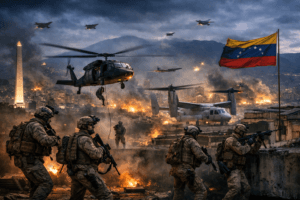
In the pre-dawn hours of January 3, 2026, the skies over Caracas roared with the sound of more than 150 American aircraft. As U.S. special forces helicopters descended on the Venezuelan capital, they executed an operation unprecedented in modern hemispheric relations: the capture and extraction of a sitting president, Nicolás Maduro, from his own country. The mission, codenamed “Absolute Resolve,” represented not just a dramatic escalation in Washington’s long-standing confrontation with Caracas but revealed the complex intersections of energy politics, historical grievances, and ideological framing that now define international conflict in the 2020s.
Venezuela’s new acting president, Delcy Rodríguez, responding to what she called a “savage attack” on her nation’s sovereignty, made a striking accusation: the operation had “Zionist undertones”. This allegation, puzzling to some outside observers, exposes the deep historical roots of the current crisis—roots that extend from Washington’s century-long hemispheric dominance to Venezuela’s deliberate foreign policy alignment against what Hugo Chávez once called “the empire,” and to the specific deterioration of relations between Caracas and Tel Aviv.
The Operation: Absolute Resolve
The military operation that unfolded on January 3 was audacious in scale and execution. Beginning at approximately 2:01 AM local time, U.S. forces launched a coordinated assault involving fighter jets, bombers, electronic warfare aircraft, and special operations helicopters. The targets included military installations across northern Venezuela, with significant strikes reported at Generalissimo Francisco de Miranda Air Base, Fort Tiuna, and Higuerote Airport.
Key Aspects of Operation “Absolute Resolve”
| Component | Details |
| Timeline | 02:01 – 04:29 VET (January 3, 2026) |
| Primary Objective | Capture of President Nicolás Maduro and First Lady Cilia Flores |
| Aircraft Involved | 150+ U.S. aircraft including F-22 Raptors, F-35 Lightnings, B-1B Lancers, and special operations helicopters |
| Special Forces | Delta Force operators transported by 160th Special Operations Aviation Regiment helicopters |
| Reported Casualties | 80+ killed according to Venezuelan officials, including 32 Cuban military personnel |
| U.S. Injuries | 2 soldiers injured |
The tactical execution involved dismantling Venezuelan air defenses to allow helicopters to deliver Delta Force soldiers to Maduro’s location. According to General Dan Caine, Chairman of the Joint Chiefs of Staff, the operation took about two hours and twenty minutes, concluding when Maduro and his wife “gave up”. They were subsequently flown to the USS Iwo Jima and then to New York City, where they were held at the Metropolitan Detention Center in Brooklyn to face federal narcoterrorism charges.
The “Zionist Undertones” Claim in Historical Context
When Acting President Delcy Rodríguez accused the operation of having “Zionist undertones,” she invoked a specific and deteriorated history between Venezuela and Israel. Her statement followed Maduro’s own comments from November 2025, in which he claimed “far-right Zionists” wanted to “hand this country over to the devils”.
The relationship between Venezuela and Israel, once cordial, has deteriorated dramatically since Hugo Chávez assumed power. Key turning points include:
- 2006: Chávez recalled Venezuela’s chargé d’affaires from Tel Aviv during the Israel-Lebanon conflict, accusing Israel of perpetrating “a new Holocaust”.
- January 2009: Following the Gaza War, Venezuela completely severed diplomatic ties with Israel, expelling the Israeli ambassador and his staff.
- Subsequent Years: Chávez and later Maduro maintained close relations with Palestine while frequently employing rhetoric that framed Israel as an extension of U.S. imperialism.
This history provides the essential context for understanding Rodríguez’s allegation. In the Bolivarian political framework, “Zionist” has evolved beyond specific reference to Israeli policy to become shorthand for what is perceived as a broader alliance between Washington, right-wing elements, and Israel against sovereign governments that resist U.S. dominance.
The allegation gained immediate traction because of Israel’s swift endorsement of the operation. Israeli Foreign Minister Gideon Sa’ar commended the U.S. action, stating that “Israel stands alongside the freedom-loving Venezuelan people, who have suffered under Maduro’s illegal tyranny”. This alignment between Washington’s action and Tel Aviv’s approval reinforced the narrative that Rodríguez articulated.
Oil as Strategic Prize and Historical Curse
Beyond the ideological framing, the material motivations for the operation are deeply rooted in Venezuela’s most valuable resource: oil. President Trump explicitly stated that the U.S. would “take control of Venezuela’s massive oil reserves” and recruit American companies to invest billions in revitalizing the country’s crippled oil industry.
Venezuela sits on approximately 303 billion barrels of proven crude oil reserves—about 20% of the world’s total and the largest such reserve on Earth. Yet due to mismanagement, corruption, and international sanctions, the country produces only about 1 million barrels per day, representing less than 1% of global production.
The strategic importance of this resource cannot be overstated. As one analysis notes, “When access to energy resources becomes the organizing principle of foreign engagement, political legitimacy is subordinated to supply security”. This dynamic has shaped Venezuela’s relationship with external powers for decades, with the country’s oil wealth simultaneously financing social programs under Chávez’s “Bolivarian Revolution” and making Venezuela a perpetual target of external interest.
Trump’s promise to “get the oil flowing” reveals the economic calculus underlying the operation. Venezuela’s heavy, sour crude is particularly valuable for producing diesel, asphalt, and industrial fuels—products that complement the lighter crude abundantly produced in the United States. Unlocking Venezuelan production could reshape global energy markets while providing a nearby, relatively cheap source of crucial petroleum products.
A Nation’s Divided Soul: Venezuelan Reactions
Within Venezuela, reactions to Maduro’s capture revealed a nation profoundly divided between hope and apprehension. For some, like Wilmer Castro, a university student from Ejido, the news represented “the best gift that I will ever receive”. He envisioned telling future generations about the day “a dictator fell”.
For others, like Edward Ocariz, a human rights activist who had been imprisoned under Maduro, the initial joy was tempered by practical concerns about what would follow. “The population still feels a huge amount of fear,” he noted, emphasizing that key institutions remain controlled by figures from Maduro’s inner circle.
The economic anxiety was immediate and palpable. Castro described scenes of people “buying food with half of what they had in their bank accounts” amid concerns about what the future would hold. These reactions echoed the traumatic shortages of 2016, when hyperinflation and scarcity created a humanitarian crisis.
Not all Venezuelans welcomed the intervention. Alex Rajoy, a mototaxi driver in Caracas, viewed the operation as an “imperialist crusade” aimed at “robbing Venezuela of its natural resources”. His perspective reflects the enduring strength of Bolivarian ideology, which frames national sovereignty as paramount, even when defending a deeply flawed government.
International Reactions and Legal Controversies
The global response to the operation highlighted deep divisions in the international community. Regional powers like Brazil, Colombia, and Chile strongly condemned the attack, as did Venezuela’s key allies Russia, China, and Iran. China specifically called for the “immediate” release of Maduro and his wife.
European reactions were more mixed. While many European countries welcomed Maduro’s removal given concerns about his authoritarian rule, some raised serious questions about the operation’s legality. Spanish Prime Minister Pedro Sánchez captured this ambivalence: “Spain did not recognise the Maduro regime. But neither will it recognise an intervention that violates international law”.
The legal basis for the operation remains particularly contentious. The Trump administration framed it as a law-enforcement action with military support, citing the president’s “inherent constitutional authority”. However, international law experts have questioned the legality of extraterritorially capturing a sitting head of state without United Nations authorization or a clear self-defense justification.
International Responses to the U.S. Operation in Venezuela
| Supportive | Critical or Opposed | Mixed/Ambivalent |
| Israel | Russia | Spain (questioned legality while opposing Maduro) |
| Some Venezuelan diaspora communities | China | Some European countries |
| Cuba (reported 32 citizens killed) | U.S. Democratic lawmakers | |
| Most South American nations | ||
| Iran |
The Road Ahead: Occupation, Transition, or Chaos?
In the aftermath of the operation, the fundamental question remains: What comes next? President Trump initially stated that the United States would “run the country” until a “judicious transition” could occur. However, this assertion was later walked back by Secretary of State Marco Rubio, creating ambiguity about America’s actual intentions.
The U.S. faces significant challenges in stabilizing Venezuela. As former U.S. Ambassador to Venezuela Charles Shapiro noted, at least 20% of the population likely remains loyal to Maduro. Winning over these citizens while navigating Venezuela’s complex political landscape will be “very, very difficult”.
The humanitarian situation presents another immediate challenge. Venezuela’s economy has been devastated by years of mismanagement, hyperinflation, and sanctions. A former NATO commander warned that securing Venezuela’s oil infrastructure could prove difficult “in a country that could turn hostile”.
Perhaps most importantly, the operation has established a dangerous precedent. As one analysis warns, “Bombing states without multilateral legitimacy corrodes the legal and moral foundations of international order”. The specter of further interventions looms, particularly after Trump’s threats against Colombian President Gustavo Petro, whom he accused of running a country “very sick too” with cocaine factories.
A Crisis of Sovereignty and Sovereignty of Crisis
The capture of Nicolás Maduro represents more than a dramatic regime change operation. It encapsulates the converging crises of our time: the struggle over energy resources in a changing climate, the erosion of international norms governing sovereignty, the resurgence of ideological framing in geopolitical conflict, and the enduring trauma of foreign intervention in Latin America.
Delcy Rodríguez’s invocation of “Zionist undertones,” while rooted in a specific bilateral history, ultimately speaks to a broader Venezuelan experience of perceived external conspiracies against its sovereignty. Whether one views this as legitimate grievance or political diversion, it reflects how historical memory shapes contemporary political discourse.
As Venezuela stands at this precipice, the fundamental tension remains between the promise of liberation from an authoritarian regime and the peril of renewed dependency under external control. The Bolivarian Revolution, born from Hugo Chávez’s promise to empower the marginalized, now faces its ultimate crisis—not from internal opposition alone, but from a foreign power that has repeatedly shaped Latin America’s destiny.
The coming months will reveal whether this operation leads to democratic renewal or deeper fragmentation, whether it strengthens the rule of law or further normalizes the rule of force, and whether it resolves a humanitarian crisis or creates new ones. What is already clear is that January 3, 2026, marks not just a turning point for Venezuela, but a defining moment for international relations in the 21st century—one where the old patterns of intervention have returned with new technologies, old resources command new priorities, and historical grievances find fresh expression in contemporary conflict.
You must be logged in to post a comment.