
The Canvas and The Pen: How Qatar Built a Museum from an Artist’s Sketch
The new Lawh Wa Qalam: M.F. Husain Museum in Doha represents a profound culmination of artistic legacy and cultural diplomacy, conceived from the artist’s own sketch and realized over a decade after his death. It provides a permanent home for the “Picasso of India,” who spent his final years in Qatari exile, and its strategic placement within Education City reflects Qatar’s ambition to build an organic cultural ecosystem rather than import global brands. The museum’s inauguration coincides perfectly with a dramatic surge in Husain’s market value, underscored by his painting Untitled (Gram Yatra) fetching $13.8 million at auction, cementing his global status as this monumental tribute opens its doors.
The Canvas and The Pen: How Qatar Built a Museum from an Artist’s Sketch
Qatar has built the first museum dedicated to M.F. Husain, the “Picasso of India,” based on a drawing from the artist himself. The new institution is a testament to artistic reinvention, a nation’s cultural strategy, and a $13.8 million art market on the rise.
The opening of Lawh Wa Qalam: M.F. Husain Museum in Doha’s Education City is more than a new museum; it is the final chapter in a long story of exile, artistic defiance, and the quiet power of cultural diplomacy. More than a decade after his death, Husain’s legacy is being monumentalized at a moment of surging global interest.
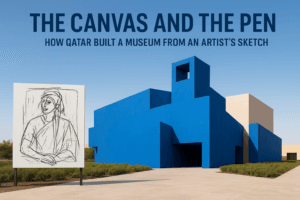
This is the first museum in the world dedicated to this legendary Indian modernist. Its creation is anchored to a promise: the building’s design is the physical realization of a sketch Husain once drew when imagining a home for his life’s work.
From Sketch to Sanctuary: An Architectural Promise Fulfilled
The museum’s creation is a unique architectural story. Indian architect Martand Khosla’s starting point was not a standard brief, but a single, symbolic sketch by Husain himself.
- Translating a Vision: Khosla described the drawing as working on “several levels – the literal, the symbolic and the metaphorical.” His task was to turn this conceptual vision into a functional, contemporary building. The design features a striking “blue house” facade and a series of interconnected geometric volumes.
- A Space for Wandering: Mirroring Husain’s own inquisitive and nomadic spirit, the museum’s layout intentionally avoids a linear path. Instead, it encourages visitors to wander and discover, moving between inward-looking contemplative spaces and outward-looking, expansive galleries. A central tower acts as a “cinematic periscope,” extending the museum’s gaze into the world.
A Final Homecoming: The Exile’s Sanctuary in Doha
For Husain, the museum’s location in Qatar is the resolution to a painful final chapter of his life. His relationship with his homeland of India grew turbulent in his later years due to controversy over his depiction of Hindu deities, leading to legal battles and death threats.
- Self-Imposed Exile: In 2006, at the age of 90, he left India, beginning a period of self-imposed exile. Qatar, where he had long-standing connections, became his refuge. In 2010, he accepted Qatari citizenship and spent his final productive years living and working in Doha until his death in 2011.
- A Creative Refuge: This period was far from a quiet retirement. Freed from controversy, Husain experienced a burst of creative energy. It was in Doha that he created some of his most ambitious works, including the monumental Arab Civilisation series, commissioned by Sheikha Moza bint Nasser, and his final multimedia installation, Seeroo fi al ardh (“Walk in the Land”).
The museum serves as a permanent home for these late-career masterpieces, presenting them not as works of an exile, but of an artist fully embraced by a new home. As one Qatar Foundation executive noted, these works “reflect a remarkable period of his illustrious life” and belong to both regional and global art history.
More Than a Museum: A Strategic Node in Qatar’s Cultural Ecosystem
The museum’s placement is a deliberate act of cultural strategy. It is situated within Education City, a sprawling 12-square-kilometer campus that is the heart of Qatar’s vision for a knowledge-based future. This location is key to understanding its purpose.
| Husain’s Market Milestones | Significance |
| March 2025 at Christie’s New York | Husain’s 1954 painting Untitled (Gram Yatra) sells for $13.8 million, shattering its $3.5 million high estimate. |
| Pre-2025 Market Performance | Only 16 of Husain’s works had ever sold for over $1 million, making the 2025 result an explosive market breakthrough. |
| Rising Category | The sale is part of a red-hot market for South Asian Modernist art, where collectors are competing for once-overlooked masterpieces. |
Qatar’s cultural approach differs from its neighbor, Abu Dhabi, which imports global brands like the Louvre and Guggenheim. Instead, Qatar is building an organic, homegrown cultural ecosystem, with Doha described as idiosyncratic and daring—”the Berlin” of the Gulf.
- An Educational Mission: Lawh Wa Qalam was conceived not as a standalone trophy but as the first dedicated cultural institution within Education City. It is designed to be a dynamic hub for workshops, screenings, and university collaborations, placing art at the center of intellectual and community life.
- A Global Stage: This project is part of a larger ambition. Qatar has become a major player in the global art world, from the Jean Nouvel-designed National Museum of Qatar to acquiring major works by Rothko and Bacon. The debut of Art Basel Qatar in 2026 will further solidify Doha’s status as a global cultural destination, attracting the world’s top galleries and collectors.
The Market and The Moment: Cementing a Legacy
The museum’s opening coincides with a pivotal moment for Husain’s legacy in the commercial art world. For decades, his work was celebrated within art circles but only occasionally broke through at auction. That changed dramatically earlier this year.
This new $13.8 million auction record is more than a price; it is a powerful validation. It confirms Husain’s place in the highest echelons of global modern art and arrives just as his life’s work finds its ultimate, permanent home. The museum, therefore, does not just honor a legacy—it actively cements it at the perfect historical and economic moment.
Conclusion: A Monument to Nomadic Roots
The Lawh Wa Qalam museum is the final, fitting tribute to an artist who was, in his own words, a “global nomad”. It turns his exile into a homecoming and his sketch into a sanctuary. It represents a profound cultural investment by a nation that understands the power of art as a form of soft power and dialogue.
For Qatar, the museum is a statement of identity. For the art world, it is a long-overdue institutional recognition of a master. And for M.F. Husain, the wanderer with a brush, it is the permanent home his work and spirit always deserved—a place where the canvas and the pen have finally found their lasting place.
You must be logged in to post a comment.