
The Bureaucratic Bulldozer: How Israel’s New Land Registration Could Redraw the West Bank
Israel has approved a land registration process in the occupied West Bank that critics warn amounts to a bureaucratic “mega land grab,” potentially transferring vast swaths of Palestinian-owned land in Area C to Israeli state control. The procedure requires Palestinians to prove ownership of ancestral lands using a complex legal system that activists say is nearly impossible to navigate, meaning land without sufficient documentation would revert to Israel and become available for settlement expansion. While framed as an administrative measure, the move is widely seen as a form of de facto annexation that could further erode the already dwindling territory available for a viable Palestinian state, drawing sharp condemnation from Palestinian leaders and regional powers like Jordan, who view it as a dangerous escalation under the cover of bureaucracy.
The Bureaucratic Bulldozer: How Israel’s New Land Registration Could Redraw the West Bank
In the sun-baked olive groves and rocky hillsides of the West Bank, ownership of a piece of land is rarely just a matter of a deed. It is a tapestry woven from Ottoman records, British Mandate tax ledgers, Jordanian survey documents, and the fading memory of a grandfather who first cleared the stones a century ago. This intricate, fragile system of proof is about to be put to its most severe test yet.
On Sunday, the Israeli government approved a decision to begin a contentious land regulation process in Area C of the occupied West Bank. While the phrase “land registration” sounds administrative—even mundane—it is being described by critics as a tectonic shift that could legalize a wholesale transfer of land from Palestinian ownership to the control of the Israeli state.
Hagit Ofran, director of the Settlement Watch program for the Israeli anti-settlement group Peace Now, did not mince words in her assessment. “This move is very dramatic and allows the state to gain control of almost all of Area C,” she said. “This process likely amounts to a ‘mega land grab’ from Palestinians.”
To understand why this seemingly bureaucratic procedure has sparked such alarm from Ramallah to Amman, one must look beyond the headlines and into the fine print of history, the mechanics of the law, and the dusty filing cabinets where the fate of millions of dunams (a unit of land area used in the region) may ultimately be decided.
The ‘Settlement of Title’: A Mechanism Frozen in Time
At its core, the decision, championed by far-right Justice Minister Yariv Levin, paves the way for the resumption of “settlement of land title” processes—a system that has been effectively frozen in the West Bank since Israel captured the territory in the 1967 Mideast War.
The process sounds simple enough: the government announces a specific area for registration. Anyone who claims to own land within that zone must come forward and submit the necessary documentation to prove their ownership. If they fail to do so, or if their documentation is deemed insufficient, the land reverts to state control. Once under state control, it becomes available for various purposes, including the expansion of Jewish settlements.
But the context in which this process will be applied is anything but simple. The West Bank is divided into three administrative zones established by the Oslo Accords of the 1990s:
- Area A: Under full Palestinian civil and security control.
- Area B: Under Palestinian civil control and joint Israeli-Palestinian security control.
- Area C: The vast expanse—about 60% of the West Bank—that remains under full Israeli military and civil control.
It is within Area C, home to over 300,000 Palestinians and the strategic heartland of the territory, that this registration process will unfold. While the Oslo Accords gave Israel administrative control over this area, they did not nullify existing Palestinian claims to the land.
The “Draconian” Burden of Proof
For decades, a legal limbo has persisted. Many Palestinians in Area C own their land through traditional systems of ownership that predate the modern state of Israel. A family might possess an Ottoman title deed from the late 19th century, a British Mandate tax receipt from the 1940s, or a Jordanian land registration document from the 1950s and 60s.
The challenge, according to Ofran and other legal experts, is that the Israeli system for proving ownership is extraordinarily difficult for Palestinians to navigate.
“Palestinians will be sent to prove ownership in a way that they will never be able to do,” Ofran told the press. The process is not merely about presenting a document. It requires a continuous, legally unbroken chain of ownership, verified by a system that has been inaccessible to most Palestinians for generations. Furthermore, the military court system that oversees these matters is complex, expensive, and conducted primarily in Hebrew.
Consider the practical reality of a Palestinian farmer, let’s call him Ahmed, who lives in a village near Nablus. His family has farmed a hillside plot in Area C for over a hundred years. His proof of ownership is a patchwork: an Ottoman deed for the land from his great-great-grandfather, a faded British tax receipt showing his grandfather paid levies on it, and decades of Israeli military-issued IDs listing his residence. When the state announces that his area is undergoing registration, Ahmed has a limited window to gather these documents, hire a lawyer (if he can afford one), and present his case in a legal system that is structurally skewed against him.
Meanwhile, a neighboring settlement, which is part of a bloc recognized by Israel, can draw on state resources, legal aid, and a friendly administration to file its claims. If Ahmed fails to navigate this bureaucratic labyrinth, his family’s land could be declared “state land” and potentially be allocated for settlement expansion.
A ‘De Facto Annexation’ by Another Name
This is why the decision has sent shockwaves through the Palestinian leadership. President Mahmoud Abbas’s office issued a stark condemnation, calling the move “a grave escalation and a flagrant violation of international law,” which amounts to “de facto annexation.”
The term “annexation” is politically charged, but the mechanics of this policy give it weight. By formalizing control over land through a “legal” process, Israel is solidifying its hold in a way that is more permanent than military closure. It is creating a bureaucratic reality that would be incredibly difficult to unravel, even in the context of future peace negotiations.
The decision effectively reverses the onus of proof. Instead of the state having to demonstrate why it should take control of private land, the burden now falls on the Palestinian owner to prove why the state should not take it. In a region where the state has had the power of confiscation, zoning, and demolition for decades, this is a monumental shift.
The Geopolitical Landscape: A Green Light from Washington?
The timing of this decision is also deeply intertwined with the shifting political winds in Washington. Previous U.S. administrations, both Democratic and Republican, have historically opposed unilateral Israeli steps that deepen control over the West Bank. However, the relationship between Prime Minister Benjamin Netanyahu and President Donald Trump has been exceptionally close. The two met in Washington just last week for the seventh time in a year.
While President Trump has publicly stated his opposition to annexation, his administration has already broken with decades of U.S. policy by recognizing Jerusalem as Israel’s capital and acknowledging Israeli sovereignty over the Golan Heights. The administration’s muted response to rapid settlement expansion in recent months has given the Netanyahu government a significant degree of confidence.
Ofran noted this paradox. “Trump has opposed annexation,” she said. Yet the Israeli government is proceeding with a policy that critics argue achieves the same end through administrative means. It appears the Israeli coalition, which includes members who openly advocate for the annexation of the West Bank, is betting that a bureaucratic process will fly under the radar, or at least avoid the international outcry that a formal declaration of sovereignty would trigger.
Jordan and Qatar: Regional Condemnation
The decision has also strained relations with key regional actors. Jordan, which signed a peace treaty with Israel in 1994 and serves as the custodian of Muslim holy sites in Jerusalem, views any change to the status quo in the West Bank as a direct threat to its national security and its own Palestinian population. The Jordanian Foreign Ministry called on the international community to “compel Israel, the occupying power, to stop its dangerous escalation.”
Qatar’s foreign ministry echoed this sentiment, framing the decision as “an extension of its illegal plans to deprive the Palestinian people of their rights.” The unified regional voice against the move underscores its gravity and the potential for it to ignite further instability.
The Human Geography of Area C
To truly grasp the impact, one must visualize the landscape. Area C is not an empty desert. It is a contiguous swath of territory that includes the fertile Jordan Valley, the strategic hilltops surrounding Palestinian cities, and the grazing land that sustains countless Bedouin and farming communities.
For the estimated 300,000 to 450,000 Palestinians living there, life is already precarious. They reside in a patchwork of villages and hamlets that are often cut off from water and electricity grids controlled by the Israeli-run civil administration. They face the constant threat of demolition orders for homes built without permits, which are nearly impossible to obtain.
This new registration process adds a layer of existential anxiety. It threatens not just their homes, but their ancestral livelihoods. The olive tree, a potent symbol of Palestinian sumud (steadfastness), takes decades to mature. If the land it stands on is registered to the state, the tree—and the family’s connection to that soil—is lost.
The Israeli Foreign Ministry has attempted to frame the move as a matter of transparency and legal order, stating that the Palestinian Authority has been “advancing land registration procedures in Area C for years in violation of agreements.” This argument posits that Israel is simply formalizing a system to prevent chaos. However, critics retort that the two situations are not comparable; the PA lacks the authority to enforce its registrations in an area under full Israeli military control.
What Happens Next?
The registration process could begin within the year. The government will likely start with pilot areas before rolling it out to larger sections of Area C. For the Israeli right, this is a historic correction—a way to solidify the Jewish presence in the biblical heartland of Judea and Samaria. For the Palestinians and the international community, it is the quiet death knell for the two-state solution.
If Israel gains control over vast new stretches of Area C, the possibility of a contiguous, viable Palestinian state dwindles to nearly zero. The Palestinian Authority would be left with non-contiguous enclaves (Areas A and B) surrounded by Israeli-controlled land, lacking the territorial depth needed for a sovereign state.
The international community, including the U.N. Security Council, is now faced with a test. Will they treat this as a purely internal Israeli administrative matter, or will they recognize it for what Peace Now and the Palestinians say it is: a state-led effort to redraw the map of the conflict using the quiet, relentless tools of bureaucracy and land law?
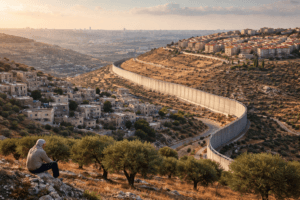
As the sun sets over the separation barrier near the Jerusalem neighborhood of Beit Hanina—the very scene captured in Sunday’s AP photo—the contrast is stark. On one side lies the city, on the other, the West Bank. The barrier is a physical manifestation of division. But the new land registration process is something more insidious: a legal and bureaucratic barrier that, once erected, will be nearly impossible to tear down. It doesn’t just divide people from land; it attempts to sever the very history that binds them to it.
You must be logged in to post a comment.