
The Bulldozers of Jericho: How Demolitions Weaponize Bureaucracy to Reshape the West Bank
In a pattern reflecting the systemic use of bureaucratic control to reshape occupied territory, Israeli forces demolished a Palestinian home and agricultural structures near Jericho, citing a lack of permits—a requirement critics describe as a nearly impossible hurdle designed to stifle Palestinian development. This incident is part of a broader campaign that has seen over 1,400 structures destroyed in a year, with a strategic increase in targeting agricultural infrastructure in fertile areas like the Jordan Valley, which is crucial for economic sustainability. Analysts view these actions not as random enforcement but as a methodical form of slow-moving, structural violence aimed at undermining Palestinian presence, severing connections to the land, and consolidating territorial control to predetermine the facts on the ground ahead of any future political negotiations.
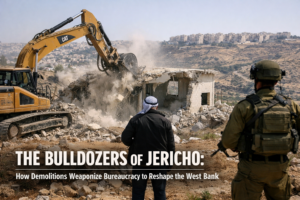
The Bulldozers of Jericho: How Demolitions Weaponize Bureaucracy to Reshape the West Bank
The dawn in the Jordan Valley is often described as a painter’s dream—a wash of gold over a vast, arid stretch of land, punctuated by the stubborn green of date palm groves and agricultural plots. But in the early hours of a January morning, the only spectacle for residents of al-Diouk al-Tahta, west of Jericho, was the grim, mechanical rumble of Israeli military bulldozers. By day’s end, a home belonging to a Palestinian man from Jerusalem and a nearby palm-farming structure lay in ruins. To the east, another family received a notice: their agricultural livelihood was next. These were not isolated incidents, but rather, precise strikes in a relentless, bureaucratic war where paperwork becomes more powerful than artillery, and the future of a landscape is decided one demolition at a time.
This latest operation in Jericho is a microcosm of a systemic strategy unfolding across Area C, the 60% of the West Bank under full Israeli military and administrative control. Here, the simple act of building a home, a barn, or a greenhouse is transformed into a high-stakes gamble. The process for a Palestinian to obtain a building permit from the Israeli Civil Administration is famously described by rights groups as a “virtually impossible” labyrinth. Applications are expensive, slow, and overwhelmingly rejected. According to data from the Israeli committee against house demolitions, over 98% of Palestinian permit requests in Area C are denied. In contrast, Israeli settlements—considered illegal under international law by most of the global community—expand with master plans and permits, their red-tiled roofs climbing the hills in sharp, geometric contrast to the organic sprawl of Palestinian villages below.
The home demolished in al-Diouk al-Tahta, belonging to Daoud Sarhan, was cited for lacking that elusive permit. For families like Sarhan’s, this creates an impossible bind: natural growth necessitates construction, but the law prohibits it. The result is what experts term “forced delinquency.” Communities build out of necessity, living with the constant, low-grade fear that today might be the day the bulldozers arrive. The demolition of a home is not just the destruction of concrete and rebar; it is the unraveling of a family’s security, the obliteration of lifelong savings, and a profound psychological trauma, especially for children who watch their sanctuary turned to dust.
However, the recent escalation around Jericho reveals a particularly alarming shift: the deliberate targeting of agricultural infrastructure. The demolition of the Abu Jarrar company’s palm-farming structure and the threat against the Sonoqrot family’s similar facility are tactical moves in an economic and territorial battle. The Jordan Valley is not just any land; it is the breadbasket of a potential Palestinian state, fertile, water-rich, and strategically significant. By systematically dismantling agricultural edifices—greenhouses, wells, storage facilities, and processing units—the occupation strikes at the backbone of Palestinian rural life and economic autonomy.
This has a cascading effect. A demolished farming structure means lost seasonal income, the withering of crops, and increased dependency. It pushes families off their land, gradually severing the intimate connection between people and their patrimony. When combined with severe restrictions on movement, water access (where Palestinian farmers are often allocated a fraction of the water used by neighboring settlements), and the expansion of settlement agricultural outposts, a clear pattern emerges: not merely control, but a methodical effort to render Palestinian sustainable life in Area C unviable.
The numbers from the Wall & Colonization Resistance Commission are staggering, but they represent cold statistics. Behind the 538 demolition operations and 1,400 structures destroyed in a single year are thousands of individual stories of resilience and despair. A home in Hebron, built by a father for his newly married son. A poultry coop in Nablus that was a family’s sole income. A greenhouse in Tubas that represented a graduate’s attempt to innovate with hydroponics. The concentration of demolitions in the governorates of Hebron, Jerusalem, and Ramallah underscores that this is not about random enforcement, but a focused pressure on areas of particular Palestinian resilience and growth, as well as those corridors deemed vital for territorial contiguity in any future political settlement.
The international community often views the conflict through the lens of high-stakes diplomacy or violent clashes. Yet, the quieter, daily reality of administrative coercion—the demolition order, the closed military zone declaration, the map that reclassifies agricultural land as “state land”—may be more definitive in shaping the land. It is a form of slow-moving, structural violence that creates facts on the ground far more permanently than any ephemeral political statement.
For the farmers of Jericho, the message is clear and chilling. The palm groves that have thrived in this oasis for generations are now in the crosshairs. Each demolished agricultural structure is a step towards consolidating control over the Valley, ensuring that even if political negotiations someday resume, the most valuable lands are already functionally annexed. The bulldozers in Jericho are not just destroying buildings; they are erasing futures, one farm, and one home at a time. The golden dawn over the Jordan Valley now illuminates a landscape of deepening shadows, where the struggle is no longer just over land, but over the very right to cultivate a life upon it.
You must be logged in to post a comment.