
The Buffalo Paradox: India’s Top Beef Exporter and the Politics of Meat
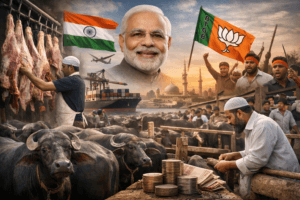
The Buffalo Paradox: India’s Top Beef Exporter and the Politics of Meat
In the scorching heat of April 2014, Narendra Modi, then the Bharatiya Janata Party’s (BJP) prime ministerial candidate, addressed a rally in the heartland of Uttar Pradesh. His voice crackled with indignation as he accused the outgoing United Progressive Alliance (UPA) government of unleashing a “pink revolution” upon the nation. It was a loaded, color-coded accusation designed to evoke a visceral response. The “pink” in “pink revolution” was a direct reference to the meat industry, a sector he painted as a machinery of slaughter, particularly targeting the bovine population held sacred by millions of Hindus.
“Across the countryside, our animals are getting slaughtered,” Modi declared. “Across India too, there are massive slaughterhouses in operation.”
It was a powerful, unambiguous message, aligning perfectly with the core Hindutva ideology that venerates the cow (and by extension, the buffalo) as a symbol of national and religious identity. It promised a future where the “holy animal” would be protected from the butcher’s knife. Fast forward nearly a decade, and a strange, quiet paradox has taken root. The Indian beef industry has not only survived under a government led by the man who gave that speech; it has, for the most part, thrived.
At the heart of this quiet, unspoken economic miracle lies a 160-year-old business empire: the Allana group. And recently, this titan of the trade made a move that throws the intricate, often hypocritical, dance between ideology and economics into sharp relief. The Allana group made its highest-ever political donation to the BJP.
A Donation and its Discontents
The news of the unprecedented donation, first reported by Scroll.in, cuts through the political noise like a well-honed knife. While the exact figure remains undisclosed, the timing and the recipient are what matter. This isn’t a titan of the IT sector or a steel magnate hedging their bets; this is the face of an industry that, in the ideological playbook of the ruling party, should not exist.
The Allana group is not just any exporter. Headquartered in Mumbai, with a history stretching back to 1865, it is a colossus in the global meat trade. It operates state-of-the-art abattoirs and processing plants, employing thousands, and has carved a dominant niche in the global market for buffalo meat, often shipped under the more palatable label of “carabeef.” Its primary customers are not in the West, but in the Islamic world—countries like Vietnam, Malaysia, Egypt, and the Gulf nations—where its halal-certified product is a staple.
The donation, therefore, is a high-stakes masterstroke of realpolitik, a testament to the industry’s understanding that in Modi’s India, survival and growth depend not just on navigating market forces, but on navigating the labyrinthine corridors of political power. It is a transactional acknowledgment of a government that, while publicly lionizing the protectors of cows, has privately facilitated the expansion of the multi-crore rupee business of exporting them.
The Buffalo Bubble: Why It’s Not Cow Meat
To understand the paradox, one must first understand a crucial, often deliberately blurred distinction: the Indian beef export industry is almost exclusively based on the water buffalo (Bubalus bubalis), not the cow (Bos taurus indicus). The cow, for much of Hindu-nationalist sentiment, is a mother figure, a symbol of gentle, selfless giving. The buffalo, while also bovine, occupies a less hallowed space in the Hindu pantheon. It is often associated with Yama, the god of death, who rides a buffalo, and with the demon Mahishasura, slain by the goddess Durga. This theological loophole has been the industry’s saving grace.
Hindutva groups have historically targeted the slaughter of cows, framing it as an assault on Hindu identity. The slaughter of buffaloes, while opposed by some of the more hard-line factions, has never carried the same incendiary weight. The government has strategically exploited this distinction. The narrative has been carefully crafted: we are not protecting the beef industry; we are facilitating the export of surplus buffaloes, a practice that provides immense economic benefit to millions of farmers, especially in states like Uttar Pradesh, Punjab, and Haryana, where buffalo-rearing is a primary livelihood.
This is where the politics gets personal. The beneficiaries of the “pink revolution” are not just the corporate giants like Allana. They are the millions of small and marginal farmers for whom a buffalo is a living, breathing ATM. Selling a male buffalo calf, which is useless for breeding or plowing, to a middleman who will eventually route it to a slaughterhouse provides a crucial cash infusion. It’s an economic reality that often trumps religious sentiment at the ground level, creating a silent constituency that relies on the very industry their political representatives might publicly condemn.
The Pragmatics of Power: Why the BJP Plays Along
So, why does a government with a deep ideological commitment to cow protection allow, and even encourage, the growth of the buffalo meat industry? The answer lies in the triumvirate of modern governance: economics, foreign policy, and the imperative of political funding.
- The Economic Juggernaut:The numbers are simply too big to ignore. India is consistently one of the world’s largest exporters of buffalo meat. The industry is worth billions of dollars and contributes significantly to agricultural GDP and foreign exchange earnings. It provides direct and indirect employment to millions in the meat processing, logistics, and leather industries. Hobbling this sector would create an economic shockwave that no government, regardless of its ideology, would willingly invite. The Allana group itself is a prime example of this economic engine, with its vast supply chains and global contracts.
- A Halal Diplomatic Tool:India’s foreign policy, particularly its outreach to the Islamic world, has found an unexpected ally in the buffalo meat industry. In a region where India’s ties with Pakistan often create friction, a steady, reliable supply of high-quality halal-certified meat is a powerful tool of soft diplomacy. It creates economic dependencies and goodwill. When India seeks to deepen ties with a country like Saudi Arabia or Iran, the meat trade provides a tangible, mutually beneficial foundation. The government’s push to penetrate new markets, especially in West Asia and North Africa, dovetails perfectly with the expansion plans of companies like Allana. The irony is profound: a government born of a movement that defines itself partly in opposition to a certain portrayal of Islam is facilitating the export of a “holy” animal to the heartlands of the Islamic world, under the strictest of halal protocols.
- The Price of Political Capital:The massive, unprecedented donation from Allana to the BJP is a stark reminder of the role of money in politics. The industry requires a predictable and friendly policy environment. It needs clear regulations that don’t get hijacked by vigilante groups. It needs infrastructure—cold chains, modernized ports, streamlined logistics. By donating to the ruling party, the Allana group is essentially buying an insurance policy. It’s a hedge against the more extremist elements within the party’s own ideological ecosystem (theSangh Parivar). It’s a message: we are with you, and we expect you to protect our interests from the very forces your rhetoric empowers.
The Human Cost at the Margins
However, to view this solely through the lens of corporate-political collusion would be to miss the human complexity. While the Allana group flourishes, the ground beneath the industry has become more treacherous. The period of the Modi government has seen a rise in incidents of cow vigilantism. “Gau rakshaks” (cow protectors) have stopped trucks, assaulted transporters, and lynched people, predominantly Muslims, suspected of carrying cows or, in some tragic cases, simply transporting buffaloes.
This creates a multi-tiered system of risk and reward. At the top, a corporation like Allana operates in a sanitized, legal bubble, its supply chains presumably vetted and its trucks protected. Further down the chain, the risk is amplified. The trader who buys buffaloes from a village fair, the truck driver who transports them at night, the worker in a smaller, less-regulated abattoir—these are the people who face the wrath of the vigilantes. The political economy of beef has thus created a class of insulated winners and a class of vulnerable, expendable intermediaries.
For the average Muslim involved in the trade, which has been a traditional occupation for many communities, the last decade has been a time of profound unease. They are the human face of the “pink revolution,” but they are also its most visible target. They are caught in a vice: economically dependent on a trade that ideologically and socially marks them as the “other.” The success of the Allana group, therefore, doesn’t just represent corporate growth; it also represents the uneasy, precarious existence of an entire community whose livelihood is tolerated but whose identity is often vilified.
A Transactional Peace
The highest-ever donation from India’s top beef exporter to the BJP is more than just a line item in a political funding report. It is a symbol of the mature, transactional relationship that has evolved between Hindutva politics and the meat industry. It represents an unspoken deal: the industry will be allowed to thrive, contributing to the exchequer and aiding foreign policy goals, as long as it remains discreet and operates within the bounds of the state’s narrative.
The Allana group’s move is a pragmatic acknowledgment of the political reality. In a system where access is paramount, a donation of this magnitude buys a seat at the table. It ensures that when policies are drafted, when licenses are needed, and when crises arise, there is a channel of communication, a line of credit in the bank of political goodwill.
The paradox of the buffalo, then, is the paradox of modern India itself. It is a nation where fierce ideological battles are fought in the public square, but where the quiet, stubborn currents of commerce often carve a deeper, more pragmatic path. The buffalo is slaughtered, processed, and shipped to the Middle East, generating wealth that, in a roundabout way, helps fund the political machinery of the very party whose ideological foot soldiers would prefer it didn’t exist. It is a delicate, cynical, and utterly fascinating equilibrium, held together by the shared, silent recognition that in the end, for those in power, the price of the meat is often worth more than the political capital spent on the principle.
You must be logged in to post a comment.