
The Breaking Point: Inside Britain’s Hunger Strike for Palestine
In UK prisons, six members of the proscribed group Palestine Action are conducting a life-threatening hunger strike, demanding bail, a fair trial, and the reversal of their organization’s terrorist designation, following their arrests for alleged direct actions against Israeli defense contractor Elbit.
The British government, mirroring Margaret Thatcher’s hardline stance during the 1981 IRA hunger strikes, has refused to negotiate, framing the strike as moral blackmail and maintaining that responsibility for any fatalities lies solely with the strikers and their supporters. This standoff has ignited a fierce legal and human rights debate, with critics arguing the terrorism label is an overreach that criminalizes dissent, while the government defends it as a necessary security measure. The outcome carries significant weight, poised to either validate the state’s use of counter-terrorism laws against protest groups or potentially create martyrs that could further radicalize segments of the pro-Palestinian movement in the West.
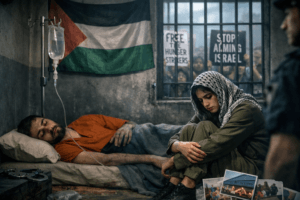
The Breaking Point: Inside Britain’s Hunger Strike for Palestine
As winter sets in across the UK, a different kind of cold is taking hold inside several of its prisons. A group of young people, held for over a year without trial, are starving themselves to death. Their empty stomachs are a final, desperate protest against a government they accuse of silencing dissent and enabling a war overseas. This standoff is not just about the activists or their charges—it has become a flashpoint for fundamental questions about justice, protest, and free speech in modern Britain.
The hunger strike, involving prisoners affiliated with the now-proscribed group Palestine Action, has reached a critical stage. Medical professionals warn that the activists are “dying” and face “immediate risk of death” from complications like heart failure and organ breakdown. As their physical conditions worsen, the political and moral pressure on the UK government intensifies, drawing unsettling parallels to one of Britain’s most traumatic modern conflicts: the IRA hunger strikes of 1981.
The Personal Cost: Lives on the Line
The human reality of the hunger strike is stark. Of the original eight strikers, six continue as of mid-December 2025. Among them is Qesser Zuhrah, 20, on the 48th day of her strike. Supporters report she suffers from chest pains, exhaustion, and a consistently high pulse. She has collapsed multiple times in prison and has found it difficult to stay awake or talk for long periods during visits. Amu Gib, 30, has lost over 11 kilograms. They describe moving in “slow motion,” with low blood sugar, high ketone levels (indicating the body is consuming its own tissue), and constant headaches.
Doctors explain the grim physiology: after about three weeks without food, the body exhausts fat stores and begins breaking down muscle and organ tissue. This leads to a growing, daily risk of sudden and severe bodily dysfunction, including heart muscle breakdown and kidney failure. Two of the strikers have already been hospitalized. Notably, two participants, Jon Cink and Muhammad Umer Khalid, have ended their strike after 41 and 13 days, respectively.
Five Demands and a Deeper Conflict
The strikers’ demands frame their protest not as a personal plea, but as a political challenge to the state:
- Immediate bail while awaiting trial, citing excessively long pre-trial detention.
- A fair trial, including the release of correspondence between British and Israeli officials regarding activists.
- An end to mistreatment and censorship of their communications in prison.
- The de-proscription of Palestine Action, removing its official “terrorist organization” label.
- The shutdown of UK operations for Elbit Systems, an Israeli defence manufacturer.
Their detention stems from alleged involvement in two incidents: a break-in at an Elbit factory in Filton, Bristol, in August 2024, and an incursion at the RAF Brize Norton base in June 2025, where protesters sprayed paint into the engines of two refueling aircraft. Crucially, these alleged acts occurred before the government banned Palestine Action in July 2025.
The Government’s Stance: Rules, Security, and a Refusal to Bend
The UK government, led by Prime Minister Keir Starmer and Justice Secretary David Lammy, has adopted a firm, procedural stance. In response to questions in Parliament, Starmer stated that the government is “following those rules and procedures” in place for hunger strikes. Lammy has refused repeated requests to meet with the strikers’ lawyers.
Officials point out that prisons handle over 200 hunger strike incidents a year and have “robust and proper guidance” for managing them. The Ministry of Justice asserts that prisoner well-being is continually assessed, with hospital treatment provided where required. The government’s position is rooted in a broader security context. A recent government policy paper highlights a significant rise in antisemitism and states that countering it is an “operational priority” for security services. The proscription of Palestine Action is framed as part of a necessary toolkit to tackle extremism and protect communities.
Echoes of 1981: A Haunting Historical Parallel
The situation irresistibly evokes the 1981 hunger strikes in Northern Ireland’s Maze Prison. Then, IRA and INLA prisoners, led by Bobby Sands, starved themselves to death demanding political status. The political playbook seems similar: prisoners use their bodies to force a moral and political crisis, while the government, then led by Margaret Thatcher, refuses to capitulate, arguing that responsibility for any deaths lies with the organizations that “order[] these young men to commit suicide”.
A Comparative Look: Hunger Strikes Then and Now
| Aspect | 1981 IRA/INLA Hunger Strikes | 2025 Palestine Action Hunger Strikes |
| Core Demand | Recognition as political prisoners | De-proscription of group; bail; shutdown of arms sites |
| Government Leader | Margaret Thatcher (Conservative) | Keir Starmer (Labour) |
| Public & Political Response | Significant public sympathy shift; Sands elected MP | Divided; some MP and public support, but also ridicule and government dismissal |
| Outcome | 10 deaths; government later made concessions | Ongoing; at least two hospitalized, doctors warn of imminent death |
Today, former Irish republican hunger strikers like Tommy McKearney, who lasted 53 days in 1980, are offering counsel to the Palestine Action prisoners, sharing the lasting physical and communal trauma of such protests.
A Legal and Human Rights Firestorm
The government’s use of terrorism legislation against Palestine Action is highly controversial. In July 2025, UN High Commissioner for Human Rights Volker Türk called the ban a “disturbing misuse” of UK counter-terrorism laws. He argued that international standards confine “terrorist acts” to criminal acts intended to cause death, serious injury, or hostage-taking—not property damage alone. The UK’s Terrorism Act 2000 defines terrorism more broadly to include “serious damage to property” done to influence the government for a political cause.
Legal scholars warn that this broad definition, when applied to a protest group, creates a “chilling effect” on fundamental freedoms like expression, assembly, and association. Since the ban, over 1,600 arrests have been linked to support for Palestine Action. Critics, including The Guardian, argue the proscription was an “illiberal overreaction” that conflates property damage with terrorism, risking the criminalization of legitimate dissent.
The Road Ahead: Martyrdom or Resolution?
As the days pass, the paths forward narrow. The government appears locked into its position, wary of setting a precedent by negotiating under the threat of self-starvation. The prisoners, fueled by what Amu Gib calls “the habit of resistance,” see their act as one of ultimate agency—the last power they hold in state custody.
If the strikers are released or their demands met, they could claim a powerful victory. If they die, they will achieve a form of martyrdom within their movement, potentially radicalizing a generation already disillusioned by the war in Gaza and domestic politics. Their deaths would also trigger a profound crisis for a government trying to project strength on security while upholding human rights.
This standoff is more than a prison protest. It is a microcosm of global divisions over the war in Gaza, a test of Britain’s post-9/11 counter-terrorism framework, and a painful reminder of how a state’s hardest moral choices are often made not in war zones, but in the silent cells of its own prisons. The outcome will resonate far beyond the prison walls, shaping the limits of protest and the price of conscience in the UK for years to come.
You must be logged in to post a comment.