
The Bongaon Capture: How the Arrest of Two Bangladeshis Could Reshape a Strained Diplomatic Landscape
Indian authorities arrested two Bangladeshi nationals in West Bengal for the killing of activist Sharif Osman Hadi, whose December 2025 assassination sparked violent anti-India protests in Bangladesh and severely strained bilateral ties during the interim government period. The suspects allegedly confessed to crossing into India after the attack, and their capture comes just three weeks after Tarique Rahman’s BNP government assumed power in Dhaka, offering both nations a potential diplomatic reset. For India, the arrests demonstrate good faith cooperation after months of tension, while for Rahman’s new administration, receiving the alleged killers through extradition could provide political space to manage domestic anti-India sentiment and navigate a more stable relationship with New Delhi.
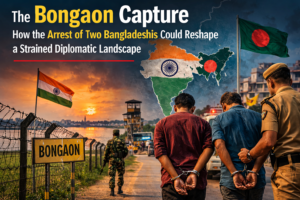
The Bongaon Capture: How the Arrest of Two Bangladeshis Could Reshape a Strained Diplomatic Landscape
In the Shadow of a Killing
The border town of Bongaon sleeps lightly. For generations, this West Bengal outpost has existed in the permeable space between nations, where families straddle an artificial line drawn in 1947 and where the night markets trade in everything from fish to futures. But on the intervening night of March 7-8, 2026, the Special Task Force moved through these familiar streets with uncommon purpose.
When they returned to Kolkata with two Bangladeshi nationals in custody, they carried more than just suspects. They carried the possibility of diplomatic reset.
Rahul alias Faisal Karim Masud, 37, from Patuakhali, and Alamgir Hossain, 34, from Dhaka, allegedly confessed to involvement in one of the most politically charged killings in recent Bangladesh history—the December 2025 assassination of Sharif Osman Hadi, a young activist whose death sent flames through the streets of Dhaka and sent diplomatic relations between New Delhi and Dhaka into a deep freeze.
The Face of a Movement
To understand why two men sleeping in a border town matter to the foreign ministries of two nations, one must first understand who Sharif Osman Hadi was—and what his death represented.
Hadi emerged from the crucible of the July 2024 Uprising, that extraordinary convulsion of Bangladeshi civil society that eventually toppled the 15-year reign of Sheikh Hasina. In his early thirties, he became the spokesperson for Inqilab Mancha, a youth platform that blended street-level mobilization with religiously inflected calls for justice. He was charismatic, unafraid of cameras, and possessed of that rare quality among activists: the ability to articulate anger in complete sentences that resonated beyond his immediate base.
But Hadi was also sharply critical of India’s influence in Bangladesh—a position that placed him at the intersection of domestic politics and international relations. When masked gunmen shot him in the head on a busy Dhaka street on December 12, 2025, they didn’t just kill a man. They created a martyr whose death would be weaponized in the information war between two uneasy neighbors.
The timing was everything. Bangladesh was still under an interim government headed by Muhammad Yunus, the Nobel laureate thrust into political leadership after Hasina’s dramatic fall. India was watching nervously as its primary regional ally crumbled, replaced by figures far less inclined to accommodate New Delhi’s strategic interests.
The Days of Rage
When Hadi died in a Singapore hospital on December 18—airlifted there in a desperate attempt to save him—Bangladesh erupted. The protests weren’t random. They were targeted with the precision of accumulated grievance.
Mobs burned the offices of Prothom Alo and the Daily Star, Bangladesh’s largest newspapers, both perceived as sympathetic to Indian interests and the old Awami League establishment. Cultural organizations associated with secular, India-friendly expressions of Bengali identity were attacked. In one horrific incident, a Hindu worker was lynched as the protests curdled into communal violence.
For India, watching from across the border, the scenes were nightmarish. The narrative emerging from Dhaka’s streets was clear: Hadi’s killers had fled to India. New Delhi was sheltering anti-Bangladesh elements. The interim government, whether by design or inability, seemed unable—or unwilling—to control the anti-India sentiment sweeping through urban centers.
Bangladesh’s interim government formally summoned the Indian high commissioner, demanding cooperation in ensuring that suspects didn’t escape into India and, if they had already crossed, that they be extradited immediately. India’s response was categorical rejection of allegations that its territory harbored anti-Dhaka actors, insisting it had never allowed activities inimical to the “friendly people of Bangladesh.”
The diplomatic language was correct. The underlying reality was anything but.
The Men from the Night
Which brings us back to Bongaon and the two men now in STF custody.
According to the press note issued by Special Task Force headquarters in Kolkata, officers acted on “secret credible information” to raid the border area. The phrasing is standard, but the operation’s success suggests intelligence-sharing mechanisms that had likely frayed during the months of diplomatic tension may have been quietly restored.
Rahul alias Faisal Karim Masud, 37, comes from Patuakhali, a coastal district in southern Bangladesh known for its rivers and cyclones rather than political violence. Alamgir Hossain, 34, is from Dhaka itself—an urbanite whose movements would have been harder to trace in the chaos following Hadi’s killing.
During preliminary interrogation, both allegedly confessed to involvement in Hadi’s killing and described entering India through the Meghalaya border, a porous frontier where the hills and forests have long provided cover for cross-border movement. From there, they traveled through various locations before reaching West Bengal—perhaps believing they had finally found safety in the anonymity of India’s borderlands.
They were wrong.
The BNP Factor
The arrests come exactly three weeks after Tarique Rahman was sworn in as Bangladesh’s prime minister—a timing that diplomatic observers will scrutinize for years.
Rahman, the son of former Prime Minister Khaleda Zia, leads the Bangladesh Nationalist Party (BNP), which returned to power in last month’s elections. For India, the transition from the Yunus-led interim government to a BNP administration required careful navigation. The BNP has historically been less accommodating of Indian strategic interests than the Awami League, and Rahman’s ascension brought with it the potential for further diplomatic friction.
Yet New Delhi moved quickly to cultivate ties. External Affairs Minister S. Jaishankar traveled to Dhaka for the funeral of Rahman’s mother and former Prime Minister Khaleda Zia—a gesture of respect that transcended protocol. Prime Minister Narendra Modi called Rahman personally to congratulate him on his party’s victory. Lok Sabha Speaker Om Birla attended Rahman’s swearing-in ceremony, placing India prominently among the nations acknowledging the new government.
These were not random courtesies. They were signals.
What the Arrests Signal
The capture of Hadi’s alleged killers, coming so early in the BNP government’s tenure, serves multiple purposes for both nations.
For India, it demonstrates good faith—a tangible delivery on the cooperation that New Delhi had promised during the darkest days of the post-Hadi crisis. The arrest allows India to say, without resorting to diplomatic abstractions: We told you we would help. Here is the proof.
For Rahman’s government, the arrests provide political space. The BNP inherits a Bangladesh where anti-India sentiment has been stoked and where any appearance of being “soft” on New Delhi carries domestic political risk. By receiving Hadi’s alleged killers from Indian custody—assuming the extradition process proceeds—Rahman can demonstrate that his government achieves results where the interim government could only issue diplomatic protests.
There is also the matter of Sheikh Hasina, still residing in India, still facing a controversial International Crimes Tribunal death sentence in Bangladesh, still issuing political statements that infuriate Dhaka. The interim government protested her presence repeatedly. The BNP government inherits that grievance but must decide whether to press it or prioritize other aspects of the relationship.
The Hadi arrests suggest a willingness to compartmentalize—to treat the Hasina question as separate from broader cooperation on security matters.
The Human Question
Amid the diplomatic calculus, it’s worth remembering that two men now sit in Indian custody, accused of participating in a killing that reshaped regional politics.
Rahul and Alamgir will face interrogation, then extradition proceedings, then trial in Bangladesh—assuming the legal machinery moves as both governments suggest it will. Their alleged confession, if proven voluntary and accurate, will form the basis of a case that Bangladesh’s new government will pursue with keen interest.
But they are also human beings, caught in the machinery of events larger than themselves. They allegedly crossed borders, sought anonymity, and discovered that in the modern world, the reach of cooperative security services extends further than any individual can run.
Their fate will be determined by courts, not diplomats. But the context of their capture—the timing, the location, the political moment—was shaped by forces far beyond any magistrate’s chamber.
The Road Ahead
For India-Bangladesh relations, the Bongaon arrests represent an opportunity rather than a resolution. The underlying tensions that Hadi’s death exposed remain: the question of India’s influence in its smaller neighbor, the fate of political exiles, the management of a porous border, the navigation of religious and political identities in both countries.
But diplomacy, at its most effective, is the art of transforming crises into openings. The Hadi killing was a crisis—one that brought thousands into the streets, burned institutions, and poisoned public discourse. The capture of his alleged killers, if handled transparently and cooperatively, can become an opening.
It will require both governments to resist the temptations of exploitation. India must ensure that the legal process is seen as genuine, not as political theater designed to curry favor with a new administration. Bangladesh must ensure that the trials that follow are fair, not revenge dressed as justice. Both must communicate honestly with publics that have been fed narratives of betrayal and bad faith.
The border at Bongaon will continue to sleep lightly. Families will continue to straddle the line. Markets will trade. And two nations will continue their complicated dance of proximity and distance, cooperation and suspicion.
But on one night in March, police officers moved through that border town with a purpose that transcended their immediate mission. They were not just arresting suspects. They were attempting to arrest a narrative—to stop the story of Hadi’s death from becoming the story of permanent estrangement between two neighbors who have no choice but to coexist.
Whether they succeeded depends not on what happened in Bongaon, but on what happens next in Dhaka, in Delhi, and in the courtrooms where justice for Hadi will finally be pursued.
The men are in custody. The question now is whether the nations can match that capture with the capture of something even more elusive: trust.
You must be logged in to post a comment.