
The Bishnoi Gang: When Crime and Geopolitics Collide on Canadian Soil
A classified RCMP report reveals that the violent Lawrence Bishnoi criminal gang is allegedly “acting on behalf of the Indian government” to target individuals in Canada, creating a severe diplomatic crisis as it exposes the tension between pursuing justice for alleged state-sponsored violence and Canada’s economic interests in strengthening trade ties with India.
The report, which links the gang to the murders of Sikh activists Hardeep Singh Nijjar and Sukhdool Singh, has emerged during a delicate period of diplomatic re-engagement, including trade missions by B.C. Premier David Eby and planned visits by Prime Minister Mark Carney, forcing the government to balance its fundamental duty to protect citizens and sovereignty against the pragmatic need to diversify trade partnerships away from an unreliable United States.
This situation has drawn fierce criticism from Canada’s Sikh community, which feels betrayed by what it perceives as the prioritization of economic gains over their security, and sets a dangerous global precedent for how democracies respond to transnational repression when perpetrated by strategically important partner states.
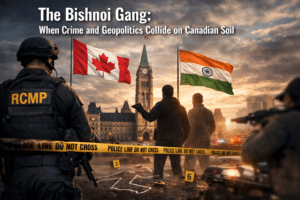
The Bishnoi Gang: When Crime and Geopolitics Collide on Canadian Soil
A Startling Disclosure and Its Diplomatic Shockwaves
In a quiet office building in Ottawa, a routine response to an Access to Information request has ignited an international firestorm. A classified RCMP national security report, marked “Protected A” and distributed internally last year, contains a blunt assessment that challenges the foundations of Canada-India relations. According to the document obtained by Global News, the violent Lawrence Bishnoi criminal organization has been “acting on behalf of the Indian government” to target individuals in Canada. This revelation arrives at a moment of delicate diplomatic re-engagement, casting a long shadow over concurrent trade missions and raising profound questions about sovereignty, security, and the price of economic partnership.
The three-page assessment mentions alleged ties between the criminal group and New Delhi a half-dozen times, describing a pattern that extends far beyond ordinary organized crime. This disclosure did not emerge in a vacuum—it surfaces amidst B.C. Premier David Eby’s trade mission to India (January 12-17, 2025) and reports that Prime Minister Mark Carney intends to visit later this year. These diplomatic efforts aim to diversify Canada’s trade partnerships to offset an “erratic tariff regime” from the United States under President Donald Trump. Yet the RCMP’s findings suggest that the very government Canada seeks to partner with may be connected to violent elements operating within Canadian borders, creating what one community spokesperson calls an unacceptable choice between “political convenience” and citizen safety.
Anatomy of a Transnational Criminal Enterprise
The Bishnoi gang represents a new breed of transnational criminal organization that blends traditional mafia activities with potential state sponsorship. According to the RCMP assessment, the group has evolved from its origins in student politics intimidation in India’s Punjab region to become a sprawling network with an estimated 700 members across several Indian states. Its reach now extends across North America, Europe, and the Gulf states—regions with significant Punjabi diaspora communities.
What makes this organization particularly concerning is its structure and leadership. Despite being imprisoned in India since 2015, founder Lawrence Bishnoi “has reportedly continued to run his organization while incarcerated.” Operational control has allegedly shifted to Goldy Brar (real name Satinderjeet Singh), believed to be Bishnoi’s closest associate. The group engages in extortion, drug trafficking, money-laundering, and contract killings—activities driven by “greed rather than political or religious motives,” according to the RCMP. Yet the report simultaneously asserts that this criminal enterprise operates “on behalf of” a foreign government, creating a dangerous hybrid threat that merges profit motive with geopolitical objectives.
The criminal methodology follows a pattern familiar to law enforcement but with disturbing state-level implications. The group reportedly uses violence systematically to further its enterprise, with its Canadian operations increasingly drawing police attention. Last September, the Canadian government officially added the Bishnoi gang to its list of terrorist entities—a significant designation that enables enhanced financial tracking and prosecution tools. Notably, this official listing contained no mention of the Indian government connection that features so prominently in the RCMP’s classified assessment, highlighting the gap between internal security understanding and public diplomatic positioning.
Targeted Violence: The Khalistan Connection
The RCMP report directly links the Bishnoi gang to two high-profile killings in Canada that have strained bilateral relations:
- Hardeep Singh Nijjar (June 18, 2023): The Sikh temple leader was gunned down in Surrey, B.C. Nijjar advocated for Khalistan—an independent Sikh homeland in India’s Punjab region—and had been branded a “terrorist” by Indian authorities. Global News has reported that Canada obtained intercepted communications linking senior Indian officials to the killing. Four suspected gunmen were arrested in May 2024.
- Sukhdool Singh (September 2023): Killed in Winnipeg, this pro-Khalistan activist was also labelled a terrorist by India and, according to the RCMP, was a member of the Bambiha gang—a rival of the Bishnoi organization.
The report states plainly that “the RCMP has claimed that agents of the Indian government were using ‘organized crime groups like the Bishnoi group’ to target leaders of the pro-Khalistan movement in Canada.” This pattern suggests a systematic approach to transnational repression, where a foreign government allegedly employs proxy actors to eliminate dissidents abroad while maintaining plausible deniability.
For Canada’s Sikh community, which comprises approximately 2% of the population and is one of the largest Sikh diasporas globally, these revelations confirm longstanding fears. Balpreet Singh, spokesperson for the World Sikh Organization of Canada, articulates the community’s frustration: “The RCMP and the government of Canada are clearly aware that the Bishnoi gang is operating in coordination with the government of India to target individuals in Canada. But for political convenience, this reality is being downplayed and hidden.”
Canada’s Diplomatic Tightrope: Justice Versus Economic Pragmatism
The Canadian government faces a classic foreign policy dilemma magnified by domestic political pressures. On one side stands the imperative of justice and sovereignty—the fundamental responsibility to protect citizens from foreign-directed violence on Canadian soil. The previous government of Justin Trudeau took concrete steps in this direction, with then-Prime Minister Trudeau telling the House of Commons in September 2023 that authorities were “investigating the possible role of Indian government agents” in Nijjar’s killing. This was followed by the expulsion of six Indian consular and diplomatic officials in protest.
On the other side lies economic pragmatism and strategic realignment. With U.S. relations uncertain under the Trump administration’s “erratic tariff regime,” Canada has actively sought to diversify trade partnerships. India represents the world’s fifth-largest economy and a market of 1.4 billion people—an obvious candidate for enhanced trade relations. Premier Eby explicitly connected his trade mission to economic necessity, stating his goal was to “ensure we’re benefiting from that, delivering jobs for B.C.ers, and, particularly, in sectors that have been particularly hard hit by Trump’s tariffs, like the softwood industry.”
Prime Minister Carney has pursued a reset in relations since taking office, restoring diplomatic ties and expressing desire for a trade deal with Prime Minister Narendra Modi’s government. When questioned about violence linked to India, Carney has maintained that “the justice system was dealing with incidents of violence”—a formulation that acknowledges the issue while avoiding direct confrontation with New Delhi.
This tension between security concerns and economic interests manifests in contradictory government actions. While the RCMP’s internal assessment repeatedly mentions Indian government ties to the Bishnoi gang, Canada’s official terrorist listing of the organization in September 2025 contained no reference to these alleged state connections. Similarly, while the government pursues trade discussions, it continues investigative and prosecutorial work that may eventually yield more evidence of foreign interference.
The Sikh Community’s Perspective: Security Sacrificed for Trade
For Canadian Sikh organizations, the current diplomatic approach represents a profound betrayal. Moninder Singh of the Sikh Federation Canada frames the issue in stark terms: “The federal government and now the B.C. government are putting lives at risk by signing trade deals with a country like India which has taken no responsibility or shown any remorse for their foreign interference.”
This sentiment reflects a broader concern that diaspora communities become collateral damage in geopolitical calculations. The Sikh community finds itself caught between a country of residence that seems willing to overlook alleged state-sponsored violence for economic gain, and a country of origin that views political dissent as terrorism warranting extraterritorial action. This creates what scholars of transnationalism call “double vulnerability”—susceptibility to pressure from both states simultaneously.
Community advocates point to what they see as a disturbing pattern of prioritization. Despite RCMP Commissioner Michael Duheme’s October 2024 warning that investigations had “linked Indian officials to violent crimes in Canada,” and despite the specific findings in the Bishnoi assessment, trade missions proceed as planned with minimal public acknowledgment of these security concerns. For those directly affected, this creates a perception that their safety is negotiable—a commodity that can be traded for market access and diplomatic goodwill.
Historical Context: From Nijjar to a Systemic Pattern
The current revelations about the Bishnoi gang fit into a longer trajectory of deteriorating Canada-India relations over the Khalistan issue. The June 2023 killing of Hardeep Singh Nijjar represented a watershed moment—the first time a G20 nation publicly accused another of conducting an assassination on its soil. The subsequent investigation and diplomatic expulsions created a year-long rupture in relations that only recently began healing.
The RCMP report suggests Nijjar’s killing was not an isolated incident but part of a broader pattern. The reference to Sukhdool Singh’s murder indicates multiple operations, while the description of the Bishnoi gang’s “continually expanding presence” in Canada suggests an ongoing, rather than concluded, threat. When combined with the group’s known activities in extortion, drug trafficking, and money laundering, this paints a picture of a multi-tentacled organization that serves both criminal and geopolitical masters.
This context makes the timing of the report’s release particularly significant. Obtained through access-to-information processes and made public as Canadian political leaders embark on trade missions to India, the document forces an uncomfortable conversation about what exactly is being normalized in the name of economic diplomacy. It raises the question of whether Canada is establishing relations with an India that respects sovereignty and international law, or one that allegedly employs criminal proxies to pursue political objectives abroad.
The Broader Implications: Transnational Repression in a Globalized World
The Bishnoi case represents a concerning example of what human rights organizations term **”transnational repression”**—when states reach across borders to silence dissent among diaspora communities. This phenomenon has grown alongside globalization, with autocratic governments increasingly viewing exiled critics as unfinished business rather than citizens who have sought refuge elsewhere.
What makes this case distinctive is the alleged employment of organized crime as intermediary. This creates multiple layers of deniability for the state actor while utilizing networks already skilled in violence, intimidation, and evading law enforcement. For the criminal organization, state patronage offers protection from domestic prosecution and potentially access to intelligence resources. It’s a symbiotic relationship that poses unique challenges for democratic states committed to rule of law.
For Canada, a country that has welcomed immigrants and refugees from conflicted regions worldwide, this case establishes a dangerous precedent. If one government can allegedly employ criminal proxies to attack Canadian residents with limited diplomatic consequence, other states may follow suit. This threatens not only specific diaspora communities but the broader principle that Canada’s territory represents a space where diverse political views can be expressed safely.
Economic Pragmatism Versus Ethical Foreign Policy: The Core Dilemma
At the heart of this controversy lies a fundamental tension in contemporary foreign policy. In an era of economic uncertainty and shifting alliances, how should democratic states balance material interests against ethical principles? The Canadian government’s approach appears to attempt both simultaneously—continuing law enforcement investigations while pursuing trade relations—but critics argue this effectively privileges economics over justice.
The arguments on both sides reveal competing visions of national interest:
| Economic Pragmatism Perspective | Security & Sovereignty Perspective |
| Trade diversification is essential given U.S. uncertainty | Citizen protection is government’s fundamental responsibility |
| India represents a massive emerging market | Allowing foreign-directed violence creates dangerous precedent |
| Engagement may foster moderating influence | Justice must not be negotiable in diplomatic exchanges |
| Sub-federal trade missions (like Eby’s) proceed regardless of federal tensions | Consistent messaging needed to deter future interference |
| Economic benefits reach broad population | Specific communities feel betrayed by prioritization of trade |
This dichotomy reflects a broader global challenge as democracies navigate relations with powerful states that do not share their commitment to human rights and rule of law. The Canadian case is particularly poignant because it involves alleged violence on domestic soil rather than human rights abuses occurring within the partner country’s borders—a more direct challenge to sovereignty that typically demands stronger response.
Looking Forward: Pathways Through the Dilemma
As Canada navigates this complex landscape, several pathways emerge, each with different implications:
- The Integrated Approach: Continuing current policy of pursuing both trade relations and justice through legal channels, hoping that economic engagement creates leverage for behind-the-scenes resolution of security concerns. This maintains diplomatic relations but risks appearing to prioritize economics over citizen safety.
- The Conditional Engagement Model: Making trade progress explicitly contingent on demonstrable changes in India’s approach to transnational repression, potentially including joint investigations of the Bishnoi gang’s alleged state ties. This aligns principles with pragmatism but may stall economic benefits.
- The Parallel Tracks Framework: Delinking trade and security issues entirely, pursuing economic cooperation while simultaneously intensifying law enforcement actions against foreign interference. This acknowledges complexity but may prove unsustainable if investigations yield more evidence of state involvement.
- The Sovereignty-First Posture: Prioritizing security concerns through stronger diplomatic responses and potentially economic costs until India addresses alleged extraterritorial activities. This affirms sovereignty principles but sacrifices near-term economic opportunities.
The path Canada ultimately chooses will reveal much about its foreign policy identity in an increasingly transactional world. Will it follow the precedent set by its response to other cases of suspected foreign interference, or will India’s economic importance and strategic position create exceptional treatment?
Conclusion: More Than a Bilateral Dispute
The RCMP’s assessment of the Bishnoi gang as “acting on behalf of the Indian government” represents more than a bilateral diplomatic challenge. It touches on fundamental questions about how democratic states maintain their principles while navigating an increasingly complex global landscape where economic partners may not share commitments to rule of law and sovereignty.
For Canada’s Sikh community, the implications are immediate and personal—the safety of their homes, places of worship, and community spaces. For Canadian policymakers, the dilemma pits economic diversification against national security and ethical foreign policy. For the international community, this case may establish precedents about the costs and consequences of transnational repression.
As trade missions proceed and investigations continue, what remains clear is that Canada cannot entirely separate its economic future from its security present. The alleged use of criminal proxies by a state actor represents a threat not just to specific individuals or communities, but to the broader social contract that ensures Canada remains a place where diverse peoples can live, worship, and express political views without fear of foreign-directed violence. How this tension between trade and security is resolved will shape not only Canada-India relations, but Canada’s very identity as it navigates the challenges of 21st-century globalization.
You must be logged in to post a comment.